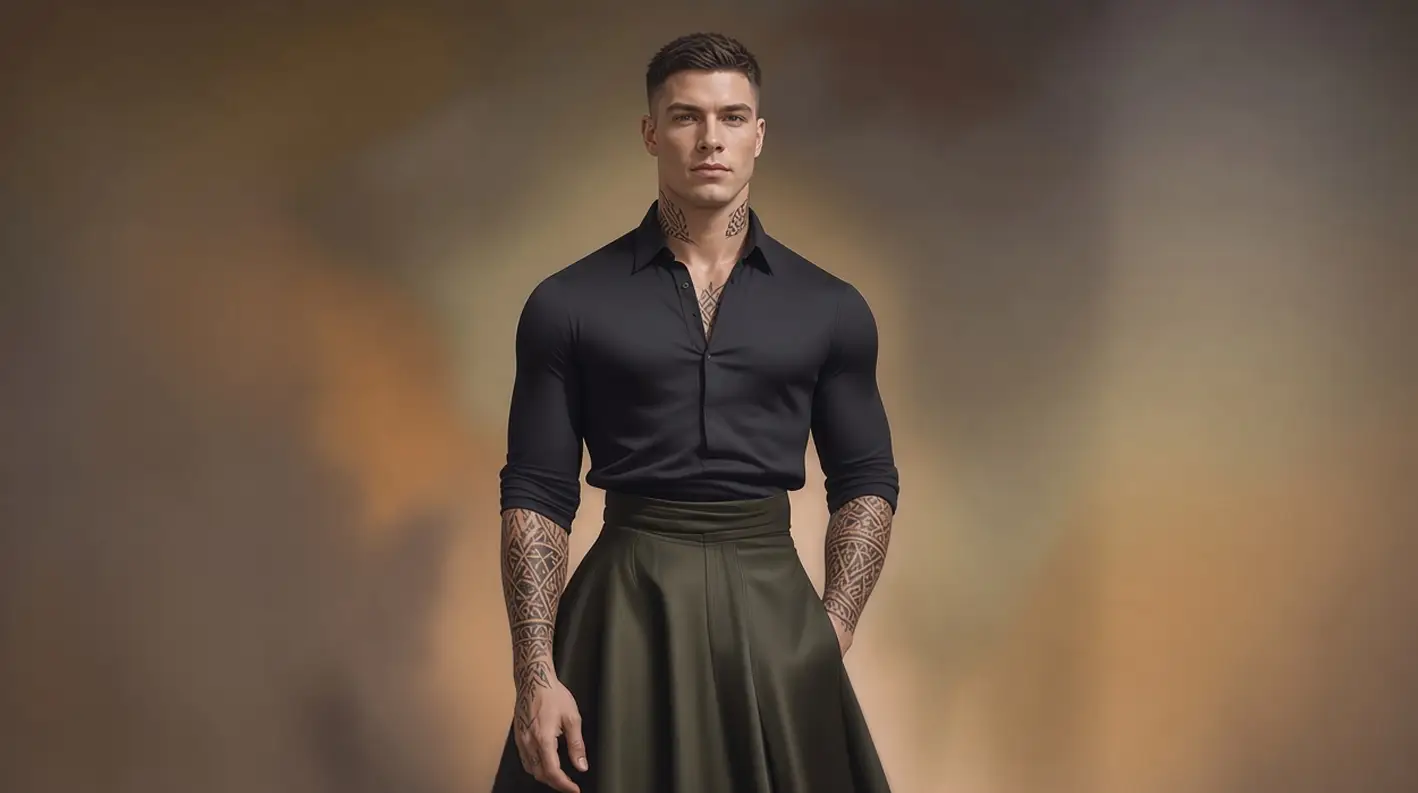

Fashion historian Alexander Vasiliev gave an interview to the Israeli YouTube channel Tel-A-Vision. In it, he discussed why men are increasingly choosing pearls and lace, whether this reflects genuine freedom of self-expression, and why “total unisex” may end sooner than we think. “Doberman Media” summarized the key points of the conversation.
Table of Contents
Why are men’s skirts being discussed right now?
What until recently was considered provocative—sheer fabrics, cropped jackets, and pearls for men—is becoming part of runway reality. However, Vasiliev believes that the current surge of interest in queer culture among young people is largely dictated by politics and marketing. In his view, the trend toward blurring gender boundaries may be linked to the global population-reduction agenda and the popularity of the childfree philosophy. The fashion historian believes this is “a matter of two seasons,” and that global military conflicts will prevent the final transition to unisex fashion.
But men wore skirts for centuries. What is different now?
Vasiliev points out that men’s dresses are nothing new in history or Eastern cultures.
- In the East: The Arab galabeya and the Indonesian sarong are seen as exclusively male attire and are not associated with queer culture.
- In Europe: Scottish kilts and the skirts worn by Greek guards are traditions that raise no eyebrows.
The issue of this “asymmetry” (why it is acceptable for a woman to wear trousers but not for a man to wear a skirt) comes down to comfort and safety. Trousers are simply more comfortable for driving, while in modern Western society, a man wearing a skirt is still perceived as an “invitation” to flirtation or even fetishization.
Is it true that fashion is created exclusively by gay men?
Vasiliev claims that 90% of designers worldwide — gays, and this leaves its mark on the industry. According to him, designers have a vested interest in selecting models and in “fittings on live mannequins.” Moreover, members of the queer community traditionally spend more money on clothing than heterosexual men, who can wear the same “striped sailor shirt or plaid shirt” for years. Brands therefore deliberately entice this audience with elaborate embellishments and lace.
How does Vasiliev himself feel about cross-dressing in women’s clothing?
Alexander Vasiliev emphasizes his commitment to a traditional men's wardrobe. He insists that he owns no women's clothing and never ventures into women's clothing departments.
He responds pragmatically to rumors that he wears women's underwear: “They simply don't make it in my size.” He calls men's interest in lace underwear or corsets “typical fetishism,” something he himself couldn't be further from.
What happens next?
Vasiliev is convinced that we are living in an era of “the breakdown of family values” and a farewell to traditional European values. Fashion, being “fickle,” is always built on self-destruction: to sell the new, the old must be declared unfashionable. Now gender has become the main trigger.
Nevertheless, mass-market fashion (such as Zara) remains fairly conservative and is in no hurry to fill men's departments with “extravagances,” preferring safe oversized clothing that helps conceal flaws in the figure.
The interview was recorded at Vasiliev's estate in France especially for Alexander Arkhangelsky's project and the Shekin 40 channel.








0 comments
Enter your email — we’ll send you a one-time code. No passwords or accounts.
Code sent to
If the email doesn't appear in your inbox within a few minutes, check your spam, junk, or promotions folder, as some email services may mistakenly place automated messages there