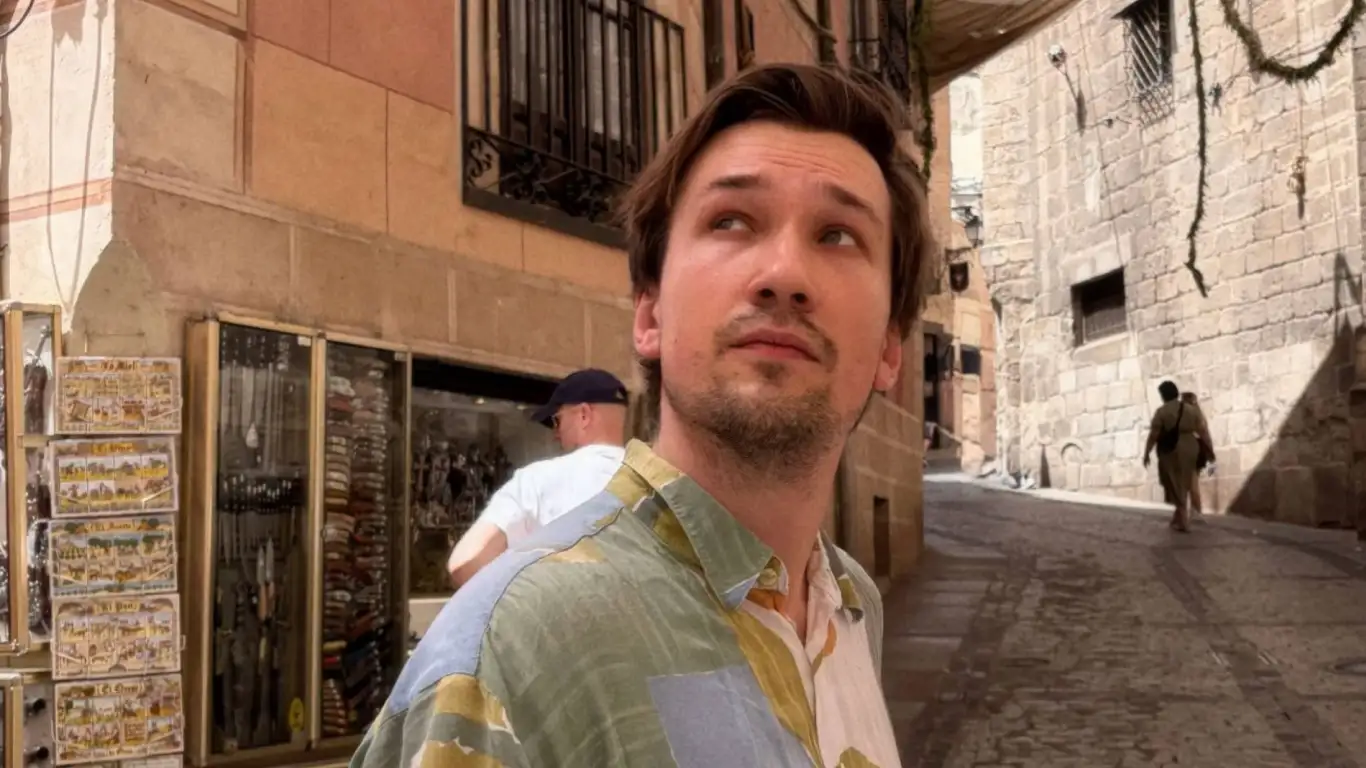

After the Russian authorities designated the “LGBT movement” as “extremist,” Spain became one of the main destinations for Russian LGBTQ refugees. Political researcher and journalist Alexander Finiarel and his partner arrived in the country after being evacuated from Georgia. They spent two years without legal status, facing difficulties renting housing and having their bank accounts frozen. In 2026, when the Spanish authorities announced a large-scale amnesty for undocumented migrants, the couple applied for residence permits through a local organization that assists LGBTQ migrants. At Meduza’s request, Alexander Finiarel described what it is like to be a queer emigrant from Russia in Europe and how life works for undocumented migrants from the inside.
How I Became Undocumented
When I moved to Spain, I had no intention of becoming undocumented. I and 64 other Russian journalists, activists, and human rights defenders were evacuated here two years ago from Georgia, which was becoming increasingly unsafe. The plan was for 206 people to come here and receive humanitarian residence permits upon arrival.
However, after the first group arrived, the agreement with the Spanish Foreign Ministry fell apart. More than a hundred people awaiting evacuation were stranded in Georgia, while those who did manage to make it out found themselves in Spain without documents or a clear legal status.
The alternative for my boyfriend and me was to apply for asylum. After the Russian authorities declared the “LGBT movement” “extremist,” Spain, judging by the experiences of people I know and those in local refugee chats, has been fairly willing to accept Russian LGBTQ refugees. So Spain is probably one of the best options for this category of refugees. It was also fairly easy to apply for asylum on the grounds of political persecution, so many people in our group ultimately did just that.
For the first six months, however, we continued to hope that the negotiations with the Foreign Ministry would lead somewhere. Besides, Spain's asylum system is severely overloaded—on the one hand, because of the influx of refugees arriving in the country, and on the other, because of “cita hunters.”
Who are “appointment hunters”?
A cita, from the Spanish word cita, meaning “appointment,” is an appointment booking. Because the number of available appointments is limited, they are booked online or by phone—almost everything here is handled by phone calls. Demand for citas is high, especially in major cities, so a black market has emerged in Spain.
Появились специальные компании и созданные ими боты, которые мониторят расписание и забирают ситы, как только они появляются, а потом продают за сотни евро. В результате самостоятельно поймать ситу для подачи на беженство, особенно в Мадриде, на который приходится 30% всех обращений, практически невозможно. Нужно либо целыми днями звонить в миграционную службу, либо попытаться получить запись в менее населенном регионе. Но тогда и на все процедуры, связанные с подачей на беженство, придется ездить туда.
Finally, my work requires me to be able to travel within the EU to meet with European officials and other Russian human rights defenders. But as an applicant for international protection, you cannot leave the country where you applied for protection. In Spain, it usually takes about two and a half years for an application to be approved.
Without applying for asylum, I can travel around Europe.
How exactly?
To enter Spain, the organization that brought me from Georgia helped me obtain a five-year tourist visa. Although I am technically violating the rules of stay, it allows me to travel around Europe without any problems. By law, this type of visa allows you to remain in the EU for no more than 90 days in any six-month period. But in my experience, no one checks the number of days.
My colleague, who is also a human rights defender, had a short-term visa, however. So when we were selected for a random check at Brussels Airport during a work trip in February 2025, I was allowed through, but he was detained because his visa had expired. The organization that had brought us had to negotiate with the border guards to prevent his deportation. Since that trip, he has had to remain in Spain without leaving. That was, however, the only time I encountered checks while crossing borders.
Although refugees can obtain citizenship after living in Spain for just five years, many other people who moved from Georgia and I chose another path to legal status—a residence permit based on social ties. That meant becoming undocumented migrants.
In Spain, a residence permit based on social ties can be obtained after two years of continuous residence in the country, provided that you did not apply for asylum during that period and have no criminal record. You only need to prove that you are already trying to integrate into Spanish society—for example, by working, studying, taking Spanish classes, having family ties, or volunteering with local NGOs.
We were lucky: a year and a half after we arrived, the Spanish authorities announced an extraordinary regularization program. It does not even require proof of integration.
What challenges do undocumented migrants face in Spain, and what advantages are there to not having legal status?
Being undocumented naturally imposes restrictions and creates difficulties. The main one is finding housing. Spain's population has been growing in recent decades due to high levels of immigration, but virtually all of this influx is headed for Madrid and the coastal areas, which also draw residents away from the rest of the country. The latter has even been nicknamed “Emptying Spain,” or España vaciada.
As a result, the real estate market in Madrid and along the coasts became overwhelmed, and landlords grew extremely selective. In most cases, they choose from several applicants and naturally prefer those whose documents are in order.
The situation is further exacerbated by the fact that tenants are so well protected under Spanish law that it is virtually impossible to evict them, even if they stop paying rent. This has led to the rise of “okupas”—people who either squat in someone else’s vacant property from the outset or stop paying rent to the owner and refuse to move out.
Landlords, in turn, began purchasing insurance to protect themselves against okupas. Insurance companies offering such services verify prospective tenants’ income. But with irregular immigration status, it is impossible to earn officially declared income and pay taxes, so we had nothing to show them.
The easiest way to avoid such checks is to sublet a room. But that option did not work for my boyfriend and me: we both work from home and are constantly on work calls. We did not want to disturb anyone with our calls or have anyone disturb us.
So we took the difficult route: we searched for apartments listed directly by owners on Spain’s main real estate website, contacted them directly, and tried to charm the owners during viewings. Like everyone else who moved at the same time as us, we found a place largely because we managed to make a good impression on the landlords. But the search took several months.
I studied Spanish at university and, although I had not practiced it for many years, I could still speak it reasonably well—which helped. Without knowing the language, we would have had to pay extra for a real estate agent to act as an interpreter.
We provided the landlords with our employment contracts and bank statements. Through friends, we found someone with income legally declared in Spain who agreed to act as our guarantor and pay on our behalf if we could not.
A rental contract allows you to register your address right away, which gives you access to most public services. For example, in Spain, even migrants without a residence permit are entitled to use the public healthcare system and enroll their children in school. Moreover, unlike people who are legally resident in the country, we do not pay taxes or social security contributions for these services because the tax authorities simply do not know we exist.
The next problem after finding housing is opening a bank account. Of course, you can receive money on foreign cards. But without a Spanish card, you cannot make recurring payments for utilities, internet, phone service, private health insurance, or a gym membership.
I solved this problem by opening an account with the online bank Nickel, where you could register using a passport. But the EU's 19th package of sanctions against Russia eliminated this option. Under the new requirements, European banks must restrict services to Russian and Belarusian citizens who do not have a residence permit in the European Economic Area or Switzerland.
Russian refugees with legal status were affected as well. Local banks became wary of opening accounts for them, while Nickel now requires Russians to have an EU residence permit. Nevertheless, those who opened accounts earlier continue to use them, promising to provide the documents once their legalization process is complete.
Finally, another challenge is finding work. Migrants without legal status are not allowed to work in Spain. Nevertheless, employers in low-skilled sectors such as food service and cleaning are often willing to turn a blind eye. But they frequently exploit workers' precarious status—for example, making them work 11 hours a day, six days a week, for less than the statutory minimum wage.
How Spanish society views undocumented migrants
Legally speaking, Spain leaves a fairly broad gray area for people without official status. Since I have long worked for Russian opposition media outlets and organizations under a wide variety of legal arrangements, I am used to operating in this gray area, and Spain seems to me one of the most accommodating countries in this regard.
During my time here, I have never encountered hostility because of my undocumented status, even at government offices. Apparently, most local authorities do not make it their mission to seek out undocumented migrants.
At the same time, migration is one of the most contentious issues in Spanish politics. The increasingly popular far-right Vox party (“Voice”), which polls suggest will win next year's parliamentary elections in coalition with the center-right Partido Popular (“People's Party”), has made combating illegal migration a central plank of its platform. But as is usually the case, they may make all migration more difficult, not just illegal migration: the People's Party is already proposing new barriers to immigrating to Spain and obtaining permanent residency.
That is why I do not share many Russian immigrants' affinity for these parties, although I do think Spain may need to limit migration until it resolves the housing crisis. For me and for Russians who are here legally, the right coming to power would mean even more bureaucratic red tape.
Spanish society as a whole is clearly growing weary of newcomers, whether undocumented migrants, tourists, digital nomads, or British and German retirees. Tourism is triggering ongoing protests across the country. My Spanish acquaintances also complain about tourists, and especially about expats who do not learn the language and expect everyone to speak to them in English. The main reason for the growing discontent with newcomers is simple: the disproportionate rise in housing costs.
Migration fuels economic growth and in recent years has made Spain the fastest-growing economy among the EU’s major countries. It is also reducing the country’s extremely high unemployment rate. But many Spaniards do not feel these benefits.
The number of homeless people on the streets is growing. Citizens’ real incomes here have stagnated for decades, largely because of rising housing costs. Young Spaniards usually live with their parents because they cannot afford to move out. This is partly what is driving the low birth rate, which in turn increases the country’s need for migrants: an aging population is losing its ability to perform labor-intensive physical work.
In summer and at Christmas, the centers of major Spanish cities are packed with tourists. Renting apartments to them, affluent digital nomads, or foreign retirees is usually more profitable than renting to Spaniards, because foreigners are willing to pay more.
Population growth is overwhelming the healthcare system and social services—patients sometimes have to wait months to see a specialist. Unions representing doctors, teachers, railway workers, and other employees are constantly striking over excessive workloads and low pay.
Interestingly, hardly any of these problems are mentioned by opponents of immigration. The only exception is the far left, which says that wealthy tourists, digital nomads, and retirees have made it harder for Spaniards themselves to find housing (“they can afford it, while locals cannot”). Movements opposing tourism have already emerged in many cities, particularly Barcelona.
The right, meanwhile, sees the announced regularization as a threat. For example, representatives of Vox claimed that it was intended to keep the left in power by supposedly providing them with a new electorate of regularized migrants. This is a fairly bold assumption: it takes at least 10 years to go from obtaining a residence permit to citizenship.
Migrants themselves are often conservative and support the right, especially if their country of origin was ruled by a left-wing dictatorship. For example, Venezuelans in Spain vote for right-wing parties far more often than locals do.
Another myth common on the right is that the government gives undocumented migrants free apartments and pays them benefits. There are several counterarguments to this.
First, the state has no record of undocumented migrants (precisely because they have no documents) and therefore provides them with no assistance. To begin receiving it, they must regularize their status by applying for asylum.
Spain’s refugee assistance programs are hardly generous. Refugees either live in overcrowded centers or receive a few hundred euros in rental assistance and another few hundred for everyday expenses. Combined, these amounts are barely enough to rent a room in a major city. Payments continue for no more than two years.
Many refugees I know do not even use these assistance programs and support themselves entirely. They often continue working for Russian companies.
Moreover, opponents of migration often say that migrants take jobs away from locals—and at the same time that they are all “idlers living off government benefits.” In fact, migration has reduced unemployment in Spain, including among locals. Migrants themselves create demand for goods and services and tend to fill low-skilled positions, while Spaniards take managerial roles.
In the public consciousness, the image of an illegal migrant is often reduced to crowds of Africans storming Spain’s shores in boats or breaking through its borders, as happened recently in Ceuta. However, statistics show that among those who applied for the extraordinary legalization program, 67% were migrants from Latin America, almost 23% from Africa, about 8% from Asia (which includes the Philippines, a former Spanish colony), and from Europe — less than 1%. It brought Spain a total of only about 13,000 illegal immigrants.
The origins of undocumented migrants largely mirror the overall makeup of migration to Spain, with the exception of Europeans (who naturally do not appear in these figures, as EU citizens can move freely within the Schengen Area). So, among the nearly 13,000 undocumented European migrants, a significant share are most likely Russians and Belarusians.
People from Belarus, Russia, and Ukraine have been one of the fastest-growing categories of migrants in recent years. There are already around half a million of them here, so Spain is gradually filling up with places where you can order a raf coffee, syrniki, and borscht, as well as Slavic grocery stores—especially along the eastern coast.
In Torrevieja — a small resort town near Alicante — the combined number of citizens of Belarus, Russia, and Ukraine grew from 8,000 to 17,000 during the war, reaching 15% of the city's population. The Ukrainian diaspora became the largest in Torrevieja, while Russians ranked third among foreign nationals in terms of population.
How and why regularization takes place
Critics of mass regularization argue that it will itself encourage even more undocumented migrants to come to Spain. However, such campaigns are held quite rarely: they are extraordinary events that cannot be anticipated. Spain last held such a campaign in 2005, Belgium in 2000, Portugal in 2004, the United States in 2012, and Italy in 2013. And in 2024, one was also held in Russia.
It is not such campaigns that encourage illegal immigration; rather, illegal immigration makes such measures necessary. Illegal immigration, in turn, results from relatively lax immigration rules on the one hand and the local labor market’s need for workers on the other.
An extraordinary regularization program had been under discussion since the COVID era. The pandemic drew attention to the fact that many undocumented migrants worked in sectors critical to the country but lacked full access to the legal labor market and social protection.
Since 2021, civil society groups campaigning for mass regularization have collected more than 700,000 signatures. More than 900 NGOs, trade unions, private businesses, and even the church joined the campaign. However, the bill stalled in parliament. The ruling Socialist Party did not want to carry out a mass regularization, preferring instead to expand and simplify existing mechanisms.
Ultimately, the far-left Podemos (“We Can”) party pushed the initiative through. To avoid taking it through parliament, where every party wanted to add its own conditions to the regularization law, Podemos secured regularization by royal decree, which was adopted on April 16, 2026.
Under the decree, all undocumented migrants who arrived in Spain before January 1, 2026 and had no criminal record are eligible to apply for legalization. It was expected to cover 500-800 thousand people. But ultimately, more than a million applied.
My boyfriend and I applied through an organization for LGBTQ migrants where I take language classes. There are quite a few similar organizations helping migrants throughout the country, and they are often government-funded. They helped us gather the necessary documents and issued us a certificate of “vulnerability,” which the government added to the list of requirements at the last minute. It is needed to confirm that a migrant is in a vulnerable situation due to lacking documents. This certificate provides no other benefits.
We submitted our documents at the end of May. Our lawyer said that a month later we should receive a letter from the immigration service confirming that our application had been accepted, after which we would have to pay a fee of 38 euros per person.
Along with this letter, we were supposed to receive a foreigner identification number—a basic document for foreigners in Spain that makes it significantly easier to access all kinds of services.
Without it, for example, I could not sign contracts with half of the internet and utility service providers or book appointments with government agencies online—I had to call or go in person. In addition, we were supposed to receive work authorization immediately.
However, as is often the case in Spain due to all the social services being overwhelmed—and in this case also because of the unexpectedly large number of applications and the vacation season—the process dragged on. We received the letter only three months later, so now we are half a step closer to legal status.
This significantly expands the range of jobs available to us. We can now start applying for positions offering more stable employment and better labor protections.
Once we pay the fee, our applications will be reviewed, and by law a decision should be issued within three months. However, the experience of other migrants suggests that the process will most likely take at least six months. At least, that is what happened to people I know who were in Spain on student visas or were trying to regularize their status based on length of residence.
If approved, we will receive a one-year residence permit. If we find jobs in Spain or legalize our foreign income through self-employment, it can be renewed.
Spain interests me as a case study of a country that went through the loss of an empire, a civil war, and a nationalist dictatorship—and ultimately became a fairly stable and open democracy. I believe that understanding this experience, especially the experience of reconciliation, would be useful for Russia.
That is why I’m constantly looking for information about the civil war here. For the past half-century, however, Spaniards have preferred not to talk about it, embracing the so-called “pact of forgetting” to preserve peace after Franco’s death. It was not until 2022 that the Democratic Memory Law was adopted, condemning the crimes of Francoism.
Under the law, descendants of those who left during the dictatorship also gained the right to obtain citizenship through a simplified process—and more than half a million applications have been approved under this program over the past three years. The law’s passage also sparked a wave of discussion and works of fiction about the conflict the country had endured.
I have moved around a lot since leaving my hometown of Lipetsk. And even more so since leaving Russia: I have lived in Georgia, Turkey, Armenia, and India. Spain, it seems to me, will not be the end of my odyssey.
My boyfriend is waiting for his legal status to be approved, hoping to find work here. I, on the other hand, am more comfortable remaining in a gray area where I do not pay taxes, because Russian journalists and human rights advocates are paid relatively little and extremely irregularly. Paradoxically, I need legal status so that I can leave Spain without any problems. I want to enroll in a PhD program in another country.
So, in all likelihood, my wanderings will continue before long. But I still hope to return to Russia someday.
Author: Alexander Finiarel / Source: meduza.io
Frequently Asked Questions
How did Alexander Finiarel end up in Spain without legal status?
He and 64 other Russian journalists, activists, and human rights defenders were evacuated from Georgia with the expectation of receiving humanitarian residence permits. After the first group arrived, the agreement with the Spanish Foreign Ministry fell through, leaving the new arrivals without documents or a clear legal status.
Why didn't Finiarel apply for asylum?
He was counting on the agreement regarding humanitarian residence permits and wanted to retain the ability to travel within the EU for work. Applicants for international protection cannot leave the country where they applied for protection, and asylum applications in Spain usually take about two and a half years to process.
How can you obtain a residence permit in Spain through arraigo?
Under the rules described in the article, you must live continuously in the country for two years, refrain from applying for asylum during that period, have no criminal record, and demonstrate integration. Proof of integration is not required for the 2026 extraordinary regularization program.
What are the main problems faced by undocumented migrants in Spain?
They have difficulty renting housing, proving legal income, opening a bank account, and obtaining formal employment. In low-skilled sectors, some employers hire them off the books, but may impose excessive working hours and pay less than the statutory minimum.
Can migrants without a residence permit use public services in Spain?
Yes. Once they register as local residents, they can access the public healthcare system and enroll their children in school.
Who are Spain’s “appointment scalpers”?
They are companies and bots that monitor and instantly snap up scarce appointment slots—citas—and then sell them for hundreds of euros. As a result, it is virtually impossible to book an asylum application appointment on your own, especially in Madrid.







0 comments
Enter your email — we’ll send you a one-time code. No passwords or accounts.
Code sent to
If the email doesn't appear in your inbox within a few minutes, check your spam, junk, or promotions folder, as some email services may mistakenly place automated messages there