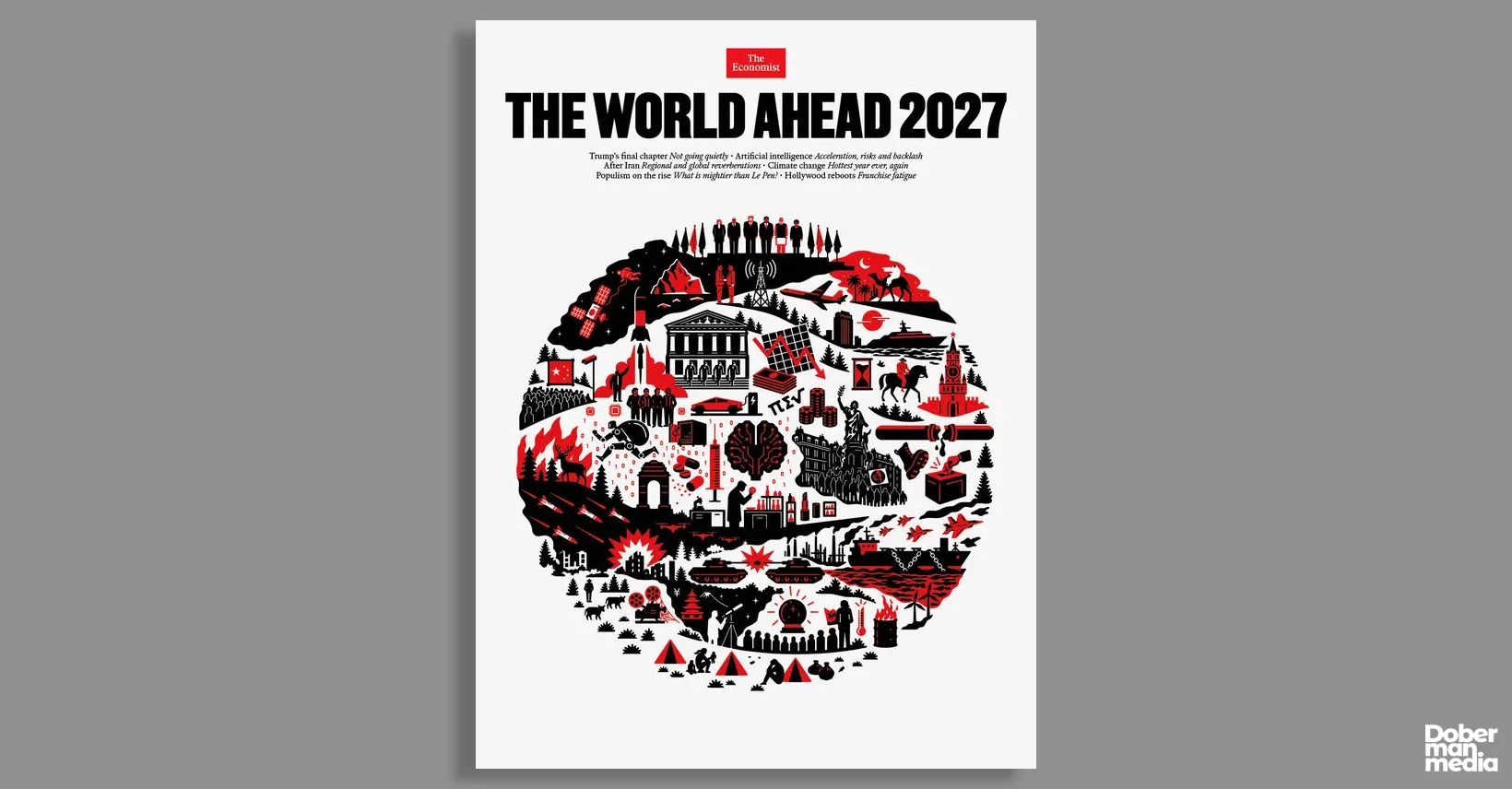

Briefly: The Economist published ten key themes of the coming year in its annual The World Ahead issue. Here are the main ones: The Trump era will draw to a close, but he himself will become even more aggressive, War with Iran will hit energy prices and food supplies, The artificial intelligence bubble may burst, Marine Le Pen could become president of France and shake the European Union.
The British magazine The Economist in its special issue
The World Ahead 2027 under the editorial direction of Tom Standage, characterized the coming era as a time of severe political and financial shocks. The forecast cover illustration, created by artist Cleon Peterson in red-black-and-white tones, depicts tanks, missiles, street protests, surveillance cameras, and stock market turbulence — a vivid map of intertwined global risks. From the American political transition to military tensions in the Taiwan Strait and the threat of a crisis in the overheated artificial intelligence market — 2027 will require governments and investors to be on maximum alert. A post shared by The Economist (@theeconomist)
Entering the final stretch of his presidential term after the midterm elections, Donald Trump is inevitably confronted with a reshaped power structure in Washington. The U.S. political climate during this period is marked by high unpredictability and sharp polarization. The administration is trying to lock in key foreign-policy and economic initiatives before the transfer of executive power.
U.S. allies and rivals alike are forced to rethink their long-term strategies. Analysts stress that uncertainty over the future course of the American administration is pushing other players on the international stage to move first with more aggressive or defensive steps.
Foreign allies and rivals of the United States are forced to rethink their long-term strategies. Observers emphasize that uncertainty about the future course of the American administration is prompting other players on the international stage to take more aggressive or defensive preemptive steps.
The turning point around Taiwan and Beijing’s military modernization factor
For the East Asian region, 2027 stands out as a key milestone in military planning. Security analysts note the coincidence of several implied deadlines tied to the modernization of the People’s Liberation Army of China and the centenary of its founding. Beijing is steadily expanding its amphibious capabilities, testing naval blockade scenarios, and strengthening economic resilience against possible external sanctions.
Public opinion in Taiwan itself continues to drift toward strengthening its own identity, making prospects for peaceful reunification increasingly unlikely. Under these conditions, the likelihood of a forceful scenario or a large-scale quarantine operation around the island reaches a historic peak, forcing neighboring countries and world powers to prepare for deep chain shocks.
The overheating of the artificial intelligence sector and the threat of a market crash
Financial analysts and industry leaders are increasingly talking about the risk of a sharp correction in global stock markets. The main driver of a possible crisis is the buildup of distortions around large-scale investments in artificial intelligence infrastructure. A noticeable rise in the cost of credit makes funding capacity expansion difficult for smaller cloud providers.
Given that a colossal share of the market capitalization of leading stock indexes is concentrated in the hands of a limited number of tech giants, any setbacks in AI profitability could trigger a chain reaction. Slower spending on advanced computing threatens to undercut market valuations and spark a noticeable drop in asset prices.
Sovereign debt burdens and bond market instability
Alongside technological risks, problems are mounting in the sovereign debt sphere of developed countries. Years of accumulating government borrowing against the backdrop of persistently high interest rates are creating a colossal burden on national budgets. Financial markets are showing heightened nervousness, reflected in swings in government bond yields.
Particular concern among experts is caused by the situation in European countries and the United States, where debt servicing is consuming an ever-larger share of revenues. The government bond market is losing its former role as an absolute guarantor of stability, becoming a source of additional turbulence for the global economic system.
The regulatory priorities of the Financial Stability Council
International institutions are responding to the system’s growing fragility by strengthening coordination and developing new standards. The Financial Stability Board is defining a set of priority tasks aimed at increasing the resilience of banking and non-bank institutions in the face of global shocks. Regulators are seeking to close data gaps and raise preparedness for possible crisis interventions.
International regulators are focusing on the risks associated with the rapid adoption of artificial intelligence algorithms in financial operations, as well as the spread of cross-border stablecoins. Supervisory authorities are trying to stay ahead of events, preventing a situation in which digital assets or automated trading systems become the trigger for systemic failure.
The risk of strategic miscalculation in the Taiwan Strait
The foreign policy expert community points to the critical danger of a shift in American rhetoric and delays in military aid. When doubts arise in Washington about the firmness of defense commitments, Beijing may interpret this as a window of opportunity to use non-military forms of pressure, including an economic quarantine.
Such a scenario poses a colossal threat, since Taiwan remains a key global semiconductor manufacturing hub. Any disruption to chip supply continuity would instantly paralyze the global computing industry and trigger a collapse of the world economy. The absence of a clear containment strategy greatly increases the risk of a catastrophic mistake by either superpower.
Climate anomalies and pressure on global infrastructure
Environmental and climatic factors are coming into resonance with political shocks. Forecasts point to a high likelihood of extreme weather conditions associated with natural El Niño cycles. Such anomalies lead to droughts, natural disasters, and significant shifts in crop yields in the planet’s key agricultural regions.
The threat to food security is becoming a direct consequence of climate shifts, creating additional hotspots of social tension in vulnerable countries. Infrastructure networks, energy, and logistics are under constant strain, which intensifies the overall backdrop of global instability.
The consequences of Middle East escalation and energy security
The geopolitical map continues to be strongly shaped by the long-lasting consequences of the conflict around Iran and the broader crisis in the Middle East. Ongoing tensions along key maritime routes and around oil fields keep the global energy market in a constant state of heightened tension.
Resource-importing countries are forced to build into their economic models the high cost of raw materials and the constant threat of supply disruptions. The Middle East remains a flashpoint that could at any moment trigger a new surge in global inflation and intensify diplomatic tensions among major global players.
Transformation of European politics and economic tensions
On the European continent, internal political divisions are deepening. Domestic elections and a shift in public opinion in favor of more radical political forces make it harder to develop a unified European strategy. Economic growth in the region remains subdued, and the need to finance defense spending and service debt limits room for social spending.
As a result, Europe faces a difficult choice between preserving social stability, meeting environmental commitments, and the need to build up its own military and technological autonomy. These contradictions weaken the region's ability to respond quickly to external challenges.
Breakthrough technologies as a factor offsetting global risks
Despite the gloomy forecasts and the buildup of threats, the picture does not look entirely pessimistic. In science and high technology, signs are emerging of future growth that could ease pressure on the economy. Breakthroughs in pharmaceuticals, including the spread of highly effective next-generation drugs, promise to reduce the burden on healthcare systems and improve quality of life.
At the same time, the development of commercial space exploration and alternative energy is accelerating. Innovative breakthroughs are laying the foundation for new industries, showing that a period of high global uncertainty is also becoming an era of searching for unconventional technological solutions.








0 комментариев
Введите email — мы пришлём одноразовый код. Без паролей и аккаунтов.
Код отправлен на
Если письмо не появилось во «Входящих» в течение нескольких минут, проверьте папку «Спам», «Нежелательная почта» или «Промоакции», так как некоторые почтовые сервисы могут ошибочно помещать туда автоматические сообщения.