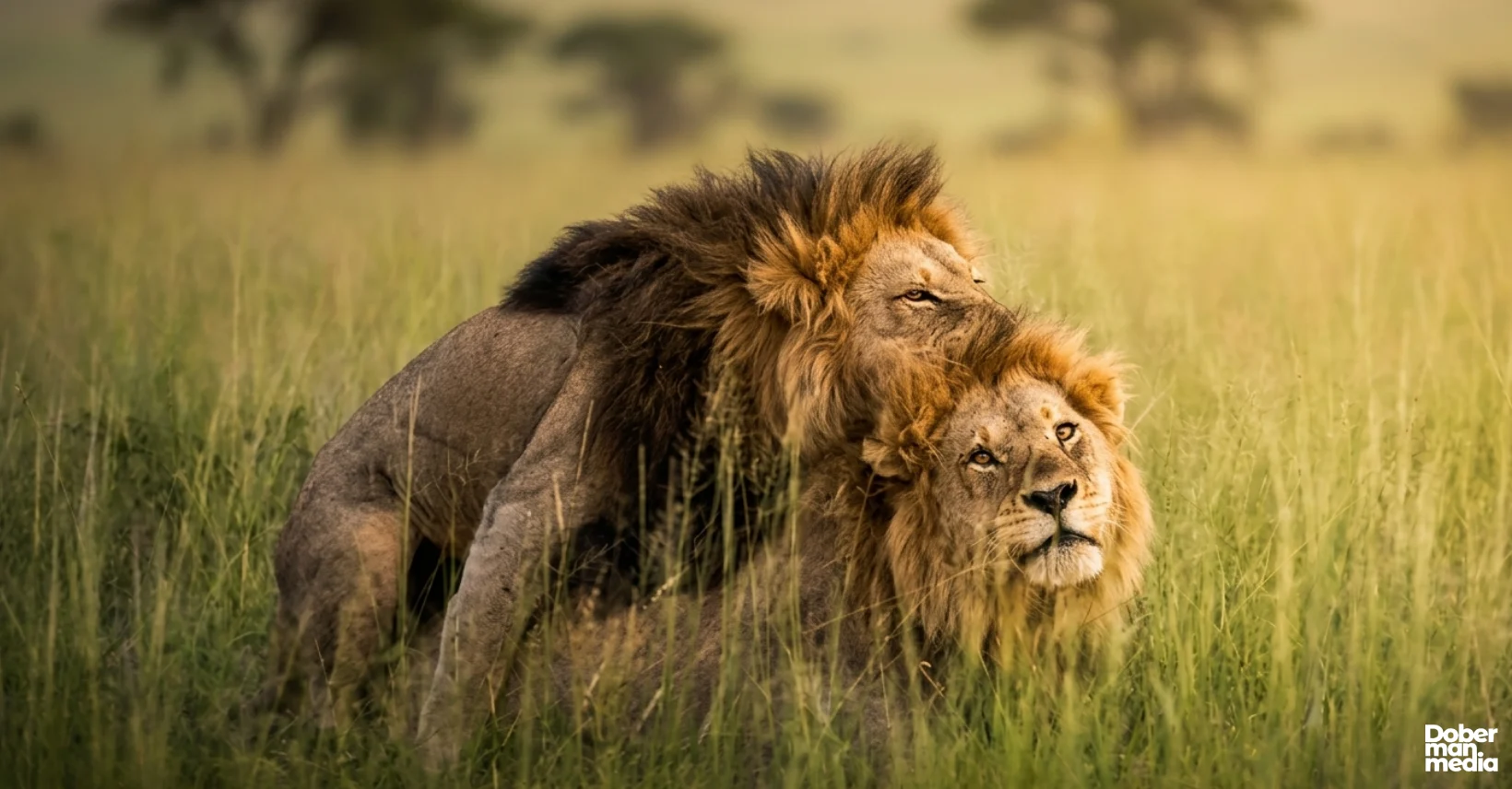
Analysis of “Doberman Media” about the documentary film “Second Nature,” same-sex pairs in albatrosses, duck anatomy, and sex-changing fish.
The documentary film has been released in theaters and on streaming services “Second Nature” (Second Nature), narrated by actor and activist Elliot Page. Director Drew Denny’s film explores facts that school biology textbooks prefer to gloss over. More than 1,500 species of animals in the wild form same-sex bonds, raise offspring in same-sex pairs, change biological sex, or live in matriarchal communities.
Doberman Media shows how sexual and gender diversity is arranged in the animal world, why these facts were left out of school curricula for decades, and how scientific data are changing society’s idea of what is natural.
The book that changed the view of Darwin’s theory
Production on the documentary film “Second Nature” lasted 11 years. Director Drew Denny first conceived the project back in 2015 as a mini-series, but over time the idea grew into a feature-length film. The film received support from the Sundance Institute Sandbox Fund, and Elliot Page’s production company Pageboy Productions took on final promotion.
The film is based on the theoretical framework of evolutionary biologist Joan Roughgarden’s book Rainbow Evolution — Diversity, Gender and Sexuality in Nature and Humans. In her work, Roughgarden challenged Charles Darwin’s classic interpretation of sexual selection, questioning the idea that any sexual contact in nature is solely about reproduction.
Joan Roughgarden and the filmmakers show that sexual behavior in animals serves important social functions. Beyond reproduction, sex in animals helps maintain peace, relieve stress, form social bonds, and reinforce hierarchies. At the same time, same-sex relationships are widespread in nature, representing a fully fledged evolutionary mechanism rather than a random anomaly. Finally, matriarchy and egalitarianism in the wild challenge the myth of absolute male dominance, since in many communities key decisions are made by females.
“I grew up in an environment where I was told that women are naturally inferior to men, and that queerness was somehow unnatural,” said director Drew Denny at a screening during PEN America’s Banned Books Week. “When I read Joan’s book, I realized that my place in this world had always been there. And I thought that if such a profound revelation was needed for me, it must be needed for others too.”
“When I saw this project, I simply fell in love with it,” Elliot Page added. “For me, as a queer and trans person, it means an incredible amount. It has so much humor, scale, and emotional warmth, and it has taught me so much.”
Examples from the wild that don’t fit into school textbooks
Researchers have documented non-heteronormative or transgender behavior in more than 1,500 species, from birds and mammals to fish and insects. The film подробно describes the most striking examples among them.
Pygmy chimpanzees, or bonobos, are among the species most closely related to humans. Their communities are led by females, who form close coalitions. These alliances are maintained in part through same-sex sexual contact, which allows females to hold collective power over males. Any tensions or aggression that arise in bonobo groups are resolved not with fights, but with kisses, hugs, and sexual activity.
Laysan albatrosses are known for their fidelity to their partners, but that fidelity is not always strictly heterosexual. On the Hawaiian island of Oahu, ornithologists found that about 31 percent of nesting pairs of Laysan albatrosses consist of two females. Such pairs form long-term bonds, build nests together, incubate eggs fertilized by outside males, and raise chicks as equals.
Ducks display even more unusual evolutionary anatomy. Only 3 percent of bird species have males with penises, and ducks are among them. A male duck’s penis is corkscrew-shaped, but the female anatomy is just as complex, since her vagina twists in the opposite direction and has spiral dead-end pockets. Scientists have found that this anatomy serves as a natural barrier. During voluntary mating, the female relaxes the vaginal muscles, allowing the penis to pass. If the male tries to mate by force, the female contracts her muscles, and the complex anatomy prevents fertilization.
Bluehead wrasse fish demonstrate even more radical biological transformations. If the dominant male disappears from the school, one of the larger females changes sex. The level of estrogen in her body drops, and ovarian tissue is reorganized into functional testes. After that, the transformed fish begins reproducing as a male, and other members of the species accept these changes as part of the population’s natural development.
Why does the school curriculum ignore these scientific facts
The reason scientific knowledge about the diversity of sexes in the wild still remains outside school lessons lies in politics and history. In the United States, the historical barrier was created by sodomy laws dating back to Puritan colonial times. These legal norms remained in force until 2003, when the U.S. Supreme Court, in Lawrence v. Texas, ruled them unconstitutional.
Today, outdated laws have been replaced by so-called “Don’t Say Gay” acts. According to the Movement Advancement Project, 18 U.S. states have laws that directly restrict or forbid discussion of sexual orientation and gender identity in schools. Only 8 states have legally established standards for inclusive education, and only 7 states require them. Even where inclusion is enshrined in law, it is almost always limited to humanities subjects and does not affect biology lessons.
How does inclusive biology affect students
Scientists have repeatedly proven that omitting scientific facts harms the educational process. According to a 2026 study involving 127 high school students, introducing inclusive materials about the diversity of sexes and animal behavior into the biology curriculum significantly reduced prejudice among teenagers, helped them move away from rigid binary stereotypes, and improved overall attitudes toward gender and sexual diversity.
Nature has never been strictly binary. The creators of the film Second Nature are convinced that school education should reflect the real world, not outdated ideas about it.
What to watch and read on the topic
For those who want to dive deeper into the topic, it is worth paying attention to the film Second Nature itself, available on streaming platforms, as well as to the educational guides from the Gender-Inclusive Biology project. Among popular science books and literature for teenagers, And Tango Makes Three by Justin Richardson and Peter Parnell stands out, about two male penguins who raised the chick Tango; Worm Loves Worm, a book about two earthworms; and Queer Ducks, the popular science book by Eliot Schrefer about sexuality in the animal world.





0 комментариев
Введите email — мы пришлём одноразовый код. Без паролей и аккаунтов.
Код отправлен на
Если письмо не появилось во «Входящих» в течение нескольких минут, проверьте папку «Спам», «Нежелательная почта» или «Промоакции», так как некоторые почтовые сервисы могут ошибочно помещать туда автоматические сообщения.