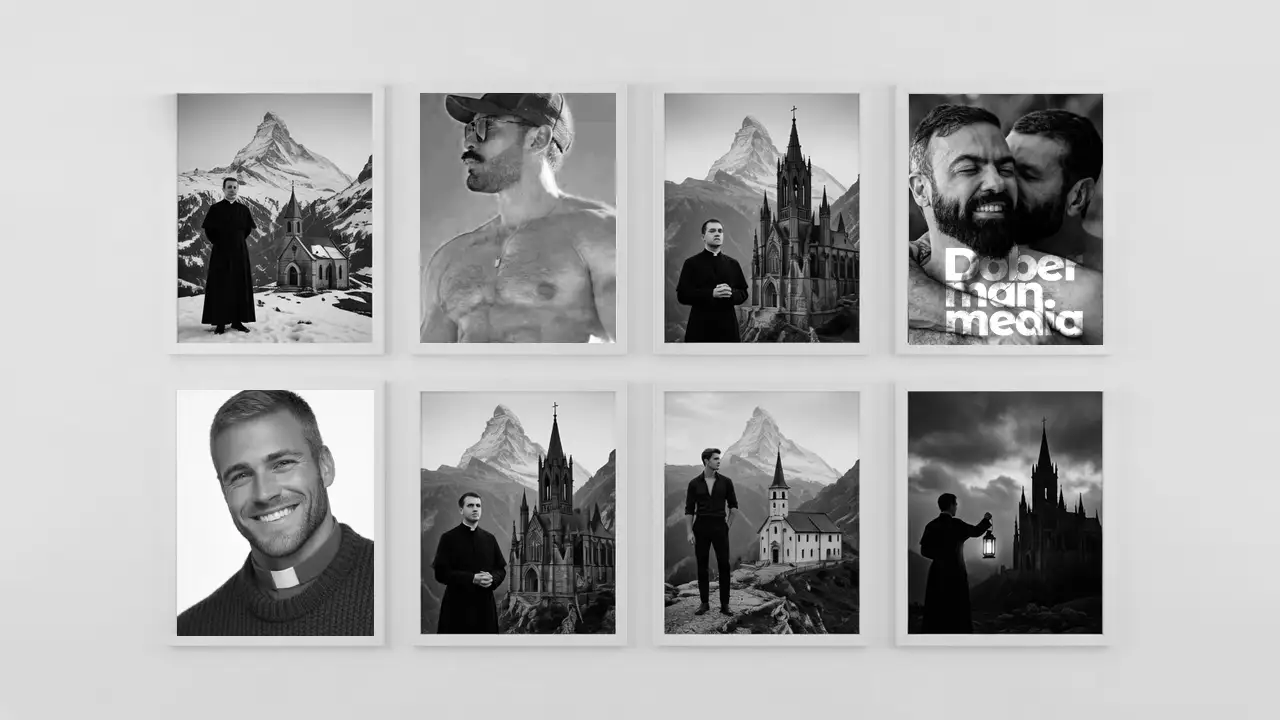

Until August 24 in Berlin, at The Museum of Homosexuality (Schwules Museum) there is an exhibition titled “Better to be happy than normal! The lives of queer people in the context of Christian fundamentalism”. The exhibition is based on the personal stories of people who faced pressure from religious communities and tried to change their sexual orientation or gender identity under the influence of church dogmas.
Can queerness and the Christian religion coexist on the same plane? Deutsche Welle discussed this with a non-binary person, a priest and a curator at the Berlin Museum of Homosexuality.
Who should change: the person or the church?
One of the key figures and the exhibition’s curator — a trans woman Sophie Rauscher, who studied evangelical theology in Giessen. According to her, many believing queer people are forced to rethink their relationship with God in order to keep their faith, since in many denominations God is still perceived as a purely monotheistic and patriarchal figure. For many, combining identity with religion becomes a way to heal from past trauma, because “there is so much in the world that is hard to bear alone.”
However, the path to such a reconciliation often goes through conversion therapy — a set of pseudoscientific and dangerous methods aimed at “correcting” identity. The Museum of Homosexuality collected interviews with seven people who went through this experience. On the surface, it may look like a simple conversation with a priest over coffee, but in reality queer people are made to feel that their way of life is sinful through hypnosis, medication, and sometimes even torture and humiliation.
The Story of Lotar: 40 Years in the Community and the Loss of Family
One of the most tragic examples featured in the exhibition is the story of 72-year-old Lotar. He spent more than 40 years in a religious community. After realizing he was gay in his youth, he faced contempt in the church youth group: his feelings were called “disgusting.” Lotar tried to “change”: he took part in conversion therapy, practiced abstinence, and even got married.
When the truth came out, his wife left him, taking their daughters, and the community completely cut him off. Fifteen years later, he still could not restore his relationship with his children. After taking a course in psychotherapy, Lothar concluded that the Bible cannot be taken literally, and now he would like to say to all fundamentalists: “You cannot change a person’s sexual orientation.”
The law and “spiritual conversations”
Since 2020, Germany has had an official ban on conversion therapy. Anyone who organizes it faces up to one year in prison, and advertising or facilitating it can be fined up to 30,000 euros. Nevertheless, the practice continues under other names.
42-year-old Austrian Damian, a non-binary person, grew up in the family of a Catholic deacon. His parents seemed like liberal “Christian hippie activists,” but they were uncompromising when it came to questions of identity. Damian recalls that religion gave him “a clear moral compass” beyond which, it seemed, there was nothing, which even led him to spend time in a monastery. Damian now considers himself an atheist, but admits that he still fears hell: “It took a lot of effort to stop feeling ashamed and hating myself.”
“Love is love”: the position of the liberal church
On the other side of the globe are priests like Joachim Reich from the Anglican Church of St. George. He emphasizes that in his parish, queer people are first and foremost parishioners. Reich gives the example of a transgender woman who openly told the congregation about her transition and name change and was accepted without judgment.
According to Reich, over the past 20 years the church’s attitude toward LGBTQ+ people has changed significantly under the influence of feminism and the civil rights movement. The main problem lies in essentialist thinking conservative churches, which regard binarity (the creation of only men and women by God) as an unshakable foundation of the world order and place assigned sex above a person's feelings.
American influence and radicalization
Важным фактором остается влияние американских проповедников. Кураторы выставки отмечают, что священнослужители из США специально приезжают в Германию для работы в конверсионных лагерях. Речь идет в основном о «свободных евангелических церквях» (они составляют около 1% жителей ФРГ и не связаны с официальной Евангелической церковью Германии).
Sometimes this influence takes extreme forms. In 2023, pastor Moses Golla, a member of the American sect Faithful Word Baptist Church, threatened to deal with German priest Lothar Gassmann. Golla released the track “God Hates F***,” in which a synthesized voice called to “kill” Gassmann. After the investigation began, the pastor went into hiding in the United States.
Megachurches and loopholes in the law
The organization is also at the center of the discussion International Christian Fellowship (ICF), whose Munich branch resembles American megachurches with a show instead of traditional services. Journalist Kevin Eberth found during his experiment that such congregations still practice prayers for the “healing” of homosexuals.
In response to questions about the 2020 law, ICF representatives say they welcome it, but emphasize that the law should not restrict “spiritual conversations.” The organization believes that “voluntary change of sexual orientation” should be possible and insists on the “liberating power of Jesus Christ.” At the same time, the law itself does not provide any exceptions for “spiritual conversations” — any methods aimed at changing identity are prohibited.






0 comments
Enter your email — we’ll send you a one-time code. No passwords or accounts.
Code sent to
If the email doesn't appear in your inbox within a few minutes, check your spam, junk, or promotions folder, as some email services may mistakenly place automated messages there