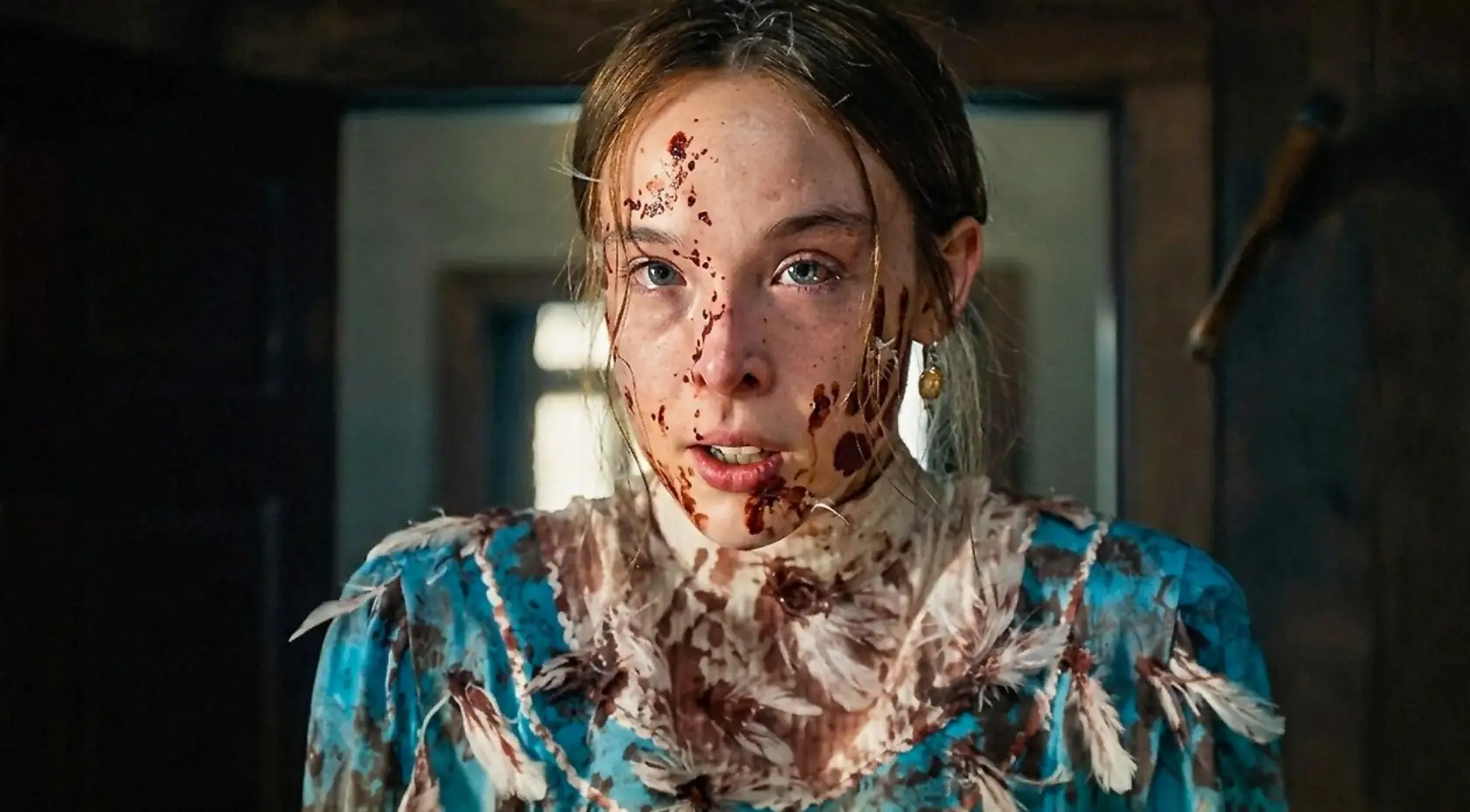

I'm a huge fan of Ryan Murphy's work. So when a new season of Monster came out on Netflix, of course I couldn't pass it up. This time, Murphy and Ian Brennan took on one of the most famous American stories of the 19th century—the case of Lizzie Borden, who was accused of murdering her father and stepmother with an axe.
Warning: This article contains spoilers!
Table of Contents
But first, an important caveat: we still don't know whether Lizzie Borden really did kill her parents. She was acquitted in 1893, and no direct evidence of her guilt ever emerged.
But Murphy and Brennan do what they do best: they take a true story with a huge number of unanswered questions and fill in the gaps with their own version of events.
And judging the show on its own terms, I personally was left with virtually no doubt: yes, Lizzie did it.
But the question here is no longer so much whether she killed them or not. Something else is far more interesting: what has to happen to a person for killing their parents to become a way of breaking free?
LIZZIE AS A “MONSTER”
The title Monster itself prompts us to look for a monster. But Ryan Murphy once again plays with the concept. What actually makes someone a monster? Are they born that way, or do they become one? In Lizzie’s case, the series offers a fairly unequivocal answer.
We see a young woman who is virtually imprisoned within her own family. Her stepmother treats her with contempt and constantly makes it clear that she is inferior to others. Her father, too, fails to become someone who makes her feel loved and protected. Even her sister Emma is part of this world, where Lizzie is constantly reminded of what she is supposed to be and what she will supposedly never become.
Most interestingly, Lizzie does not come across as foolish at all. Quite the opposite. She is observant, capable, curious, and clearly far more complex than the “old maid” persona those around her try to impose on her.
She is simply given virtually no room to live a life of her own. Now add the nineteenth century to the equation. A woman is expected to conform to a particular model of behavior. Her sexuality, desires, relationships, education, and future are all largely determined by those around her. And in the series, Lizzie also happens to be a woman who is attracted to women. This is where the story becomes especially interesting to me.
LIZBIE, BRIDGET, AND THE RIGHT TO BE YOURSELF
The romance between Lizzie and Bridget is one of the elements that most clearly sets the series apart from the historical record.
We have no reliable evidence that the real Lizzie Borden was a lesbian or romantically involved with Bridget Sullivan. Bridget herself was a real person who worked as a maid in the Borden household, but the love story between the two women is a fictional interpretation by the show's creators. Netflix explicitly describes the show's version of events as heavily fictionalized.
And yet, it is this fictional part of the story that strikes me as one of its most powerful. Because Bridget becomes more than just a lover to Lizzie. She shows her a completely different world. A world in which she is free to want things.
She is free to choose.
She is free to talk about her desires.
She does not have to be a dutiful daughter, a good woman, or a suitable bride.
She can simply be herself.
To a modern viewer, this may seem basic. But for a woman in the world the show depicts, it is an almost unimaginable luxury. So I was not at all surprised by how deeply Lizzie became attached to Bridget.
And when the two women begin working out a plan to free Lizzie from her own family, I no longer saw what was happening as merely the story of a future crime. It was the story of two people who wanted to gain at least some control over their own lives. Of course, this does not justify murder. But understanding a motive and justifying an action are not the same thing. And the show truly does make us understand Lizzie.
AFTER THE MURDERS
This story does not end when two bodies turn up. There is an investigation. There is a trial. There is a society that has already turned Lizzie into a sensation. And there is Lizzie herself, who must somehow go on living after everything that has happened.
I liked that the series does not try to portray her as a stereotypical “deranged killer.” It is interested in a far more troubling question: can a person who has committed a monstrous act still be someone who has longed all their life for love, freedom, and a normal life?
And that is precisely why the finale felt especially important to me. After everything that happens, Lizzie finally gets what she has been denied for so long: the chance to live for herself. And yes, I was glad to see her together with Bridget.
Some may find such an ending overly romanticized. But within Murphy’s version of the story, it works. A woman who has been denied the right to choose for nearly her entire life finally has the chance to make her own choice.
SARAH PAULSON — BECAUSE IT WOULDN’T WORK WITHOUT HER
And, of course, where would Ryan Murphy be without Sarah Paulson. For me, that's a reason in itself to watch his projects. Paulson is one of those actresses I could watch in just about anything. I already written about her before and make no secret of how much I love her work.
So Sarah Paulson's appearance in the new Monster considered it a special treat. This time she plays Aileen Wuornos — a woman who committed murders in the late 20th century. And it is a very interesting choice by the creators: Lizzie's story is carried across the decades and casts a kind of shadow over another woman who also commits murder. Netflix explicitly describes Wuornos as a thematic continuation of Lizzie's story, exploring female rage and the circumstances that drive a woman to violence.
And Sarah Paulson is wonderful here.
It is especially fascinating to watch her play a woman who is nothing like Lizzie, yet is connected to her by one common theme: what happens to a woman when, for years, the world around her leaves her no real room to live? At the same time, the series does not try to suggest that Lizzie and Aileen are the same kind of people. And rightly so.
They live in completely different eras, have completely different life experiences, and commit their crimes under completely different circumstances. But Murphy draws a line between them. For Aileen, Lizzie becomes a kind of ghost from the past—the story of a woman who also once crossed the line. And there is something very Murphy-esque about that.
RYAN MURPHY AND LGBTQ THEMES
Murphy is openly gay, and LGBTQ themes have long been a prominent part of his work. From Glee and American Horror Story up to Pose, Hollywood and other projects, he regularly explores the stories of people who fall outside traditional norms.
So it seems entirely fitting to me that even the story of a 19th-century woman who cannot confidently be described as a lesbian from a historical standpoint is told through the lens of female desire and the inability to freely act on it.
And for me, that is one of the main reasons why this version of Lizzie works. This is no longer merely a story about two murders. It is the story of someone who was told for a very long time, who they were not allowed to be. And then that person decided they were no longer going to listen to anyone.
DID LIZZIE REALLY KILL THEM OR NOT?
This is where the series, of course, does not give us the historical truth. Because no one actually knows it. The real Lizzie Borden was acquitted. The true circumstances of her family, her relationships with her relatives, and her inner world cannot be reconstructed in as much detail as the series attempts to do.
That's why Monster: The Lizzie Borden Story is best viewed not as a documentary reconstruction, but as a fictional interpretation of a person whose life has been surrounded by a vast historical void for more than a century.
And it is precisely this void that Murphy fills with his own version.
In his version, Lizzie is more than just a murderer.
She is a woman who had been caged for years.
A woman who wanted love.
A woman who wanted freedom.
A woman who did not want to live her whole life according to someone else's script.
And a woman who, at some point, decided to destroy those who, she believed, had built that cage.
Is she a monster?
Every viewer will probably answer that question for themselves.
And after eight episodes, I can say only one thing: I don't know whether the real Lizzie Borden was a murderer. But I understood Ryan Murphy's Lizzie.
And perhaps that is precisely what makes the new season Monster a good story.
I recommend watching it.







0 comments
Enter your email — we’ll send you a one-time code. No passwords or accounts.
Code sent to
If the email doesn't appear in your inbox within a few minutes, check your spam, junk, or promotions folder, as some email services may mistakenly place automated messages there