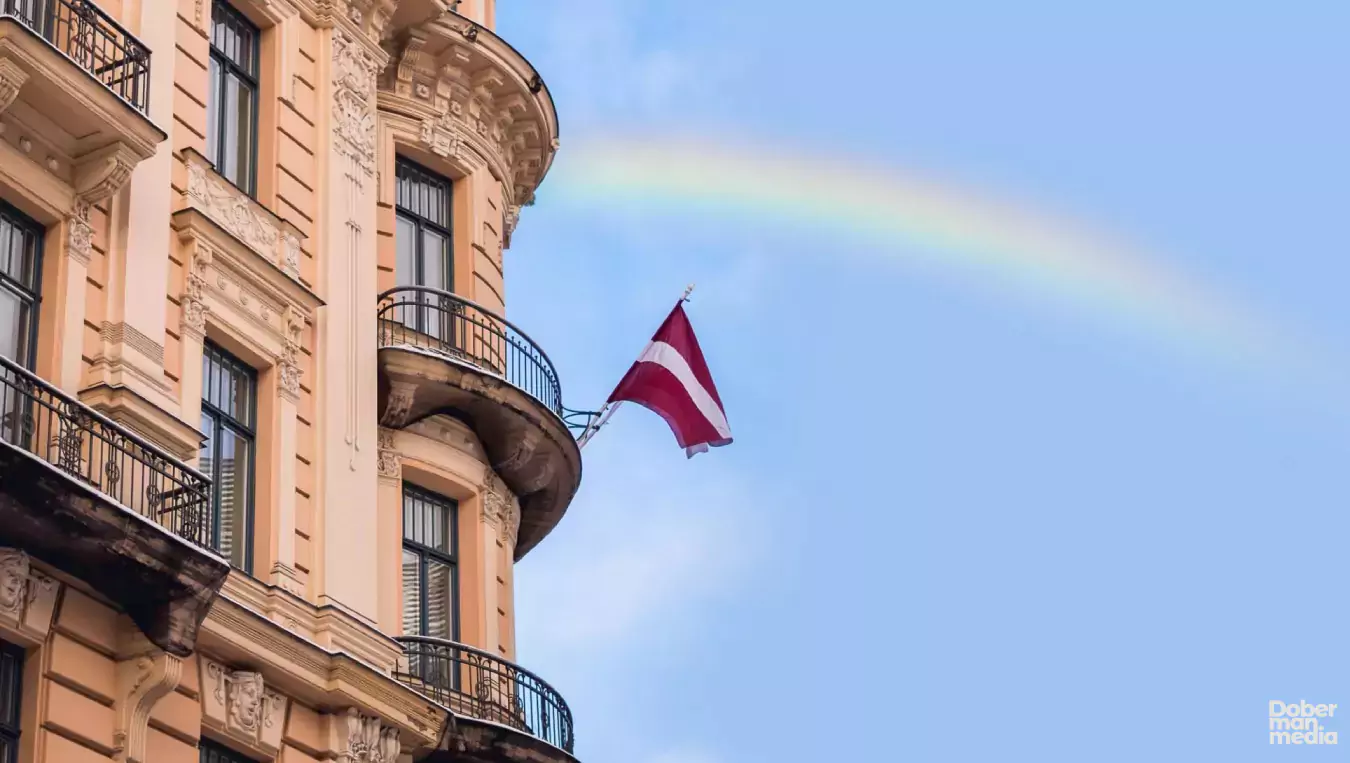

To be honest, when I left for Latvia, the sex lives of the locals were the last thing on my mind.
But here I am, in Europe, so to speak. I'm starting my life with a clean slate, and I'd say a whole new world of possibilities is opening up before me.
Let's say (just for the sake of a thought experiment) that I'm gay and have decided to come out. I can do that right away, right?
On the one hand, of course, yes.
Gay People in Riga Yes.
If you wander through the bohemian hangouts, you can even find, you know, those overt, flamboyant gay men. Wearing makeup, with a manicure, and in a white suit that stands out especially brightly against the backdrop of the dirty slush underfoot.
We had a Pride event this summer.
And I was on it.
It was really nice and fun. Gay and straight people alike dressed up in bright clothes, danced, sang, and had a great time. There were several marching bands and drummers. Someone even showed up in their own pink pickup truck with huge speakers.
There was, however, one serious-looking man standing on the side of the road holding a sign that said all the marchers would burn in hell.
So the kids, all decked out in feathers and rainbows, took selfies with him!
To be fair, things weren't always like that in Riga.
Old-timers say that the first Pride parade in 2005 barely got off the ground.
The country's prime minister was opposed to it. The deputy mayor resigned in protest. And there were far fewer parade participants than protesters.
The current president of Latvia is an interesting person. For those who don't know, Edgars Rinkēvičs has been openly gay since 2014.
The upside is that it’s now much easier for voters to criticize the president. The downside is that he doesn’t take offense.
What else is gay about this…
Yeah! The coolest club in town is the one for sexual minorities. The club plays really great music. And besides the target audience, girls love going there when they just want to dance, without those drunk princes who are eager to whisk them away on their white horses.
In short, there are some bright spots, but not that many.
It seems to me that this is exactly the kind of situation where, having become part of the European family, people have committed themselves to upholding liberal values. But deep down, they’re still just a little bit against it (though it’s unlikely anyone would admit it out loud).
Parents with numbers instead of "Dad" and "Mom," all that pretentiousness, same-sex marriages… All of this is a bit un-Christian and doesn't resemble traditional family values at all.
"How, then, did they end up electing a president like that?" you might ask. And I'll answer.
In Latvia, people vote for political parties; the parties form the parliament; and the parliament elects the president.
I remember the day of that election very well. No water cannons, no cosmonauts, no protesters. What a bore!
Be that as it may, when it comes to tolerance, the country is definitely making progress—and moving in the right direction.
Although the people of Riga aren't known for being promiscuous, people here have much more freedom.
You see all kinds of people on these streets.
In black down jackets and in bright pink fur coats. In knitted beanies and luxurious hats straight out of nineteenth-century Paris. In onesies shaped like pandas, cows (with udders), or Pikachu. With hair of various colors, piercings, and tattoos.
And that's really great.
After all, respect for sexual minorities is part of respect for minorities of any kind. It is a specific instance of respect for a person—for any member of society.
And I think things aren't too bad here, after all.
All in all, if you're looking for a place to take a trip in your golden years, Riga is a great choice.
But it all comes down to determination and the energy you put into tackling a problem.
What if, for example, we were to turn the consumption of pork or beef from a matter of taste into a religious issue?
And that's it. And on that simple basis, arguments, conflicts, fights, and perhaps even a full-scale holy war will begin.
People are masters at this—finding differences where there aren’t any. And then they blow those differences out of proportion. That’s how our primitive brain divides people into “us” and “them.”
And, of course, it’s okay to beat up strangers, call them all sorts of nasty names, blow up the cities where they live, and launch drones, missiles, and other harmful things at them.
The absurdity lies in the fact that anything can serve as a reason for such a division.
To a European, the differences between the Tutsi and Hutu tribes are incomprehensible. Yet in Rwanda, a million people were killed because of them.
Does anyone know the difference between Sunnis and Shiites?
Why were Catholics and Protestants in Ireland shooting at each other?






0 comments
Enter your email — we’ll send you a one-time code. No passwords or accounts.
Code sent to
If the email doesn't appear in your inbox within a few minutes, check your spam, junk, or promotions folder, as some email services may mistakenly place automated messages there