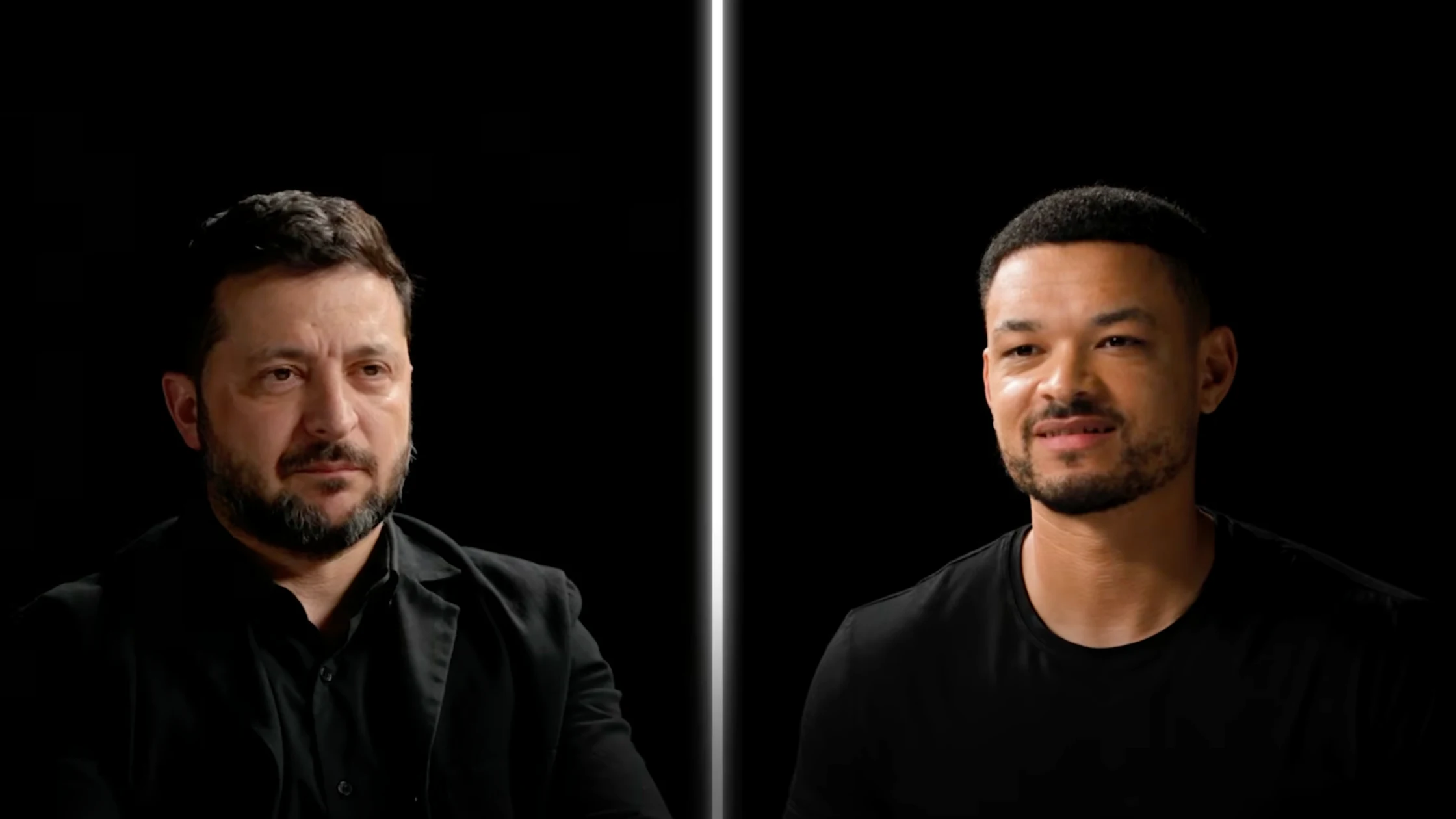
Ukrainian President Volodymyr Zelenskyy gave an in-depth interview to British entrepreneur Steven Bartlett, host of one of the world's most popular podcasts The Diary Of A CEO with an audience of more than 20 million people.
In the hours-long conversation, Zelenskyy gave a detailed account of events since the full-scale invasion began on February 24, 2022. He explained why the Kremlin's attempt to capture Kyiv in three days failed, how the atrocities witnessed in Bucha forever changed Ukrainians' attitude toward compromise, and why he believes geopolitical pressure over diesel prices amounts to unfairly shifting the blame.
A Fatal Miscalculation: How Russia's Failure to Recognize Ukrainians as a Distinct People Led to Its Catastrophic Military Blunder
Reflecting on what drove Vladimir Putin to launch the full-scale war, Volodymyr Zelenskyy emphasizes that the Russian president remains “a thoroughly Soviet man.” According to him, Putin sincerely believes that the collapse of the USSR was the greatest catastrophe of the 20th century and seeks to rebuild an empire in which he views Ukraine as a key part.
At the same time, the Kremlin bases its rhetoric on denying Ukrainian history and statehood. Commenting on Putin's claim that Ukraine was supposedly “entirely created by Lenin,” Zelenskyy points to Kyiv's thousand-year history:
“We have magnificent churches that are a thousand years old, painted by masters of the highest caliber. Ukraine is the heir to Kyivan Rus, a great state with an advanced civilization, art, and traditions. Russia did not even exist at the time. But he cuts all of that out and begins with 1917 because he instills in his citizens the idea that their life is the Soviet Union and that they are returning to it.”
The Kremlin's main fatal miscalculation was its failure to understand that Ukraine is a separate state with its own identity and a free people. Moscow expected a swift triumphal march. This was evidenced by the parade uniforms Ukrainian troops found in disabled Russian armored vehicles near Kyiv:
“He still does not understand and refuses to acknowledge that these are a different people and a different country. He thought: I'll march in with the army, bang my fist on the table, the president will flee, the people will hide, and the Ukrainian flag will be replaced with the Russian one. They were literally marching toward a parade. They wanted to capture Kyiv in three days and stage a sham victory spectacle on Khreshchatyk.”
Zelensky also commented on Donald Trump's recent claims that the attempt to capture Kyiv allegedly failed because of a “Russian general's mistake” in directing a column of tanks onto a dirt road soaked by rain. According to the Ukrainian president, it had nothing to do with the weather or a navigation error:
“I don't know what President Trump is talking about. They surrounded Kyiv, reached the suburbs, and armored vehicles were breaking into the city itself. But our people burned all of it. It wasn't because some general was an idiot. The real mistake was that they never even considered the possibility that they would face resistance.”
A pivotal episode in the defense of the capital was the battle for Antonov Airport in Hostomel. Russian airborne troops attempted to seize the strategic airfield to land the main force, but Ukraine's National Guard and special forces counterattacked the enemy, damaged the runway, and destroyed the landing force, thwarting the operation's initial plan.
A Turning Point of Brutality: How Bucha Transformed a Military Conflict into a Deeply Personal Tragedy
While many around the world still viewed the events of the first weeks of the war through the lens of a conventional military or political conflict, the liberation of Kyiv's suburbs in the spring of 2022 changed everything.
Volodymyr Zelensky calls the day he personally visited the liberated town of Bucha the most terrifying day of the entire war. Mass graves were discovered there containing civilians who had been tortured and executed:
“Never in my life had I seen people's bodies simply lying in the streets. Children, adults, the elderly—they were tortured, their hands were tied, and they were thrown into pits. In just one mass grave, we found about 500 people who had been tortured to death. When you see something like that, everything inside you changes completely. A feeling of pure vengeance takes over. I had never wanted to kill anyone before, but at that moment, you see these monsters and want to destroy them”.
Zelensky emphasizes that the atrocities committed against civilians have turned the war into a deeply personal tragedy for every Ukrainian family. That is precisely why proposals for immediate concessions without justice are seen by society as a betrayal of the memory of those who died.
“When President Trump says that a compromise must be found… How can you force people to forgive when their child was tortured? Как после этого можно просто слушать Путина, всё простить и сказать: “Ну ладно, давайте снова покупать и продавать газ или дизель”? That is impossible. There can be no true peace without justice. Those responsible must be punished; otherwise, this wound within people will never heal”.
The Price of Staying: How Refusing Evacuation from Kyiv Prevented a Catastrophe
Recalling the first hours of the full-scale invasion on February 24, 2022, Zelensky described waking up to missile strikes and telling his family that the war had begun. A massive 64-kilometer convoy of Russian military vehicles was advancing on Kyiv, while the invading forces numbered as many as one hundred thousand troops.
At that point, foreign leaders, including U.S. President Joe Biden, were convinced that the capital would soon fall and offered Zelensky an emergency evacuation. The Ukrainian president's response went down in history: “I need ammunition, not an evacuation” (“I need ammunition, not a ride”).
Zelensky explains that the decision to remain on Bankova Street in Kyiv was driven by the absolute necessity of keeping the country under control and preventing panic:
“Russian propaganda was constantly spreading fake stories claiming that I had fled—first to the border, then to another country. Their main calculation was that if the leader abandoned the capital, everyone would start trying to save themselves and the nation would surrender out of fear. So I decided to go outside two or three times a day, record videos, and show that I was in my office on Bankova Street and had not gone anywhere. The military later told me how important this had been for them: they were defending the capital and knew that their president was there with them.”
The first weeks of the war were marked by nonstop crisis management. Zelensky slept for 15 minutes a day while negotiating around the clock with world leaders to arrange weapons supplies, unblock logistics, and deliver food and water to besieged cities.
Geopolitical reality: holding the aggressor accountable instead of shifting the blame onto energy markets
A significant part of the conversation focused on the current geopolitical situation and pressure from the United States. In particular, Donald Trump publicly criticized Ukraine for strikes on Russian oil refineries, claiming that they were driving up global diesel prices and hurting American farmers.
Zelensky categorically rejected these accusations, calling them an attempt to shift the focus and redirect responsibility:
“Russian diesel export volumes are so insignificant that they have zero impact on prices in the United States—this information is completely false. We have no reason to strike their energy sector for no reason. We launch retaliatory strikes because Russia is systematically destroying our energy system, depriving people of electricity and heat. They make money from diesel and spend it on weapons. I suggested to Trump: reach an agreement with Putin on an energy ceasefire; let’s protect electricity supplies for the people. But Putin refused. And instead of putting pressure on Putin, Trump is starting to shift the blame for the aggression onto me.”.
The Ukrainian president stressed that genuine peace through diplomacy cannot be built by covering up the aggressor’s crimes or by attempting to justify turning a blind eye to the war in the interests of fuel markets. According to him, if Ukraine’s partners cannot force the Kremlin to stop striking civilian infrastructure, they must provide Ukraine with the air-defense systems it needs to protect itself.
At the end of the three-hour conversation, Zelenskyy expressed confidence that, despite all the immense hardships and the human cost, time would inevitably prove to be on the side of truth:
“Over time, all hidden motives and secrets always come to light. Time is always on the side of those who are open, ready for honest dialogue, and fighting for their right to live. That is why time will be on our side”.





0 comments
Enter your email and we will send you a one-time code. No passwords, no accounts.
Code sent to
If the email does not arrive in your inbox within a few minutes, check your Spam, Junk or Promotions folder — some mail services may wrongly place automated messages there.