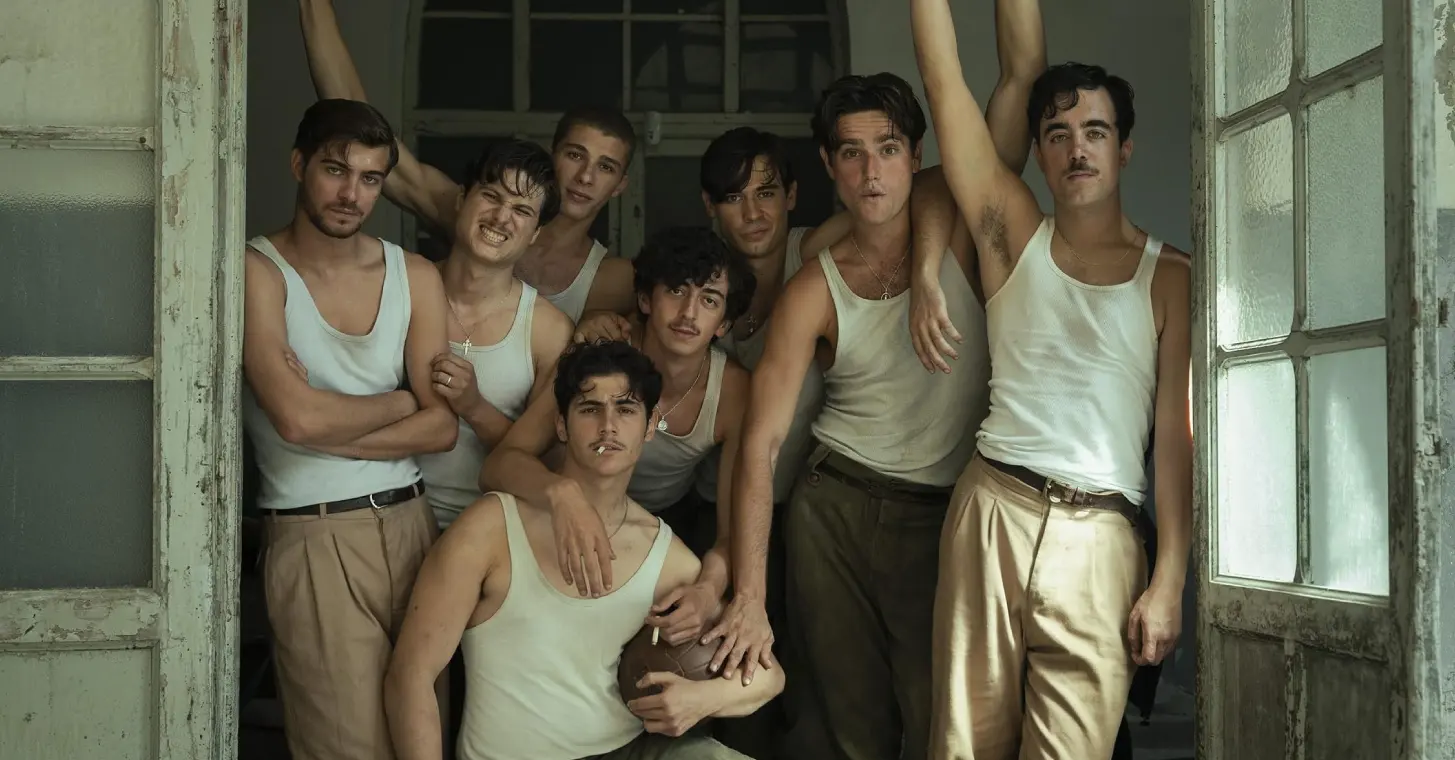

Movie“The Black Ball” (La bola negra, 2026) by the directing duo Los Javis (Javier Calvo and Javier Ambrossi) has established itself as the year's defining cinematic and sociocultural event. It is not merely a monumental historical epic, but also an uncompromising political and poetic manifesto linking the collective trauma of repression with the intimate anatomy of repressed fear and forbidden passion.
At the heart of the film's concept is a radical reimagining of queer memory through the figure and legacy of the great poet and playwright Federico García Lorca, who was executed by Francoists in 1936. Transforming decades of enforced silence and historical amnesia into a dazzling artistic act, the film recasts the martyred poet from a victim of circumstance into an eternal symbol of resistance.
“The Black Ball” is a sweeping epic about the right to identity, in which the historical memory of repressed desire finds its voice, becoming an uncompromising and triumphant celebration of freedom, love, and art.
A Triptych of Time: Narrative Architecture and Three Generations of Repressed Passion
The narrative architecture of the film, with a running time of 158–159 minutes is structured as a polyphonic chronological triptych connecting three eras and spanning 85 years of Spanish history (from 1932 to 2017). Cinematographer Gris Jordana delicately distinguishes between the eras, masterfully alternating monochrome contrasts with a rich color palette (in a 1.85:1 aspect ratio), while the masterful editing by Alberto Gutiérrez weaves the fragments of this historical mosaic into a seamless operatic flow. The filmmakers’ own personal drama—the breakup of Calvo and Ambrossi in late 2025, right in the midst of filming—imbued the direction with extraordinary intimacy, poignancy, and emotional honesty.
1932: Exile from Granada Society During the Second Spanish Republic, Carlos, a young aristocrat from Granada (Milo Keefe) applies for membership in an exclusive elite club. However, the elite council rejects his application: in a secret ballot, club members cast “black balls” because of rumors circulating in society about his homosexuality. The metaphor of the “black ball” (blackballed) becomes the central symbol of institutional veto, social isolation, and the erasure of the “undesirable” from civic life.
1937: Love Amid the Ruins of the Civil War The film’s central emotional arc unfolds at the height of the Civil War. Sebastián, a sensitive musician and trumpeter (in the acting debut of popular folk singer Guitarricadelafuente / Álvaro Lafuente Calvo), conscripted into Francoist forces against his will, is assigned to a military hospital. He is tasked with guarding a wounded Republican prisoner, Rafael Rodríguez Rapún (Miguel Bernardeau). Rapún was a real historical figure, an athlete who played for Atlético Madrid, a Republican officer, and García Lorca's last great love. Amid mortal danger, a magnetic and sensual attraction ignites between the reluctant guard and his charismatic prisoner.
2017: A Modern-Day Echo and the Unraveling of Family Secrets The story shifts to present-day Madrid. Historian Alberto (Carlos González) investigates the legacy of a grandfather whose existence he had never suspected. Documents from the past force him to undergo a painful process of reconciliation with his mother, Teresa (Lola Dueñas), who struggles with addiction, and uncover a repressed family trauma linking all three generations.
Literary Genealogy: From Lorca's Unfinished Manuscript to Conejero's Play
The screenplay, written by the duo Los Javis together with playwright Alberto Conejero, draws on a complex literary foundation in which documentary facts intertwine with poetic reconstruction.
| Primary source (author, title, historical context) | Integration into the film's narrative fabric |
|---|---|
| Federico García Lorca — the unfinished manuscript “The Black Ball” (La bola negra) Historical Context: The poet managed to write only four pages before being killed by Francoists in 1936. The story centered on the discrimination faced by a young man at an exclusive club in Granada. | Serves as the foundation for the first timeline (1932), in which Carlos (Milo Keefe) becomes a victim of class-based and moral rejection. The filmmakers complete Lorca's unfinished story. |
| Alberto Conejero — the play “The Dark Stone” (La piedra oscura, 2013/2015) Historical Context: A drama about the final days of Rafael Rodríguez Rapún, Lorca's lover, and his relationship with a young soldier named Sebastián. | Forms the central 1937 storyline (the romance between Sebastián and Rafael), while also providing a metatextual link to the Madrid story set in 2017 through archival testimony. |
A Star-Studded Ensemble and Production Scale: Almodóvar's Support and Hollywood Guest Stars
The film's impressive scale is made possible by an alliance of leading production companies: Suma Content, Movistar Plus+, Le Pacte, Los Esquiadores A.I.E. and the production company of brothers Pedro and Agustín Almodóvar — El Deseo. This collaboration represents the direct passing of the Spanish queer auteur cinema tradition to a new generation of filmmakers.
The score by composer Raúl Refree (Raül Refree) infuses the film with avant-garde flamenco and authentic Spanish duende — the dark, authentic spirit of passion and tragedy.
Festival Triumph and Box-Office Sensation: From Cannes to the Spanish Theatrical Release
The Los Javis epic went from an auteur phenomenon to the nation's biggest blockbuster, proving that radical queer art can dominate the mainstream box office.
World Premiere at Cannes (May 2026): The film debuted in the Official Competition at the 79th Cannes Film Festival, where its triumph culminated in a 20-minute standing ovation and the Los Javis receiving the Best Director Award (Prix de la mise en scène).
A Triumph on the Global Festival Circuit: The film won the People's Choice Awards (People’s Choice Award) at the Toronto (TIFF) and San Sebastián film festivals, as well as the top audience awards in Sydney and Busan (Flash Forward Audience Award).
Acclaim from American Critics: The film garnered an impressive array of awards in the U.S., including Gotham Vanguard Tribute, the Critics Choice Celebration of Latino Cinema & Television for Best Director, as well as breakthrough performance awards for Guitarricadelafuente at the festivals in Middleburg (International Spotlight Award) and Savannah (Discovery Award).
Box-office triumph in Spain: Released in theaters on September 25, 2026 (distributor Elastica Films), the film topped the box office, grossing on its very first day €1.3 million (175,000 viewers) — the second-best opening for a Spanish film in the past decade. With a budget of €15 million the box office gross exceeded €28.6 million.
The Road to the 2027 Oscars and International Distribution
The Spanish Academy of Cinematographic Arts and Sciences has officially selected “The Black Ball” for the 2027 Oscars (the 99th Academy Awards) in the Best International Feature Film category. Goodfellas is handling international sales Goodfellas.
Global distribution rights were allocated as follows:
- USA and Canada: The rights were acquired by Netflix with an exclusive 4-week theatrical window (opening in theaters on November 6, 2026), after which the film will become available for streaming on December 4, 2026.
- Europe: In France, the film is distributed by Le Pacte (releasing on December 16, 2026), and in Italy by Movies Inspired (opening in theaters on January 14, 2027).
- Spain: Following its theatrical triumph, the film will join the platform's catalog Movistar Plus+.
The Oscar campaign calendar for “The Black Ball”:
- December 15, 2026 — publication of the official Oscars shortlist.
- January 21, 2027 — announcement of the nominees (including the five Best International Feature Film nominees).
- March 14, 2027 — the 99th Academy Awards ceremony in Los Angeles.
Revenge Served Hot and a Celebration of Queer Memory
Los Javis’ “The Black Ball” is more than just a work of cinema; it is a sweeping act of historical and cultural restitution. The directors have transformed Lorca’s tragedy and the silent pain endured by generations of oppressed people into a sensual, baroque, and uncompromising celebration of freedom.
The filmmakers present their cinematic “vendetta” against the reactionary forces of the past as a dazzling, passionate celebration of life. Ninety years after Lorca’s death, history has vindicated him both as a poet and as a human being, and Los Javis’ film has immortalized this victory in the global pantheon of cinema.
«Спустя десятилетия тишины “Чёрный шар” превращает историческую травму в горячий, страстный и победоносный манифест — доказательство того, что память и искусство всегда оказываются сильнее любых запретов.»








0 comments
Enter your email and we will send you a one-time code. No passwords, no accounts.
Code sent to
If the email does not arrive in your inbox within a few minutes, check your Spam, Junk or Promotions folder — some mail services may wrongly place automated messages there.