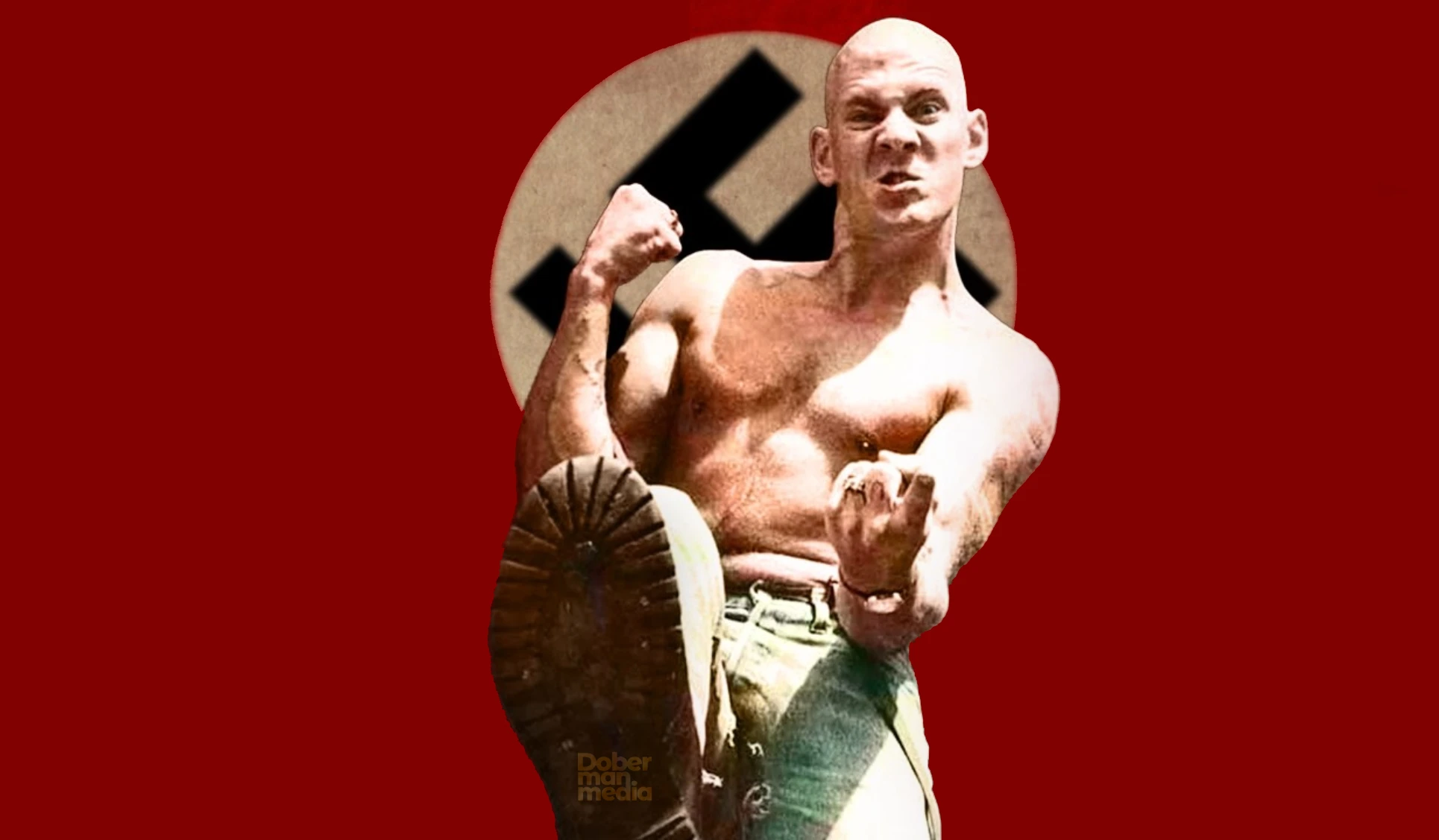

Britain in the 1970s–1990s was an arena of acute social conflict, economic upheaval, and an aggressive clash of subcultures. Against a backdrop of deindustrialization, the disintegration of traditional working-class neighborhoods, and growing social despondency, the country’s street culture became a breeding ground for radical political extremism. During this period, far-right groups waged a bitter war for influence against the radical left and antifascist movements, while an openly LGBT subculture was simultaneously emerging within London’s underground scene. In this turbulent atmosphere, Nicholas Vincenzo (Vincenzio) Crane (May 21, 1958 — December 7, 1993) occupies a wholly unique and valuable place for researchers. From the perspective of social anthropology and criminal biography, the study of Crane’s life reveals the workings of a profound ideological divide and extreme hypocrisy, demonstrating the stark contrast between public neo-Nazi violence and a secret life within the queer community.
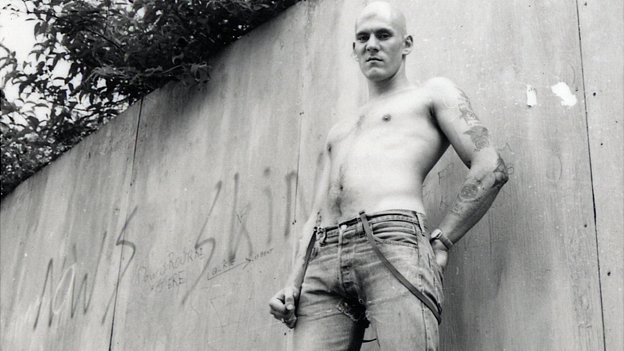
Crane is remembered in the history of British extremism as one of the fiercest and most feared street fighters on the far-right fringe. He served as an enforcer, leader of militant gangs, and the neo-Nazi movement’s principal media icon. At the same time, for many years he regularly visited and worked at London gay clubs, appeared in amateur pornography,* and took part in queer events.
Reddit users found at least 2 amateur porn films featuring Crane: one and two (links for adults only!).
This paradox produced one of the most striking examples of a double life in the history of British subcultures. Sociologically, Crane was not an isolated figure: he belongs alongside historical precedents such as Ernst Röhm in Nazi Germany and Martin Webster—one of the principal organizers of the British National Front in the 1970s, whose open homosexuality was paradoxically ignored by his associates. Such figures expose a systemic vulnerability within far-right movements, where homophobic rhetoric and a hypermasculine cult of strength coexist with the latent or secret presence of those who lead repressive street organizations.
To understand how this contradictory phenomenon developed, Doberman Media examined the origins of Crane’s socialization and the early stage of his radicalization.
Origins and Early Years: Family Background and Radicalization (1958–1970s)
Early socialization and a distinctive family environment played a decisive role in shaping Crane's attraction to subcultural radicalism. The search for a tough outward identity, the need to compensate for inner turmoil, and the desire for emotional protection through belonging to an aggressive group often drive teenagers toward extreme forms of street activity.
Nicola Crane was born in Bexley and grew up in Crayford, Kent, in a large working-class family with ten children. His father worked as a technical draftsman, while his mother was of Italian descent. In light of Crane's subsequent neo-Nazi activities, centered on ideas of racial purity and the superiority of the “white Aryan race,” his mother's partly immigrant, Italian background is a poignant historical irony, starkly illustrating the ideological blindness and incoherence of racial dogma.
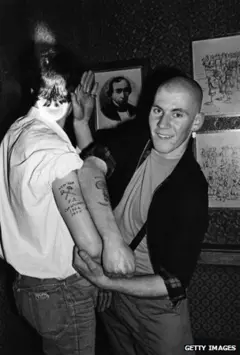
Crane entered the subcultural scene by adopting the skinhead style in 1969, when he was just 11 years old. From an anthropological perspective, it is crucial to distinguish the original skinhead movement of 1969 from its later far-right mutation. The original skinhead subculture emerged among Britain's white and Jamaican working classes, was apolitical, and was built around a love of ska, reggae, and soul music, as well as working-class pride (workwear, heavy Dr. Martens boots, braces, and neat haircuts). By the late 1970s, however, political recruiters from the National Front and the British Movement had deliberately reshaped part of this subculture into racist “boneheads” (boneheads).
The psychological factors that pushed the young Crane toward the far right included a yearning for a surrogate sense of “comradeship,” a need for approval from dominant street figures, and the opportunity to cultivate his physical strength as his primary means of asserting himself socially.
This subcultural fascination with outward symbols of strength quickly developed into direct involvement in organized neo-Nazi political activism.
Street Terror and the Structure of Neo-Nazism: British Movement and Leader Guard
In the late 1970s and early 1980s, Britain was swept by a wave of racist street violence. Against this backdrop, Crane rapidly became the far right's leading enforcer, earning a reputation among his contemporaries and law enforcement as the country's “most dangerous street fighter.”
In the late 1970s, Crane joined the British Movement (British Movement, BM)—an openly neo-Nazi organization that openly used Nazi symbols. By 1980, his pathological brutality and immense physical strength had enabled him to take charge of the BM organization in Kent. He soon joined the Leader Guard —the elite paramilitary wing and personal guard of BM leader Michael McLaughlin. Members Leader Guard wore black uniforms with Nazi symbols and party badges and conducted paramilitary drills in the countryside on weekends, preparing to physically eliminate political opponents and racial minorities.
Court records and chronicle accounts document key incidents of violence involving Crane:
- May 1978: An attack on a dark-skinned family at a bus stop near Liverpool Street station immediately after a British Movement rally. Crane was tried for taking part in the fight and disturbing the peace but received a suspended sentence and remained free.
- 1979: Organizing and leading an attack by a group of 200 skinhead boneheads on Pakistani and Bangladeshi immigrants in the Brick Lane area.
- March 28, 1980: A planned pogrom outside the Odeon cinema in Woolwich, targeting a predominantly Black line of moviegoers. During the trial, the prosecutor described the events as “a brutal, vicious, premeditated and organized riot.”
- 1980 (trial in 1981): A violent attack on a group of Black teenagers who had arrived by train at Woolwich Arsenal. Crane was sentenced to four years in prison for organizing this mass brawl.
- June 10, 1984 (Attack at Jubilee Gardens): Disruption of an anti-racist protest concert against unemployment on London's South Bank. During a performance by the far-left skinhead band The Redskins Crane's militants stormed the stage and started a brawl, but met with fierce resistance from activists of Red Action and striking miners from Yorkshire who had come to the concert. After the anti-fascists knocked him down, Crane regrouped his forces and attacked the second stage, where country singer Hank Wangford was performing. When the crowd once again overwhelmed the neo-Nazis, Crane grabbed a female activist as he fled and used her as a human shield, shielding himself from the blows.
The prison system failed to curb his aggression. While serving a four-year sentence handed down in 1981, he repeatedly attacked prison officers, leading to his transfer to a maximum-security prison on the Isle of Wight. In 1986, not long after his release, he was sentenced to another six months in prison for a vicious fight on a London Underground train.
Crane's reputation as a ruthless neo-Nazi “gladiator,” forged in street fights, made him an ideal subject for far-right propaganda, which turned his criminal persona into a cult media icon.
Cult status: Cover of Strength Thru Oi!, media image, and the far-right music scene
Crane's physical image—his clean-shaven head, massive muscular torso, and tattoos—was actively exploited by the far-right musical alliance of the Oi! movement and the network Rock Against Communism (RAC) to construct the normative image of the “Aryan warrior.”
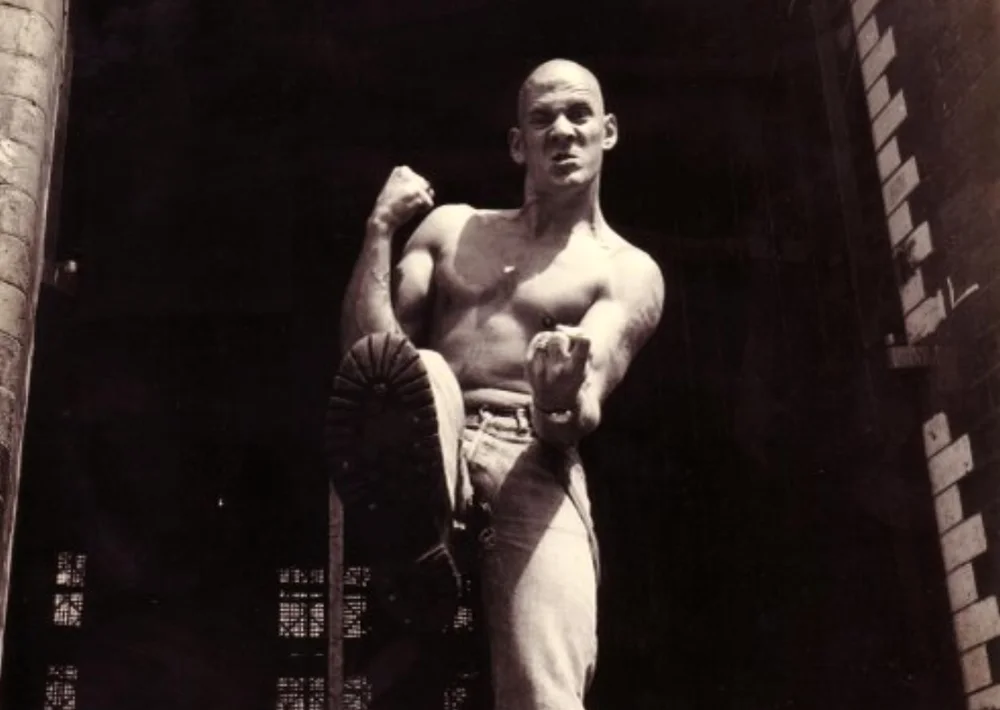
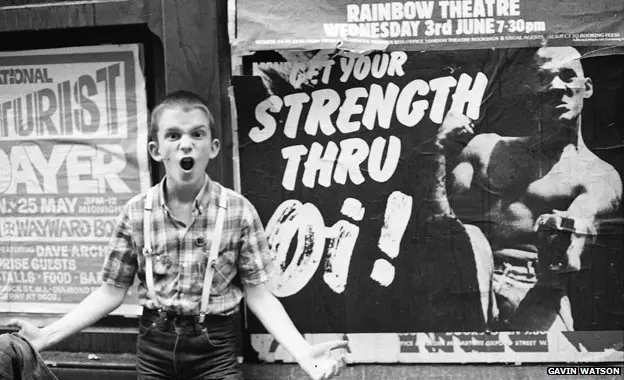
The most high-profile episode in Crane's transformation into a media icon was the story behind the cover of the music compilation Strength Thru Oi!, released in 1981 by Decca Records. A journalist for the weekly Sounds Garry Bushell, who oversaw the project, was looking for a striking visual embodiment of skinhead aesthetics. In his office hung a faded Christmas card featuring a young man with a shaved head and braces, photographed near the Woolwich pedestrian tunnel beneath the Thames. Bushell hastily and mistakenly assumed it was a still from the Hollywood street-gang film The Wanderers (The Wanderers). It was only when the original photograph was submitted for approval just before publication that it emerged that the man pictured was real-life neo-Nazi activist Nicky Crane, and that his body was covered in swastikas. In the rush to meet the print deadline, and rather than delay the release, the Nazi tattoos were airbrushed out and the record went on sale. When the national press exposed the model's identity and his recent convictions for racist violence, a huge scandal erupted. The label Decca Records hastily recalled the release from distribution, turning copies of the album into collectors' items.
Crane quickly parlayed the resulting notoriety into media celebrity:
- He became the official model for the iconic skinhead clothing shop The Last Resort на Гулстон-стрит в Олдгейте, рекламируя майки “Action Man 80s”, позируя для календарей и плакатов.
- It was Crane who established and popularized among the British far right the radical “shaven-headed bonehead” haircut (grade-0 bald).
- From 1984 onward, he headed security for the key far-right group Skrewdriver и стал ближайшим соратником ее лидера Иэна Стюарта Дональдсона. Крэйн оформил обложки альбомов группы, написал текст к песне “Justice” для диска Hail the New Dawn (and became the inspiration for its protagonist himself).
- In 1987, Crane and Donaldson co-founded the international neo-Nazi music and propaganda network Blood & Honour.
Comparison of N. Crane's public image and actual criminal and organizational status
| Public neo-Nazi image | Actual criminal/organizational status |
|---|---|
| Symbolism and aesthetics: A bonehead-style icon, a poster-boy “Action Man,” the face on the cover of Strength Thru Oi!, popularizer of the haircut grade-0 bald. | Criminal record: Convictions for racially motivated group assaults and riots (1978, 1980, 1984); served prison sentences on the Isle of Wight for attacks on prison officers. |
| Role in music: Head of security Skrewdriver, co-founder of the chain Blood & Honour, lyricist and album designer. | Organizational status: Leader of the militants Leader Guard, organizer British Movement in Kent, an enforcer at street demonstrations. |
Yet behind this imposing, monolithic facade of a neo-Nazi poster boy, another, carefully concealed side of his personality was developing in parallel.
Secret Life: Infiltrating London's Gay Community (1984–1990)
Crane's double life was built on extreme cognitive dissonance. He had been aware of his homosexuality since adolescence, but only began exploring same-sex relationships around 1984, at the age of 26, immediately after his release from a maximum-security prison.
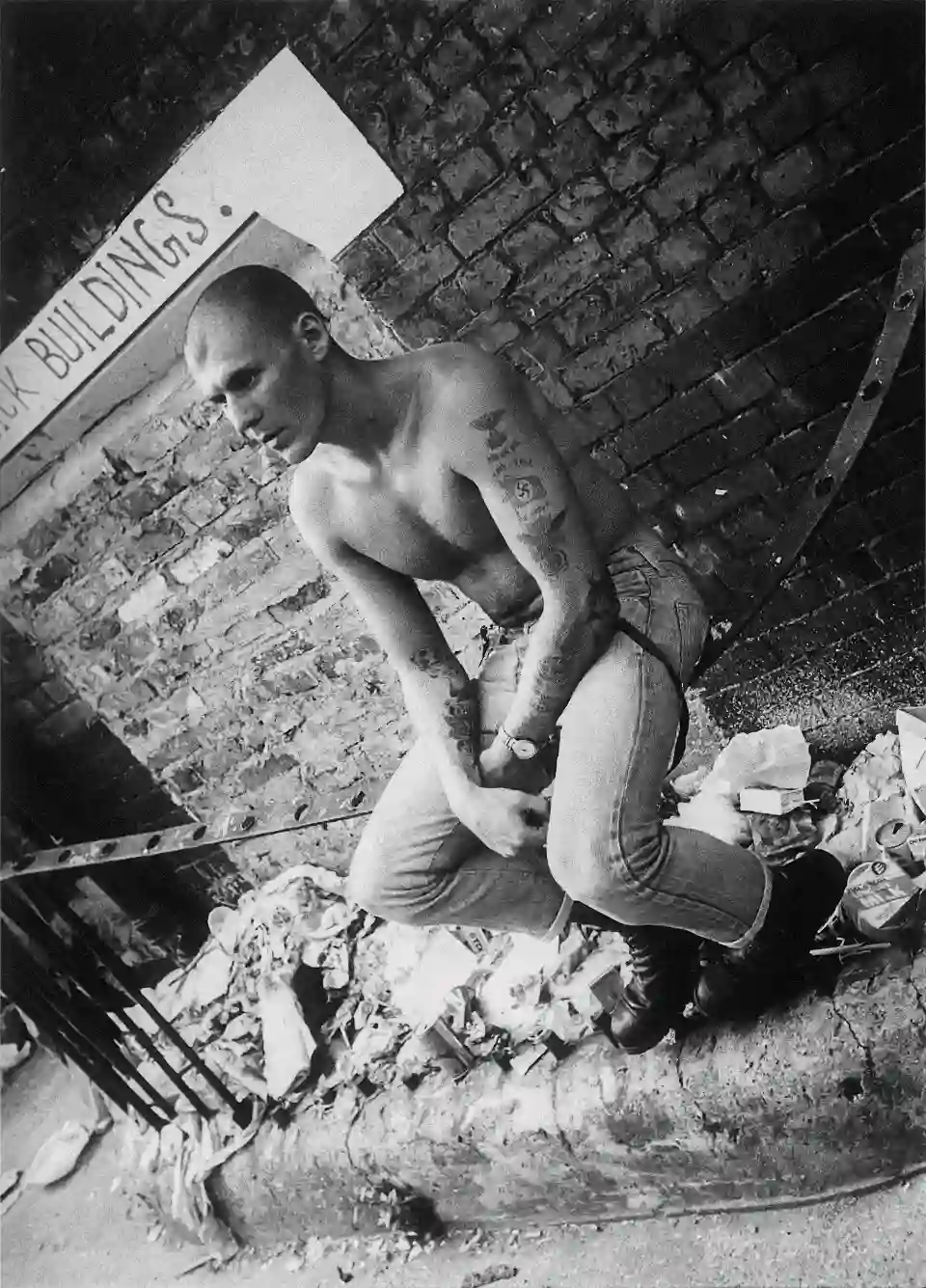
For more than six years, Crane immersed himself fully in both London's underground and openly gay scenes:
- Club scene: He was a regular patron and bouncer at the capital's leading gay venues, including the iconic club Heaven near Charing Cross station, and the club Bolts, pub The Bell in the Kings Cross area, as well as private BDSM/S&M clubs.
- Security work and community service: Crane was officially employed by the security agency Gentle Touch. In 1986, he even served as a steward maintaining order at the Gay Pride march in Kennington. When human rights campaigner Peter Tatchell and other activists learned of his Nazi past, it sparked a wave of protests.
- Media appearances: Крэйн снялся в музыкальном видеоклипе авангардной группы Psychic TV на трек “Unclean”, а также принимал участие в съемках любительских гей-порнографических фильмов. Чтобы прокормить себя, он также подрабатывал мусорщиком и велокурьером.
Maintaining such an exotic double life for so long was made possible by specific psychological and social defense mechanisms:
- Why the far right did not believe the rumors: When rumors reached the neo-Nazis that Crane had been seen at gay venues, Ian Stuart Donaldson and his associates accepted his explanations: Crane claimed that he was working there solely under contract for an agency Gentle Touch as a hired security guard. Moreover, Crane's fearsome reputation terrified his associates so much that no one dared ask him direct questions for fear of physical violence. To maintain the façade, he occasionally appeared in public with women posing as his partners and spread rumors that he had an illegitimate son.
- Why the gay community did not perceive the threat: A hypermasculine fetish subculture was rapidly developing in London's queer scene in the 1980s. Many saw the swastikas and racist tattoos on Crane's hulking body not as a declaration of genuine fascism, but as an element of extreme fetishism, a sexual kink, or a provocative performance.
The anti-fascist magazine Searchlight twice attempted to expose Crane, publishing exposés in April 1985 and October 1987. They described in exhaustive detail his regular presence at the club Heaven, cited attempts to form a group of “homosexual skinheads,” and characterized Crane himself as a “clinical psychopath.” However, the far-right leadership chose to dismiss the articles as “hostile disinformation from leftists.”
The turning point came in 1990, when a group of anti-fascist activists happened to recognize Crane on the street and brutally beat him unconscious (three of his attackers later received prison sentences). This incident, combined with mounting inner exhaustion, prompted Crane to begin gradually distancing himself from the neo-Nazi movement.
Maintaining a balance between two irreconcilable worlds became impossible, and the situation was rapidly heading toward a resolution.
The 1992 Coming Out: Stepping Out of the Shadows and the Reaction of His Comrades
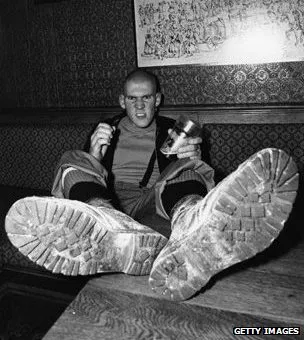
29 июля 1992 года наступил поворотный момент в истории Ники Крэйна. На Channel 4 вышел выпуск “Skin Complex” телевизионного альманаха Out, in which Crane publicly came out. On national television, he openly acknowledged that he was gay, saying that he had been aware of his sexuality since the early days of his involvement in the British Movement. Crane publicly expressed remorse for the racist violence he had committed, admitted that his former blind worship of Hitler had given way to deep shame, and declared that he had come to see people as individuals, rendering racial and ethnic criteria entirely meaningless.
The mass media reacted immediately. The British tabloid The Sun ran a scathing front-page story with the mocking headline “Nazi Nick is a Panzi” (“Nazi Nick is a fag”). The article was illustrated with the well-known photograph of a snarling, shaven-headed Crane, shirtless and wearing suspenders, faded jeans, boots with white laces, and holding an axe. It ended with a quote from him:
“That's all in the past; I've changed dramatically.”
For the far-right camp, this interview came as a devastating blow. The neo-Nazi leadership was overcome by a profound sense of humiliation and betrayal. The group's leader Skrewdriver Ian Stuart Donaldson publicly disowned his former associate, issuing explicit death threats in the press and at concerts:
“I feel more betrayed by him than by anyone else. This simply shows that nationalism and homosexuality are incompatible, because nationalism is a genuinely right-wing cause, while homosexuality is a perversion.”
After coming out, Crane found himself in a complete social vacuum. His former neo-Nazi brothers sentenced him to death, declaring him a “legitimate target,” while the antifascist movement and the LGBT community refused to forgive him for years of racist terror, street violence, and the physical injuries inflicted on their supporters.
Final Years, Illness, and Death (1992–1993)
Having become an outcast among every subcultural and political group without exception, Crane made desperate attempts to escape his own past. During the final months of his life, he regularly traveled to Thailand—a place where no one knew him and where, at least for a short while, he could escape the fear of revenge from his former associates from Blood & Honour.
His physical condition deteriorated rapidly. In the early 1990s, Crane was diagnosed with HIV/AIDS. On December 7, 1993, Nicola Vincenzo Crane died in Paddington, London, at the age of 35 from pneumonia caused by complications of AIDS. His death came just a few months after that of his principal ideological ally and enemy, Ian Stuart Donaldson, who was killed in a car crash in September of that same year.
Crane's life story left a profound mark on the history of British street culture, becoming a vivid case study in the anthropology of extremism. His persona and the phenomenon of his double life became the central theme and inspiration for characters in Max Schaefer's novel Children of the Sun (2010), which explores in detail the allure of far-right aesthetics and the hidden mechanisms of same-sex desire within neo-Nazi circles.
The story of Nicky Crane is more than just a biographical account of a street fighter and crime boss; it is a profound anthropological case study. It lays bare the deep-seated insecurity, self-loathing, and utter hypocrisy at the heart of extremist ideologies. For fourteen years, Crane channeled his inner conflict and denial of his own identity into outward violence, maiming and destroying the lives of innocent people in the name of an ideology that regarded him as a “degenerate” who deserved to be physically exterminated.
The ultimate lesson of Nicholas Crane's fate is that an ideology of tribal hatred and absolute intolerance is inherently self-destructive. When a person's true identity breaks through, the machinery of repressive violence they themselves created inevitably turns against its creator, leaving them utterly alone in the face of inevitable ruin.






0 comments
Enter your email and we will send you a one-time code. No passwords, no accounts.
Code sent to
If the email does not arrive in your inbox within a few minutes, check your Spam, Junk or Promotions folder — some mail services may wrongly place automated messages there.