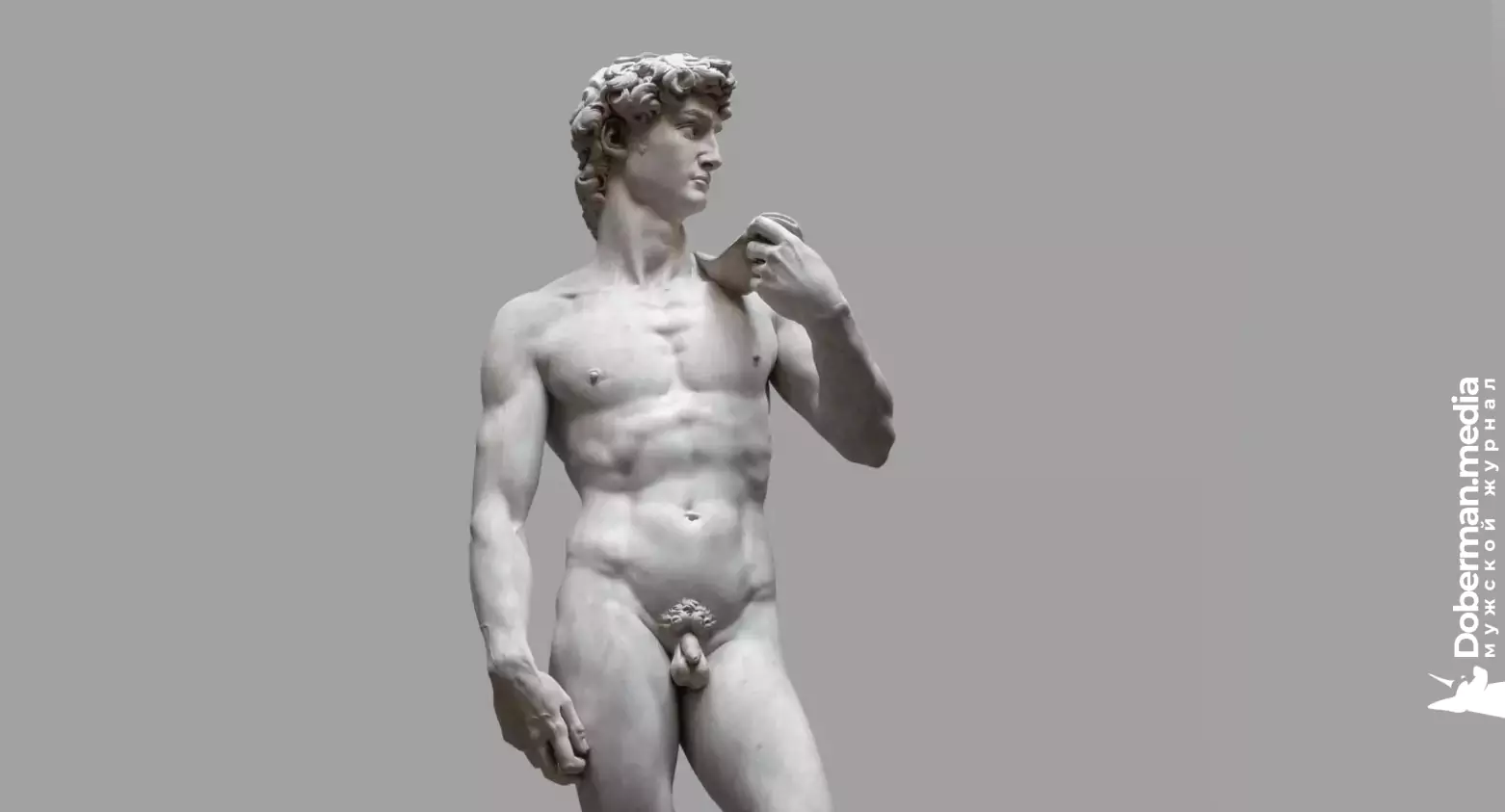

During the Renaissance, sex between men was formally punishable by death, yet in Florence nearly half the population may have engaged in such practices. However, these Renaissance practices should not be compared with the modern LGBTQ+ movement: they constituted a rigid social institution steeped in patriarchal hierarchy, the inaccessibility of women, and deep misogyny.
Drawing on a lecture by art historian Artur Chekh, we explore how ancient myths served as Renaissance “sexting,” why displaying one’s legs was considered a male privilege, and how Michelangelo used a drawing to declare his love.
Double Standards: The Death Penalty and the Institution of Mentorship
In the 15th and 16th centuries, Florence experienced rapid advances in science and art, gradually emerging from the religious Middle Ages. A strange contradiction arose within society: sex between men was punishable by death or fines, yet almost every other man slept with youths, and few tried to hide it.
This model derived directly from the ancient traditions of Greece, where sex with youths was regarded as a marker of masculinity, authority, and dominance. The logic was strictly patriarchal: the receptive (passive) role was viewed as effeminate and feminine.
In Italy, a distinct age-based social ritual emerged:
- Young men (up to the age of 18–20) served as passive partners and effectively as “wives” to older patrons, receiving money, work, and social connections from them.
- Upon reaching the age of 20 these same young men became “active partners” and entered into relationships with younger boys.
- By the age of 30–32 (the average age at marriage), men readily married women, and their previous same-sex relationships carried no stigma.
Such practices were also widespread among the clergy: priests often engaged in petting and sodomy with one another and with parishioners inside churches during services.
Misogyny and the Inaccessibility of Women
The prevalence of same-sex relationships was explained not only by social institutions, but also by the structure of everyday life at the time:
- The inaccessibility of women: young women rarely went out in public without the supervision of relatives, and losing one's virginity before marriage was considered shameful.
- Male spaces: men and young men spent all their time together—they worked in workshops, relaxed in clubs, bathed naked in bathhouses, and constantly saw one another's bodies.
- Radical misogyny: women were considered intellectually, physically, and emotionally inferior. Drawing on Aristotle, who claimed that “a woman is an imperfect copy of a man,” patriarchal culture regarded the male body as the ideal of beauty and perfection.
Вопреки стереотипу о том, что «все художники Ренессанса были геями», исторические данные показывают, что среди живописцев таких было не более 3%. Чаще всего в содомии обвиняли представителей рабочего класса (портных, музыкантов, барменов), однако во Флоренции в подобные практики были вовлечены более 50% знатных семейств, которым удавалось скрывать следы с помощью подкупов.
Mythology as the “sexting” of the 16th century
Since society was fascinated by classical mythology, same-sex stories were regularly used as a language of innuendo and declarations of love.
The myth of Jupiter and Ganymede became a central theme—the story of a young shepherd whom the god, in the form of an eagle, carried off to Mount Olympus. The misogynists of the time were delighted by the fact that, for Ganymede's sake, Jupiter dismissed his own daughter Hebe from her position as cupbearer and replaced her with the young man.
In 1532, the 57-year-old Michelangelo, whose attraction to men was widely known, drew “The Rape of Ganymede” for the young nobleman Tommaso Cavalieri. In the drawing, the eagle embraces the young man with its wings, while its pelvis is positioned directly behind the youth's buttocks, suggesting penetration. In the context of the time, this was the direct equivalent of modern-day “sexting” and a declaration of love.
Other masters also used similar motifs:
- Correggio depicted Ganymede with a flirtatious gaze, suggesting flirtation and mutual consent.
- Benvenuto Cellini sculpted a youth petting an eagle.
- In Angelo Poliziano's play about Orpheus, men were explicitly urged to abandon their wives and children for a life with beautiful youths.
Phallic arrows and men's miniskirts
The symbolism of same-sex love also permeated religious art:
- Saint Sebastian: in the works of Sandro Botticelli and other masters, the saint's body was depicted in a markedly aestheticized manner, while his face conveyed not agony but the ecstasy of being pierced by phallic arrows.
- Statues of David (Donatello and Verrocchio): the sculptures of youths emphasized rounded forms, thighs, and bare legs.
- Men's legs as an erotic object: until the twentieth century, displaying bare legs was an exclusively male privilege—it was for men that stockings and miniskirts emphasizing the calves and buttocks were created.
- Gestures of possession: in Raphael's frescoes at the Villa Chigi, Jupiter takes Cupid by the chin—during the fifteenth and sixteenth centuries, this gesture was unmistakably understood as an invitation to a love affair.
Italy versus Northern Europe
The liberal Italian model was unique in Europe. In the north of the continent, these subjects were treated much more conservatively:
- In France the myth of Ganymede was interpreted exclusively as an allegory of the human soul's love for God, while the favorites of King Henry III were ridiculed.
- In the Netherlands until the seventeenth century, images of Ganymede served as memorial portraits of children who had died young (the sole exception was Peter Paul Rubens).
The Renaissance culture of Florence proves that same-sex relationships have existed throughout every era of human history. At the time, however, they represented not a personal identity or lifestyle, but a rigid social order and hierarchy that left an enormous mark on the world's visual art.








0 comments
Enter your email — we’ll send you a one-time code. No passwords or accounts.
Code sent to
If the email doesn't appear in your inbox within a few minutes, check your spam, junk, or promotions folder, as some email services may mistakenly place automated messages there