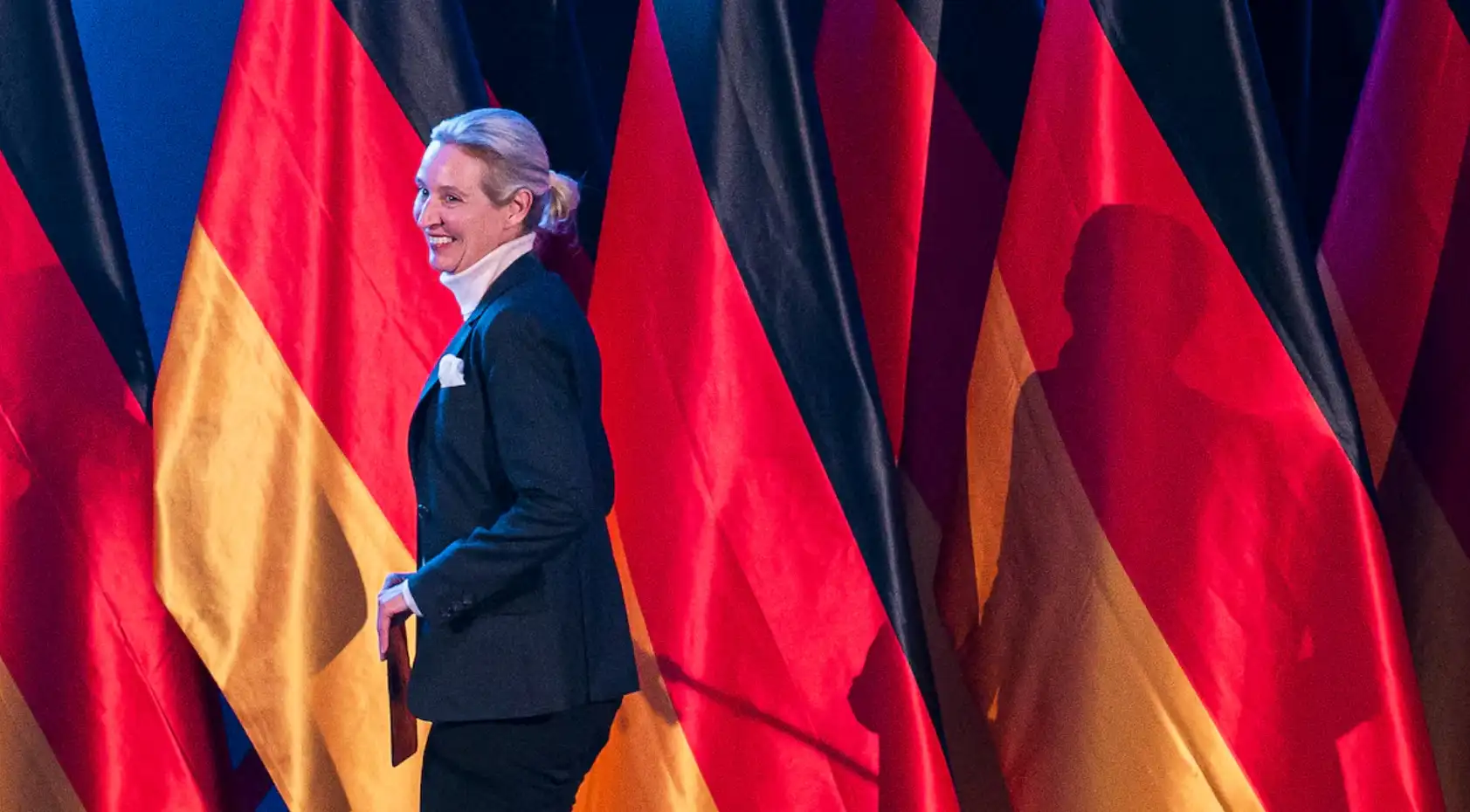

В Германии крайне правые силы популярнее, чем когда-либо. 6 сентября «Альтернатива для Германии» (AfD) получила 43,8% голосов в земле Саксония-Анхальт, показав лучший результат на выборах в Германии со времен Второй мировой войны.
The central paradox of modern German politics remains the figure of the co-chair of the far-right party Alternative for Germany (AfD) Alice Weidel. As a candidate for chancellor and the public face of a party promoting a hard-line anti-immigration and anti-LGBT+ agenda, Weidel herself leads a life that directly contradicts her own organization’s ideological dogmas. This is highly reminiscent of someone or something. Isn’t it?
Alice Weidel is openly lesbian and is in a registered partnership. Her legal spouse is an immigrant, a woman originally from Sri Lanka.
Together, they are raising two adopted children. And the cherry on top of this cake of hypocrisy: this champion of “German greatness” and the purity of the nation prefers not to live in her native Germany, but has instead made a comfortable home for herself in Switzerland.
Table of Contents
1. A private life at odds with party doctrine
Alice Weidel is openly lesbian. Since 2009, she has been in a registered same-sex partnership with Sarah Bossard — a film producer who was born in Sri Lanka and adopted by a Swiss family as a child. Together, they are raising two sons. Her family lives in the Swiss municipality of Einsiedeln, while Weidel works in Berlin and is registered as a resident in Germany.
At the same time, the AfD's official platform espouses values that deny the very foundation of Weidel's relationship:
- Family model: The AfD party manifesto officially defines the family exclusively as the traditional union of a father, mother, and children.
- LGBTQ+ rights: The party is staunchly opposed to marriage equality («Ehe für alle») and to expanding the rights of the LGBTQ+ community.
- Education: The AfD calls for a complete ban on sex education programs and lessons on sexual diversity in schools.
Weidel herself says that she supports only civil partnerships and opposes full marriage rights for same-sex couples. In defending her position, she invokes the maxim «Family is where the children are,» while also stating that she will not allow anyone promoting «gender ideology» or early sex education near her children.
2. Marriage to an immigrant woman amid the fight against migrants
The second layer of contradictions is the AfD’s hard-line anti-immigrant stance. The party built its popularity on demands for “remigration” (mass deportation), an end to social benefits for foreigners, and severe restrictions on immigration.
At the same time, Weidel’s legally recognized partner is a native of Sri Lanka, while the leader of Germany’s nationalists has established her family life outside Germany—in Switzerland.
3. A “fig leaf” and political calculation
Human rights advocates and experts call Weidel “the perfect fig leaf” for the far right. As Evelyna Chaika, founder of the European LGBTQ rights organization EQUAL PostOst notes, the AfD cynically uses Weidel as a trump card: when the party is accused of xenophobia, racism, or homophobia, its leadership points to an openly lesbian woman with a partner of foreign origin as “proof of diversity.”
Human rights advocates view Weidel’s conduct as cynical political calculation and an “illusion of immunity.” Queer people in positions of power who use homophobic rhetoric often sincerely believe that their high status will personally shield them from their own party’s repressive measures.
4. Fearmongering: “Islam as the Main Threat”
When asked how her identity aligns with leading an anti-LGBT+ party, Weidel gives a paradoxical answer: she is a member of the AfD because of, not in spite of, her homosexuality.
Weidel promotes the narrative that the main threat to gays and lesbians in Germany comes not from her colleagues’ far-right ideology, but from mass migration and “Muslim gangs.” By shifting the focus to anti-Islam rhetoric, she justifies aligning herself with far-right forces that advocate restricting the rights of sexual minorities.
Alice Weidel enjoys all the benefits of a liberal state governed by the rule of law, including the right to a same-sex partnership and international mobility in Switzerland. Yet in Germany’s political arena, she leads a movement whose victory directly threatens to strip tens of thousands of other people of those very same rights.
The Third Reich and the AfD Party
The claim that the Alternative for Germany party (AfD) was founded by Nazis, historically speaking, is неверно. The party was founded by respected economists, professors, and lawyers with moderate conservative views. The party's founders created it solely to criticize the euro currency. But by 2015–2017, the intellectuals had been completely pushed out of the leadership. Radical national populists seized power within the AfD, shifting the focus to a hard-line anti-immigration and ethnic agenda.
Over its 13 years of existence, the party has shifted to the far right, flirted with neo-Nazis, and used prohibited rhetoric; in German society, it is often described not merely as a populist force, but as a neo-fascist one.
A number of the party's key figures also openly use language that evokes the era of the Third Reich.
Björn Höcke (one of the AfD's most influential leaders and head of its Thuringia branch) was formally fined by a court for knowingly using the banned Nazi slogan of the SA stormtroopers (“Everything for Germany!”). A German court also officially allowed Höcke to be publicly called a “fascist.”
Alexander Gauland (the party's former leader) publicly stated that the Nazi period was merely “a speck of bird shit in more than 1,000 years of successful German history,” sparking widespread outrage.
For decades, Germany built its democracy on acknowledging and atoning for the guilt of Hitler's crimes. Today's AfD (especially its eastern branches) openly opposes this, calling the government's policy a “cult of guilt.” They are demanding fewer lessons about the Holocaust in schools and an end to the “denigration” of German history.
Secret ties to neo-Nazis. In early 2024, investigative journalists from Correctiv revealed information about a secret meeting between AfD officials and prominent neo-Nazi activists in Potsdam. At the meeting, they discussed a “remigration” plan—the forced deportation of millions of people, including German citizens with migrant backgrounds. The public saw this as a direct parallel to the Nazis’ plans of the 1930s.
Officially designated as extremists. Germany’s Federal Office for the Protection of the Constitution (BfV) officially classifies the AfD’s youth wing, as well as its regional branches in Saxony, Thuringia, and Saxony-Anhalt how as “confirmed right-wing extremist organizations”. The party itself is officially suspected of extremism at the federal level.
Recommended reading:
The Insider’s report on Alice Weidel’s political career and life
The Times of India article profiling Alice Weidel’s political persona
Alice Weidel’s detailed biography on Wikipedia
El País article on the phenomenon and contradictions of the AfD leader
Indian Express overview of the party's political success and its leader







0 comments
Enter your email — we’ll send you a one-time code. No passwords or accounts.
Code sent to
If the email doesn't appear in your inbox within a few minutes, check your spam, junk, or promotions folder, as some email services may mistakenly place automated messages there