

Publications in the Russian media about the rise in sexually transmitted infections (STIs) in Europe have long since become a genre of political feuilleton. Instead of an impartial analysis of reports by the European Centre for Disease Prevention and Control (ECDC), the reader is offered an ideological construct, where medicine serves merely as a screen for demonstrating traditionalist dogmas.
A vivid example of this approach — a Life.ru article with comments from infectious disease specialist Elena Meskina. In the text, a diagnosis is made of European healthcare not on the basis of epidemiological maps or infrastructural failures, but through the stigmatization of migrants and queer communities.
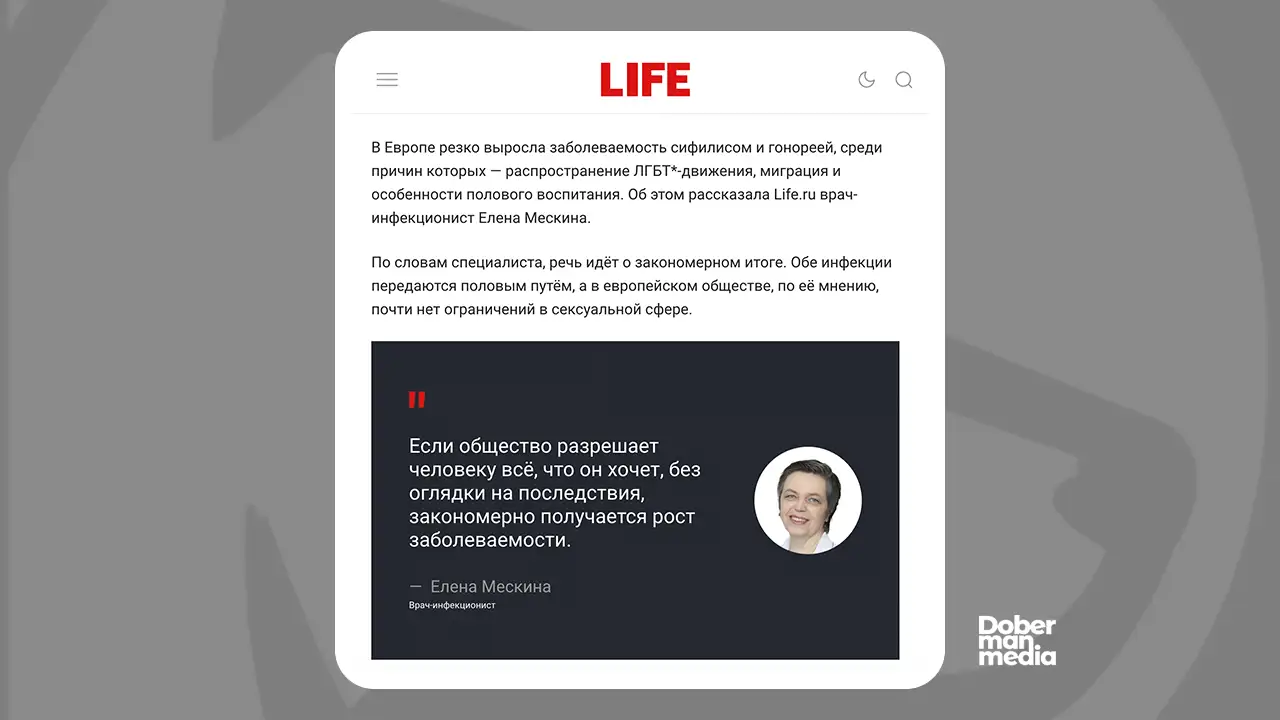
Doberman.media examines how Russian propaganda turns epidemiology into xenophobia and a tool for pressure on LGBT people in Russia.
What is stated in the report of the European Centre for Disease Prevention and Control (ECDC)
European Centre for Disease Prevention and Control (ECDC) published in May 2026 data containing key epidemiological reports on bacterial sexually transmitted infections (STIs) for 2024
- Gonorrhea: Recorded 106 331 cases in EU/EEA countries (rate — 26.9 per 100,000 population). This is an all-time high in the history of European surveillance since 2009. Compared with 2015, the increase was more than 300%.
- Syphilis: Registered 45 577 cases (about 10.8 per 100,000 population). Over the past 10 years, rates have more than doubled.
- Congenital syphilis: A worrying increase was recorded — from 78 cases in 2023 to 140 cases in 2024 in reporting countries.
Who is at risk and how the transmission patterns are distributed:
Да, мужчины, практикующие секс с мужчинами (МСМ), по-прежнему составляют значительную долю заболевших (около 62% по гонорее и 69% по сифилису там, где указана категория передачи). This is driven by the active involvement of the queer community in regular medical surveillance programs and community testing.
However, ECDC separately notes a steady rise in incidence among the heterosexual population (including women of reproductive age), which refutes primitive attempts to blame everything solely on the "homosexual movement".
Myth one: “Anything goes” versus systematic screening
The main point of the article comes down to the claim that in European society there are “almost no restrictions in the sexual sphere”, which allegedly leads to disaster. This argument ignores the basic principles of epidemiology.
- The paradox of testing accessibility: The rise in registered STI cases in ECDC reports reflects not so much an epidemic surge as a colossal expansion of screening programs. In Western and Northern European countries, testing for gonorrhea, chlamydia, and syphilis is part of routine medical care. It is available free of charge in community centers, sexual health clinics, and through insurance.
- Evidence-based prevention: Access to pre-exposure prophylaxis (PrEP) and regular testing among vulnerable groups means infections are detected at an early stage. In health systems with limited testing access (where stigma and silence prevail), the numbers may look "better" simply because the disease is not being diagnosed, not because it is absent.
Shifting the blame to an abstract "anything goes" culture erases the fact that the rise in rates is driven by the lack of barrier contraception among young people, cuts to budgets for some social programs in a number of regions after the pandemic, and the post-COVID increase in the number of contacts.
Myth Two: Scapegoats — LGBT people and migrants
Linking epidemiological trends to the "spread of the LGBT movement" and migration from Africa and Asia is a favorite tactic of conservative punditry that does not hold up under factual scrutiny.
- Institutional xenophobia: The claim that migrants "bring in" infections from regions with "weak medicine" ignores the barriers refugees face in accessing medical care. According to European researchers, migrants are more often themselves affected by the lack of access to prevention and by language barriers, rather than serving as the "main spreaders".
- Real profile of vulnerability: The impact of STIs on the queer community is driven not by "immorality" but by concrete social factors: the historically necessary struggle for their rights, the creation of specialized mutual-aid networks, and the development of community medicine, which actively encourages testing. Shifting responsibility for the Europe-wide rise (where the bulk of cases traditionally occurs among heterosexual couples in young age groups) onto queer people is classic victim blaming.
References to "traditional Muslim societies," where the spread of diseases is supposedly curbed by prohibitions, ignore the secrecy of such communities, the latent nature of epidemics under conditions of intense social pressure, and the lack of reliable statistics in places where sex outside marriage or homosexuality are criminalized.
A scientific view against moralizing
In the publication, an infectious disease specialist claims that the "most reliable protection" is traditional marriage with mutual fidelity. Of course, monogamy reduces the risk of infection, but reducing public health prevention policy to moral sermons is a recipe for failure.
- Real prevention works differently: Effective harm-reduction strategies include uncensored sex education, free access to condoms and lubricants, regular testing, and early treatment with antibiotics.
- Antibiotic resistance: The real challenge facing modern European (and global) medicine is not "politics," but gonococcus resistance to standard treatment regimens. Strains with multidrug resistance require ongoing investment in pharmacology, not moral lectures about traditional values.
Articles like this on Life.ru serve a purely psychotherapeutic function for the conservative viewer: they create the illusion of their own superiority ("we don't have that here") by demonizing their neighbors.
For a modern open society, rising STI rates are a signal to strengthen clinics, expand free distribution of protective supplies, and invest in education. For propaganda, it's yet another excuse to target marginalized groups. Real epidemiology is treated with medicine, science, and open dialogue, not moralizing and fear of freedom.









0 comments
Enter your email — we’ll send you a one-time code. No passwords or accounts.
Code sent to
If the email doesn't appear in your inbox within a few minutes, check your spam, junk, or promotions folder, as some email services may mistakenly place automated messages there