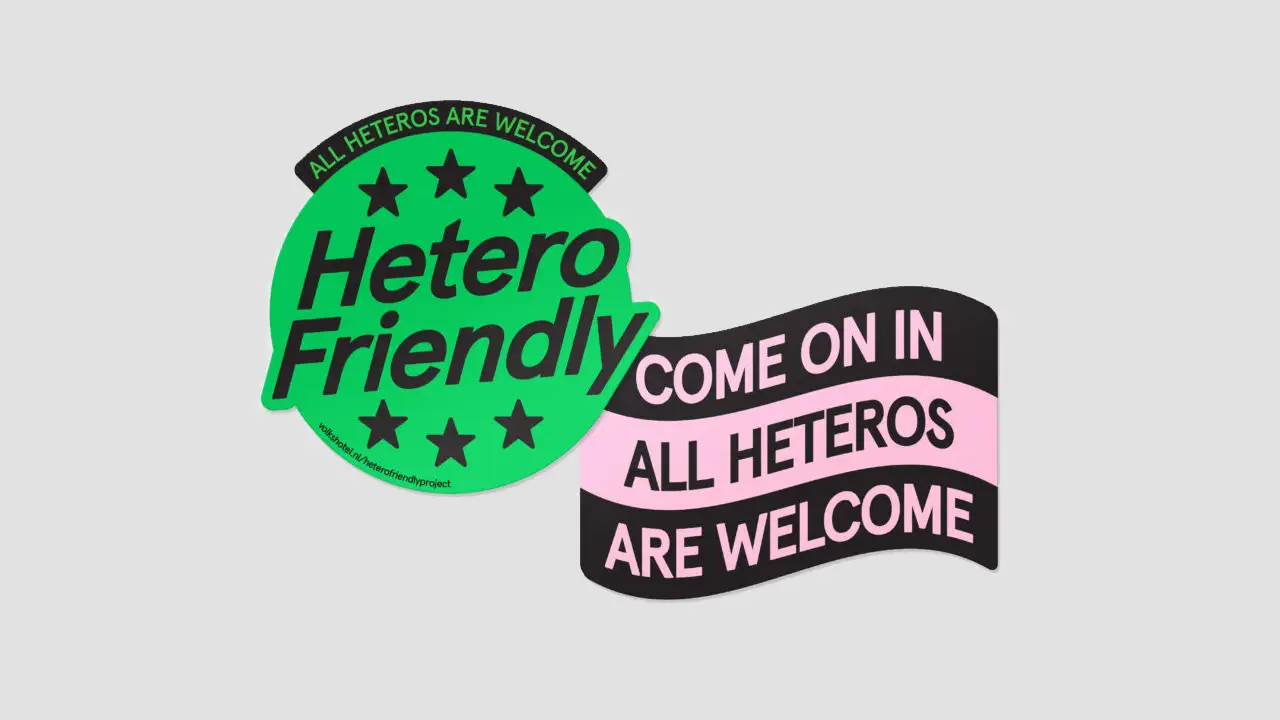

Recently, in some LGBTQ+ spaces — from bars to cultural centers — signs with the inscription have started to appear “Hetero friendly”. It sounds ironic: after all, most public places in the world are already geared toward heterosexual people. However, behind this phrase is an attempt to turn the usual logic of “safe spaces” upside down and draw attention to the problems of the queer community.
Where did this come from?
This phrase emerged as an ironic response to the popular “LGBTQ+ friendly” marker, which businesses use to identify themselves as safe and open to everyone.
For example, in 2022 the Amsterdam hotel Volkshotel officially launched a “hetero friendly” label ahead of Pride. The organizers said that in an ideal world such labels should not exist at all, because everyone should be treated with respect regardless of orientation.
Using a “reverse” label is a way to show the absurdity of the situation, when a certain group of people has to look for special stickers on doors just to feel safe.
Why is this needed if the world is already so “friendly” to heterosexuals?
For LGBTQ people, specialized bars and clubs are not just places to party, but “safe spaces” (safe spaces) where they can be open about who they are. This is especially important in countries where homosexuality is still stigmatized.
The sign “friendly to heterosexuals” carries several important messages:
- A reminder that you’re a guest. Heterosexual visitors are welcome, but they are made to understand that they are on queer community territory and should respect its rules and culture.
- Dealing with disrespectful behavior. Sometimes heterosexual guests in gay bars act without restraint, not understanding the specifics of the place. The sign encourages them to be more aware.
- Role reversal. This gives heterosexuals a rare opportunity to feel what it’s like to be a minority. It’s a kind of social experiment: a person sees that the space is “friendly” to them, and understands that in ordinary society LGBT+ people are constantly looking for the same reassurance of their safety.
Isn’t that discrimination against heterosexuals?
Representatives of the community emphasize that such signs are a social statement, not a real restriction of rights. This is not an attempt to drive out or segregate heterosexual people, but a way to emphasize that this place belongs first and foremost to the community.
Essentially, it is a call for solidarity: by entering such a place, a guest agrees that “safe spaces” are not something self-evident, but the result of a long struggle for the right to be oneself. As organizers of such actions note, the goal is to wait until the day when no “friendly” labels (for anyone) will be needed anymore.








0 comments
Enter your email — we’ll send you a one-time code. No passwords or accounts.
Code sent to
If the email doesn't appear in your inbox within a few minutes, check your spam, junk, or promotions folder, as some email services may mistakenly place automated messages there