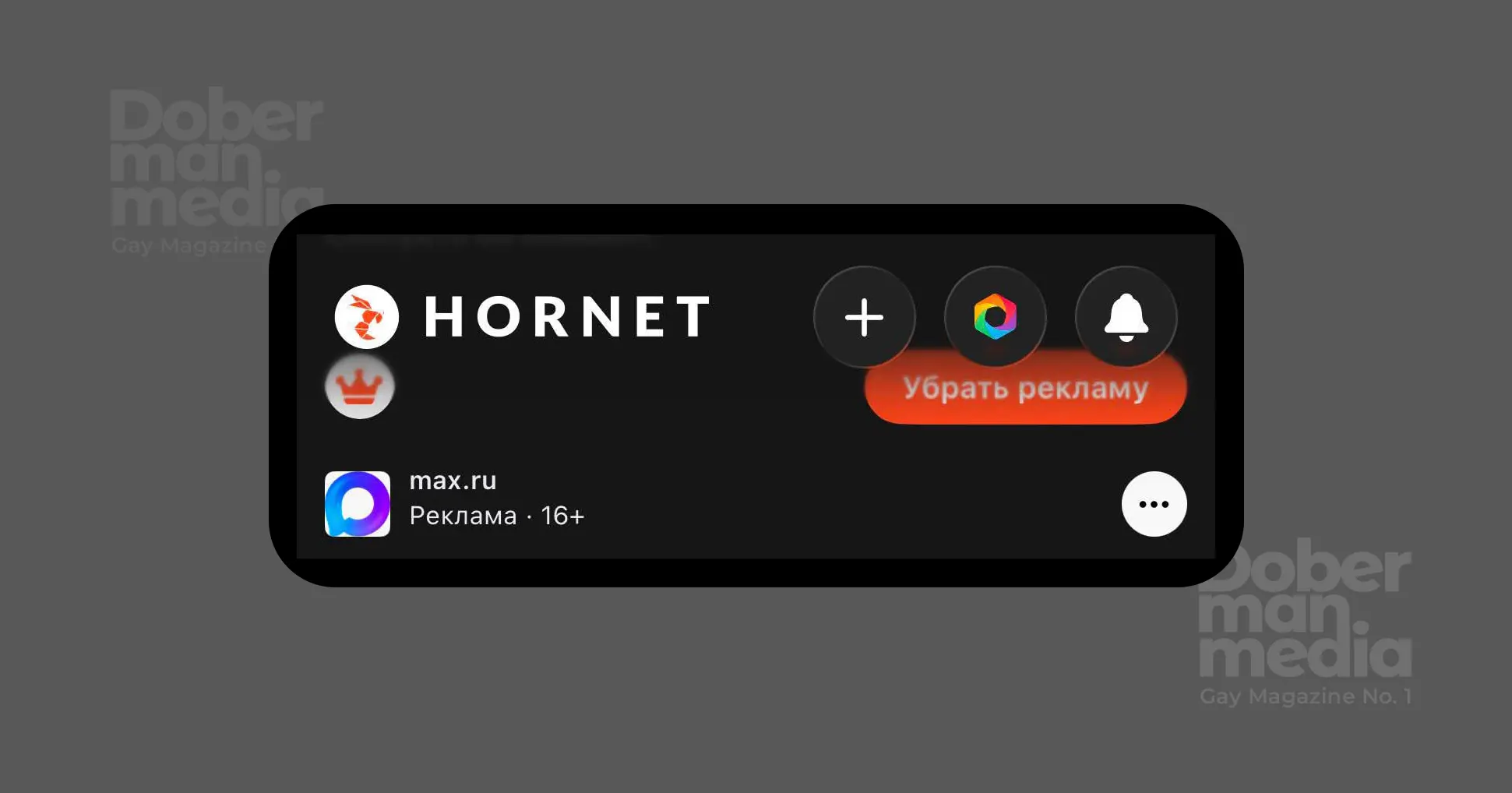
Hornet users noticed an advertisement for the Russian MAX service in the largest international dating app for gay and bisexual men Hornet. After a request from Doberman.media, the Hornet administration conducted an internal audit and stated that the ads were removed and their further display on the platform was blocked.
In June, Hornet users began reporting ads for the MAX app. Screenshots of the ads were posted on social media and raised questions about how the Russian service ended up on a platform aimed at LGBTQ audiences.
MAX was launched with the support of the Russian authorities as a national digital platform. Critics of the project point to the risks of privacy and potential government control over user data. This is of particular concern among LGBTQ people, given the increasing pressure on the community in Russia.
After discovering the advertisement, the editors of Doberman.media turned to Hornet for clarification.
In response to the editors, Hornet Ad Monetization Manager Pedro Moreno said that the company began an internal audit immediately after receiving an appeal from Doberman.
"We immediately initiated an internal review and took action with our advertising partners to remove this advertiser and prevent it from appearing on the Hornet in the future."
Hornet explained that some of the ads are placed through automated programmatic advertising networks, where thousands of advertisers participate at the same time. According to the company, the platform's management was not aware of the presence of this advertising campaign before receiving a request from Doberman.media.
Hornet also stressed that the platform is committed to providing a safe space for LGBTQ communities around the world and is considering ads that may contradict this mission.
Hornet confirmed that the MAX ad appeared on the platform through third-party advertising mechanisms and was removed after being contacted by our media.
Context. In May 2026, an information security researcher published the results of an analysis of the Android version of MAX. According to him, the application contains mechanisms that allow you to determine the use of VPNs, collect additional data about the device, and perform actions that raise serious questions among digital security specialists.
Later, some of the conclusions were confirmed by an independent technical analysis by the human rights organization RKS Global. Of the 25 problems claimed, experts have fully confirmed 14 and partially confirmed several more. The developers of MAX denied the accusations.
Experts also draw attention to the lack of full-fledged end-to-end encryption by default and the fact that user data can potentially be accessed by the server infrastructure inside Russia.








0 comments
Enter your email — we’ll send you a one-time code. No passwords or accounts.
Code sent to
If the email doesn't appear in your inbox within a few minutes, check your spam, junk, or promotions folder, as some email services may mistakenly place automated messages there