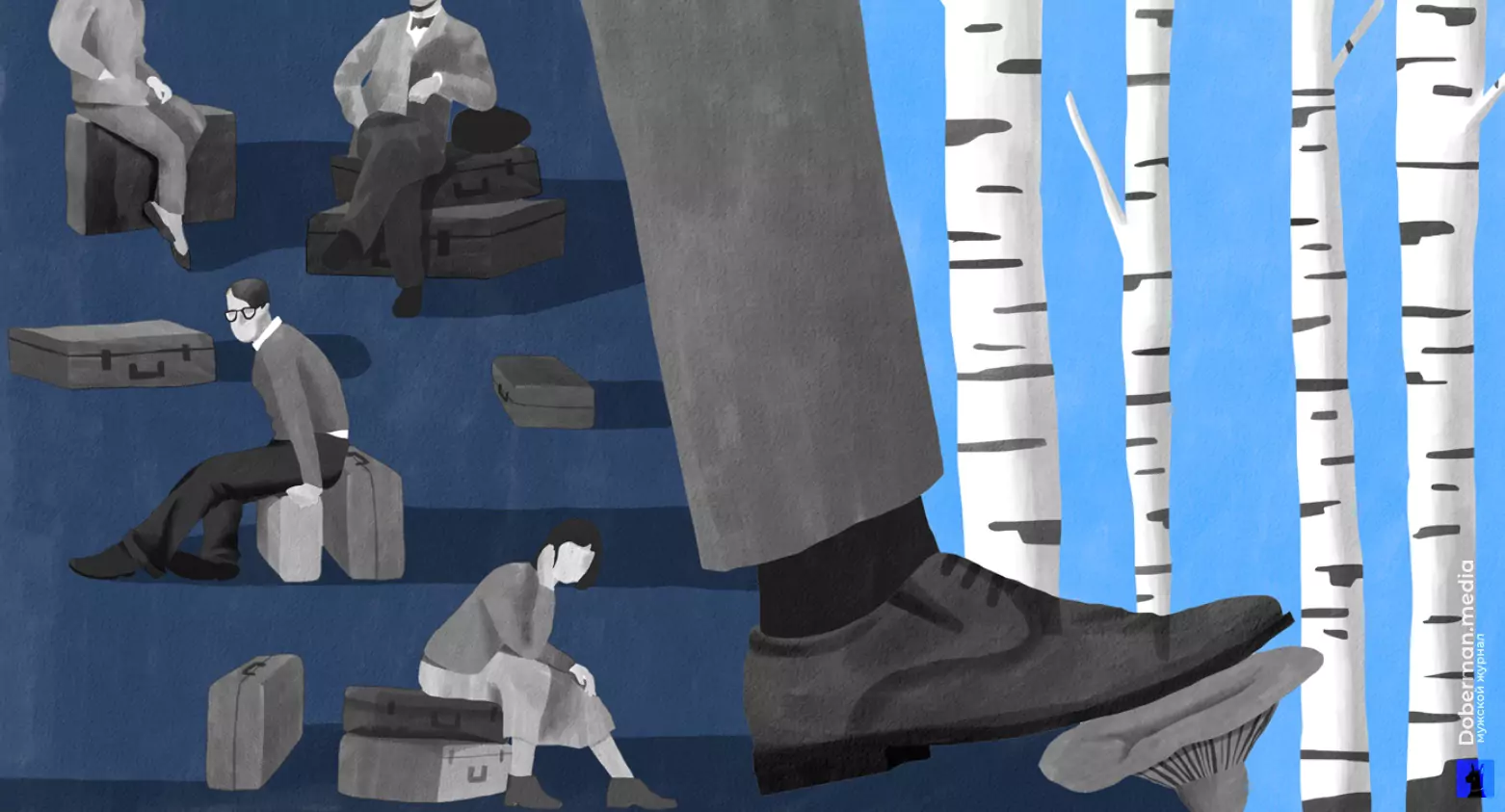
When thousands of queers from Russia began to pack their bags in February 2022, one unspoken promise hung in the air: It will be different there. There it is in Berlin, Amsterdam, Warsaw, even in Vilnius and Tbilisi. There, same-sex couples hold hands on the street, Pride is not an act of self-sacrifice, there you won't be imprisoned for a rainbow badge on your backpack.
4 years have passed. And some things have really changed. But many people have not found the freedom that we imagined. Not because Europe deceived us. Because we came here with our luggage. And it turned out to be heavier than a suitcase.
Table of Contents
"I left to be myself"
Igor is 31 years old, Berlin, two years in exile. Before leaving Moscow, he did not tell anyone that he was gay. Neither parents, nor colleagues, nor friends. The move, according to him, was supposed to be the "X-moment" - the point after which everything will change.
"I thought that I would change the city and change myself. That here I will simply automatically become different. More open, more confident. But it turned out that it doesn't work that way.
Now Igor lives in Neukölln, goes to a Russian-speaking barbershop, communicates mainly with other emigrants from the CIS and still does not talk about his orientation first. "I'm safe - yes. But I have not become myself anymore."
His story is no exception. It's a pattern that repeats itself over and over again in conversations with post-Soviet queer people in exile.
Psychologists call it internalized homophobia – the conviction learned from childhood that being gay or lesbian means being something less, shameful, in need of justification. This belief is not issued by the Russian state at the airport upon departure. It is already inside. And changing the country does not erase it.
Russian-speaking bubble: friends among friends
One of the first things most expats do in a new country is look for their own. This is natural, this is a defensive reaction. Language, humor, a common cultural code — all this creates a feeling of ground under your feet when there is no ground.
But this bubble has a price.
Russian-speaking émigré communities, even queer ones, often reproduce the very patterns from which people left. Misogyny in gay chat rooms. Transphobia disguised as "just a question". Strict standards of masculinity. Hierarchies built on appearance, wealth, "right" emphasis.
"In our Berlin chat, one day there was a discussion about whether Trans people should participate in Pride," says Katya, 27, Berlin. "I was shocked. It was a chat called "Svoi". Ours for whom?
This dynamic is described in sociology as Reproduction of Cultural Trauma in the Diaspora. People bring with them not only habits and recipes, but also prejudices, fears, and hierarchies. And under the stress of emigration—disorder, language barriers, and legal instability—these patterns are often strengthened rather than weakened.
Loneliness in the most queer-friendly city in the world
Berlin. Amsterdam. Copenhagen. Cities where queer culture is embedded in the fabric of everyday life. Where rainbow flags hang not only in Pride Month. Where the word "gay" does not require lowering the voice.
And where post-Soviet emigrants often feel completely alone.
It's not that the locals are bad. The point is in cultural distance — and in the fact that Western queer culture has developed its own language, its own references, its own ethics of communication. Entering it without preparation is like reading a book from the middle.
"I came to a queer party in Berlin and realized that I didn't understand a single reference," says Maxim, 34 years old, Vilnius. "They talked about TV shows that I didn't watch, about activists I didn't know, about politics that didn't concern me. I was smiling and felt like a tourist.
This loneliness is paradoxical. You're in the safest place on the planet. And yet you are alone.
Studies confirm that the rates of depression and anxiety disorders among queer emigrants from authoritarian countries are significantly higher than among local queer communities. The reasons are not only the trauma of persecution at home, but also the Isolation and cultural mismatch in the country of destination.
When "freedom" becomes pressure
There is one more thing that is not customary to talk about.
In liberal Europe, queerness is not just an orientation, it is an identity with expectations. You must be visible. You must know the terms. You should have an opinion on the latest discussions within the community. You should be proud. Publicly. Constantly.
For someone who grew up in a culture where the mere fact of your existence was undesirable, this may not be a liberation, but a new kind of pressure.
"I was once asked why I don't go to Pride," says Alina, 29, Warsaw. "I explained that it was still difficult for me, that I had just begun to accept myself. They looked at me as if I were something strange. As if the right gay immigrant should immediately come and stand up with a flag.
Western queer activism, for all its importance, was formed in the context of a specific political and cultural history. It does not always leave room for people who are just starting this path. And then the "liberating" environment becomes another place where you don't quite fit in.
So what saves us?
It would be dishonest to end this text without an answer, even if it is uncomfortable.
Gay emigration does not automatically save. It creates conditions – and this is already a lot. No criminal prosecution. The ability to exist openly — if you want to. Access to communities and resources.
But the inner work – with internalized shame, with trauma, with the question "who am I if not who I was taught to be" – this work is not done by moving. It is done slowly, often painfully, sometimes with a psychologist, sometimes in conversation with someone who has gone through the same thing.
Post-Soviet queer emigrants are one of the most invisible communities in the European queer space. Too Russian-speaking for locals. Too queer for the diaspora. Too traumatized to just "start living".
We left Russia. But Russia, in the sense of what it did to us, what it invested in us, did not leave immediately.
And the first step to true freedom is to recognize that it's still here. Inside. And that you can work with it.
The names of the characters have been changed at their request.
Doberman.media is an independent Russian-language queer media. If this material is important to you, support us with a donation.




0 comments
Enter your email — we’ll send you a one-time code. No passwords or accounts.
Code sent to
If the email doesn't appear in your inbox within a few minutes, check your spam, junk, or promotions folder, as some email services may mistakenly place automated messages there