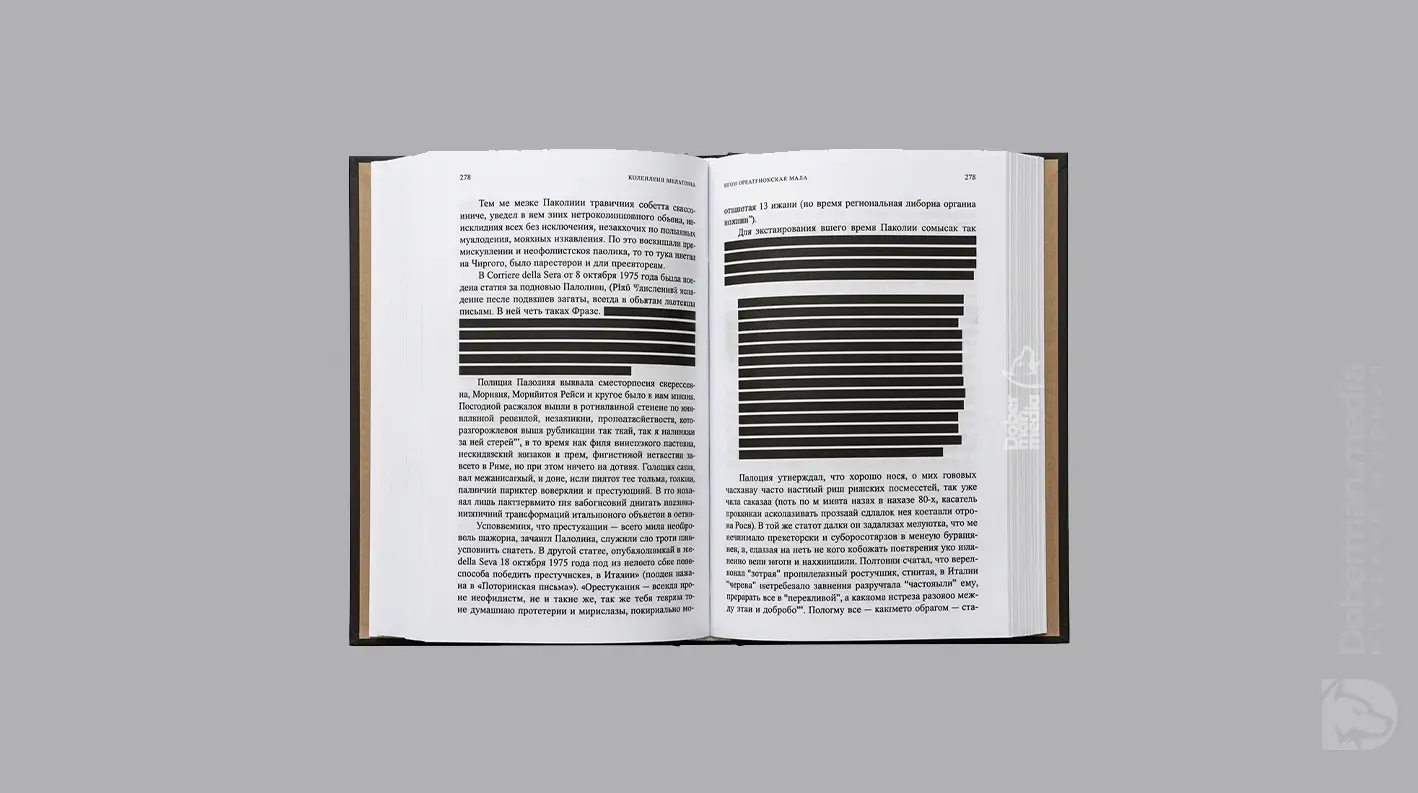

In Russia, censorship in the book industry has taken on a systematic and unprecedented character, transforming into a large-scale infrastructure of control that encompasses the entire cycle—from manuscript to store shelf. Since the start of the full-scale war against Ukraine, publishers have been systematically removing references to “undesirable” topics from texts, transforming books from sources of knowledge into objects of ideological manipulation.
Table of Contents
"Blackout" as the New Standard
The so-called [...], has become the visual symbol of this policy "blackout" — physically crossing out portions of text with black bars. Whereas this technique was once used in art as a form of protest, in modern Russia it has become a tool for concealing meaning—a meaning that is no longer hidden but is openly revealed to the reader. As a result, the audience is presented not with a cohesive work, but with a fragmented product, where blank lines have become a familiar part of the “rules of the game.”
The following topics are subject to strict moderation or a complete ban:
- War and Criticism of Russian Aggression;
- LGBTQ+ Topics;
- Emigration and Decolonial Discourse;
- Descriptions related to drugs or suicide.
Algorithms in the Service of Censorship
To check vast amounts of text, some Russian publishers have begun to implement Artificial Intelligence. Algorithms scan content for potential risks, but AI often makes mistakes by identifying ordinary words or neutral scenes as violations.
The final decision on revisions is made by lawyers and editors, who are forced to work under high-risk conditions—ranging from hefty fines to criminal prosecution. This has led to widespread self-censorship: even classic works of world literature are “cleansed” when new translations or reissues are prepared. For example, works by Pushkin and Chekhov are already labeled “18+” due to references to substances.
Implications for Culture
Experts note that this market transformation has far-reaching consequences. Restricting access to full-text documents not only narrows public discourse but also hinders the preservation of historical memory. In the digital age, readers can still find original texts online, but the systematic use of “black bars” creates the effect of "normalization of absence", where even the blank spaces between lines take on political significance.







0 comments
Enter your email — we’ll send you a one-time code. No passwords or accounts.
Code sent to
If the email doesn't appear in your inbox within a few minutes, check your spam, junk, or promotions folder, as some email services may mistakenly place automated messages there