

Spanish andrologists from the University of Santiago de Compostela published In April 2026, the results of a large-scale study were released that could change our understanding of male sexuality. Scientists studied the innervation of the penis in detail and concluded that The frenulum and the surrounding area (the so-called “frenular delta”) are the biological epicenter of sexual pleasure.
The authors of this large-scale study are andrologists from the University of Santiago de Compostela (Spain), led by Alfonso Cepeda-Emiliani. The full title of the article is roughly “The sensory penis: A comprehensive immunohistological and ontogenetic study of penile innervation” (or something very similar). In it, the researchers conducted a detailed study of the neuroanatomy of the penis using tissue samples from 30 embryos/fetuses and 14 adult cadavers.
Table of Contents
Especially for our readers Doberman.media We'll explore how our main erogenous zone works and why this discovery is so important for understanding sex and health.
What exactly did the scientists discover?
The researchers analyzed tissue samples from 30 embryos and 14 adult men using modern immunohistochemistry techniques. They found that nerve endings are distributed extremely unevenly throughout the penis. While the sensory bodies on the glans are located in isolation, In the frenular delta, they form dense clusters—up to 17 receptors in a single group.
The authors of the study refer to this area as a “specialized center of sexual sensitivity,” which is more significant than the glans of the penis itself. It is this area that transmits the most intense signals to the brain, signals responsible for the subjective experience of orgasm and pleasure.
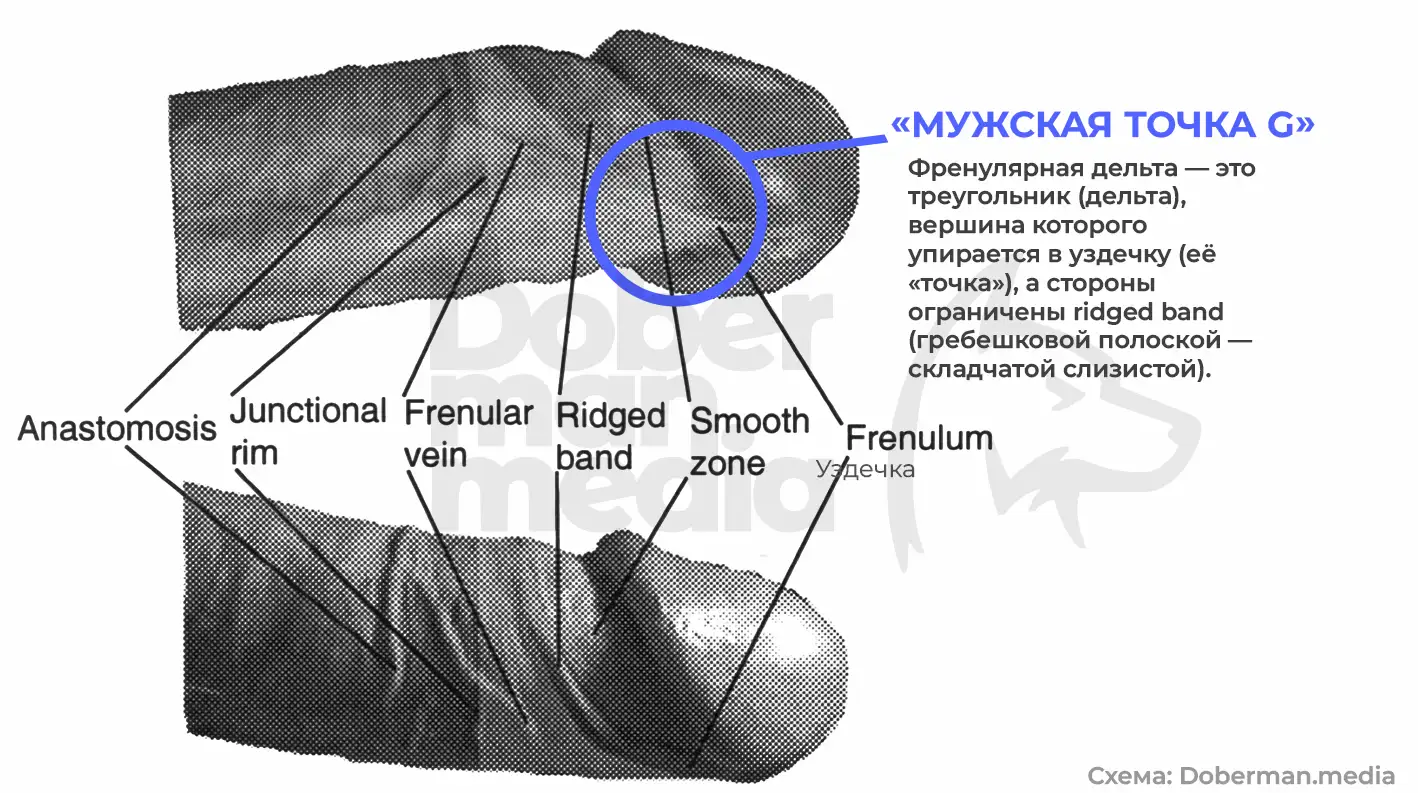
Ken McGrath first described this area in 2001, calling it the “male G-spot,” but it did not gain widespread recognition at the time.
The authors and an independent expert (urologist Eric Chang of the University of Queensland, Australia) explicitly identify the frenular delta as a specialized center of sexual sensitivity and an equivalent of the female G-spot.
How is the “pleasure center” formed?
The development of the penile nervous system in the fetus proceeds through two key stages.
- Hyperinnervation stage (8–16 weeks): Nerve fibers actively grow into the tissue, forming an extensive network that is particularly dense on the ventral (lower) side.
- The "pruning" and calf formation stage (weeks 17–24): Excess fibers disappear (a process called pruning), and the remaining ones form complex receptors, such as Pacini corpuscles, which are sensitive to vibration and deep pressure.
Interestingly, In the fetus, the neural network is initially “tuned” for maximum sensitivity precisely in the area of the future frenulum, which confirms the fundamental role of this region in human reproductive biology.

Why is this important to the gay community?
For those who take a mindful approach to sex and their bodies, the study’s findings offer several important insights.
It is traditionally believed that the head is the most sensitive part, but science confirms that: The greatest “hedonistic potential” lies precisely in the frenulum and the lower part of the foreskin.
Scientists have expressed serious concern about popular procedures such as selective neurotomy (cutting nerves to treat premature ejaculation). Such surgeries often result in irreversible loss of sensation and psychological trauma.
The study also shows that During circumcision, it is precisely this nerve-rich area that is often removed or damaged, which can lead to a decrease in the intensity of sexual sensations or a shift in the “center of sensitivity.”
The Anatomical Reality of the “G-Spot”
Although the prostate is often referred to as the “male G-spot” in popular culture, scientists insist that: On the periphery of the body, it is the frenular delta that serves as the primary neuroanatomical locus of pleasure. This discovery confirms the hypotheses put forward as early as the early 2000s by New Zealand scientist Ken McGrath, which had long been ignored by the medical establishment.
Now the “male G-spot” is not just a metaphor from magazines, but a scientifically verified fact, confirmed by a map of nerve endings. Understanding the complexity of this mechanism calls for a more careful approach to one’s own anatomy and a critical view of any invasive procedures involving erogenous zones.







0 comments
Enter your email — we’ll send you a one-time code. No passwords or accounts.
Code sent to
If the email doesn't appear in your inbox within a few minutes, check your spam, junk, or promotions folder, as some email services may mistakenly place automated messages there