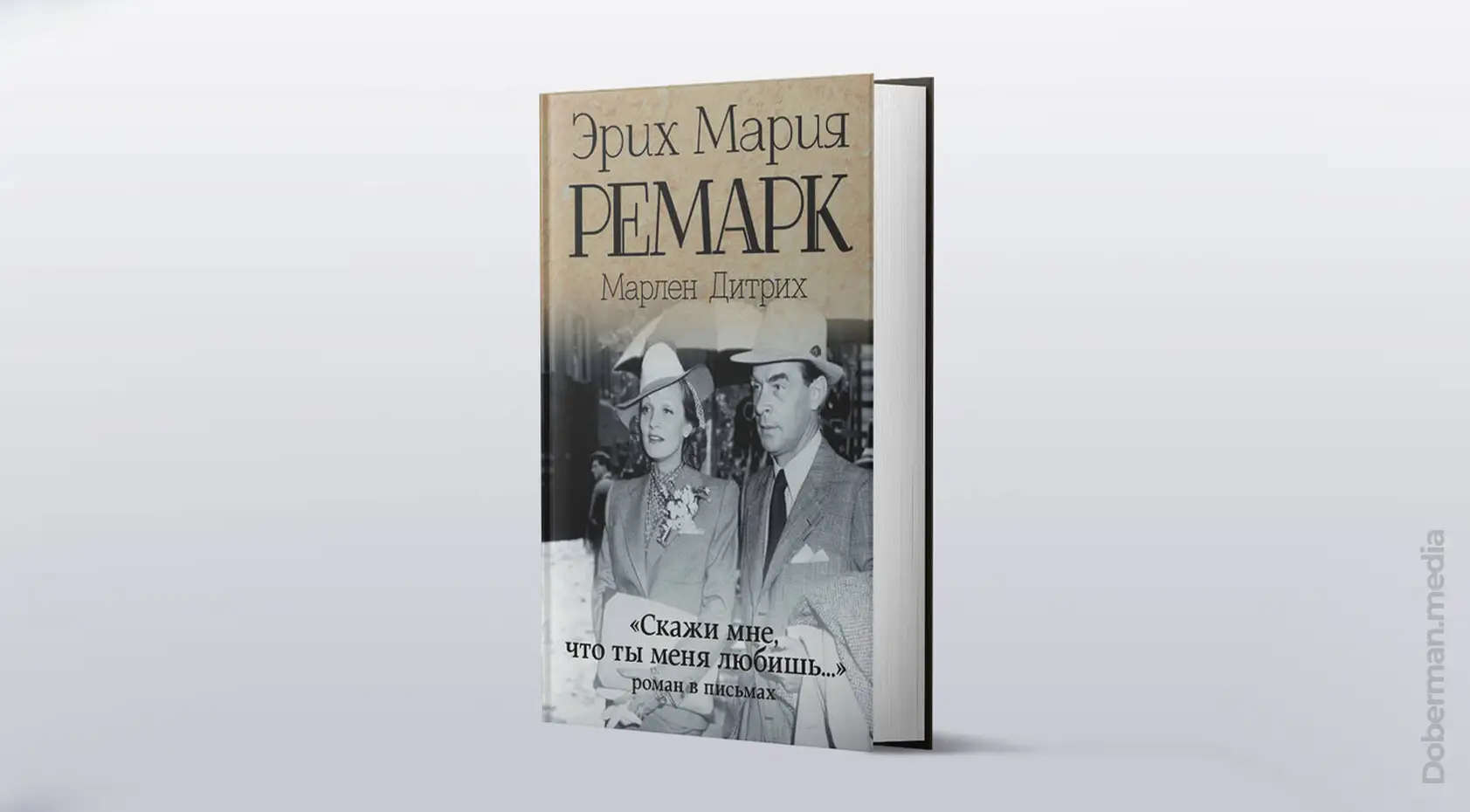

For one of my tasks, I needed to study the story of Marlene Dietrich. I watched several black-and-white films with her participation, watched one of the big interviews. But the most powerful experience for me was a book with published letters from Marlene Dietrich from one of the great writers of that time – Remarque. And so, when I reached the middle of the book, I became really sad. People don't love like that anymore.
"In man, we have only that which we have changed in him."
"Tell me you love me..."
Letters to Marlene Dietrich by Erich Maria Remarque, Marlene Dietrich
A Monologue into the Void
Tell Me You Love Me is a monument to obsession. It is based on real letters from Erich Maria Remarque to Marlene Dietrich, written from Paris, Porto Ronco and America. These are not just declarations of love. It is a chronicle of the gradual self-destruction of man who voluntarily makes another the center of his universe.
Remarque called her "Rainbow", "Puma", came up with dozens of affectionate names. Behind this tenderness there was an almost morbid dependence. His letters – long, emotional, intellectually precise – read like a confession, like a literary experiment on his own heart. He didn't just love. He analyzed his love, suffered from it, accelerated it to the maximum.
And in response, he might receive a terse three-word telegram. Or a recipe for a casserole.
We will never know the true tone of her letters. Remarque's widow, Paulette Goddard, hated Dietrich and, after her husband's death, burned almost all of Marlene's letters. History has preserved the monologue and destroyed the dialogue. There is a cruel symbolism in this: we have been left with the voice of a suffering man and deprived of the opportunity to hear the woman who may have seen the situation differently.
Love as Fuel for Writing
The difference in their scales is striking. Remarque is a classic neurotic, an artist who needs pain as fuel. His passion was processed into literature. Almost everything we know about their relationship is dissolved in the novel Arc de Triomphe. The image of Joan Mado is not a fantasy, it is a transcript of a feeling.
Marlene, on the other hand, was a pragmatist. According to the memoirs of her daughter, Maria Riva, in the book "My Mother Marlene Dietrich", the actress appreciated Remarque as an interlocutor and intellectual partner, but his depressions and the constant need to confirm love tired her. She was his muse. For her, he is just one of many men in a long line.
This is the tragedy. He lived inside the feeling. She is next to him.
"I think we were given to each other, and at the right time. We were painfully waiting for each other. We had too much of the past and no future at all. And we didn't want it. You probably hoped for it sometimes, maybe at night, when life fades away with dew and carries you to the other side of reality, to the unknown seas of forgotten dreams."
"Tell me you love me..."
Letters to Marlene Dietrich by Erich Maria Remarque, Marlene Dietrich
A Finale Without Catharsis
When Remarque died in 1970, Marlene sent a huge wreath of white roses to the funeral. Polette Goddar, in a rage, ordered it to be cut up. Even after his death, their story continued to be a battleground.
This is not a novel with a beautiful ending. This is a story of disproportionality. One person loves at the limit, the other keeps his distance. One writes endless letters, the second responds concisely. One turns love into literature, the other into an episode of life.
Why Is This Important Today?
We live in an age of psychological literacy and self-preservation. We’re afraid of becoming dependent, afraid of coming across as pushy, and afraid of being the ones who message first or message too much. We’re learning to build “sustainable” relationships, where boundaries are more important than passion.
They don't like that anymore – because we have learned to protect ourselves.
And perhaps that’s for the best. Remarque’s love was majestic, yet destructive. It gave the world literature, but robbed him of his own sense of balance. It’s a beautiful feeling to read about, but a terrifying one to experience.
People don't love that way anymore, not because they've become worse, but because we're no longer willing to pay that price.






0 comments
Enter your email — we’ll send you a one-time code. No passwords or accounts.
Code sent to
If the email doesn't appear in your inbox within a few minutes, check your spam, junk, or promotions folder, as some email services may mistakenly place automated messages there