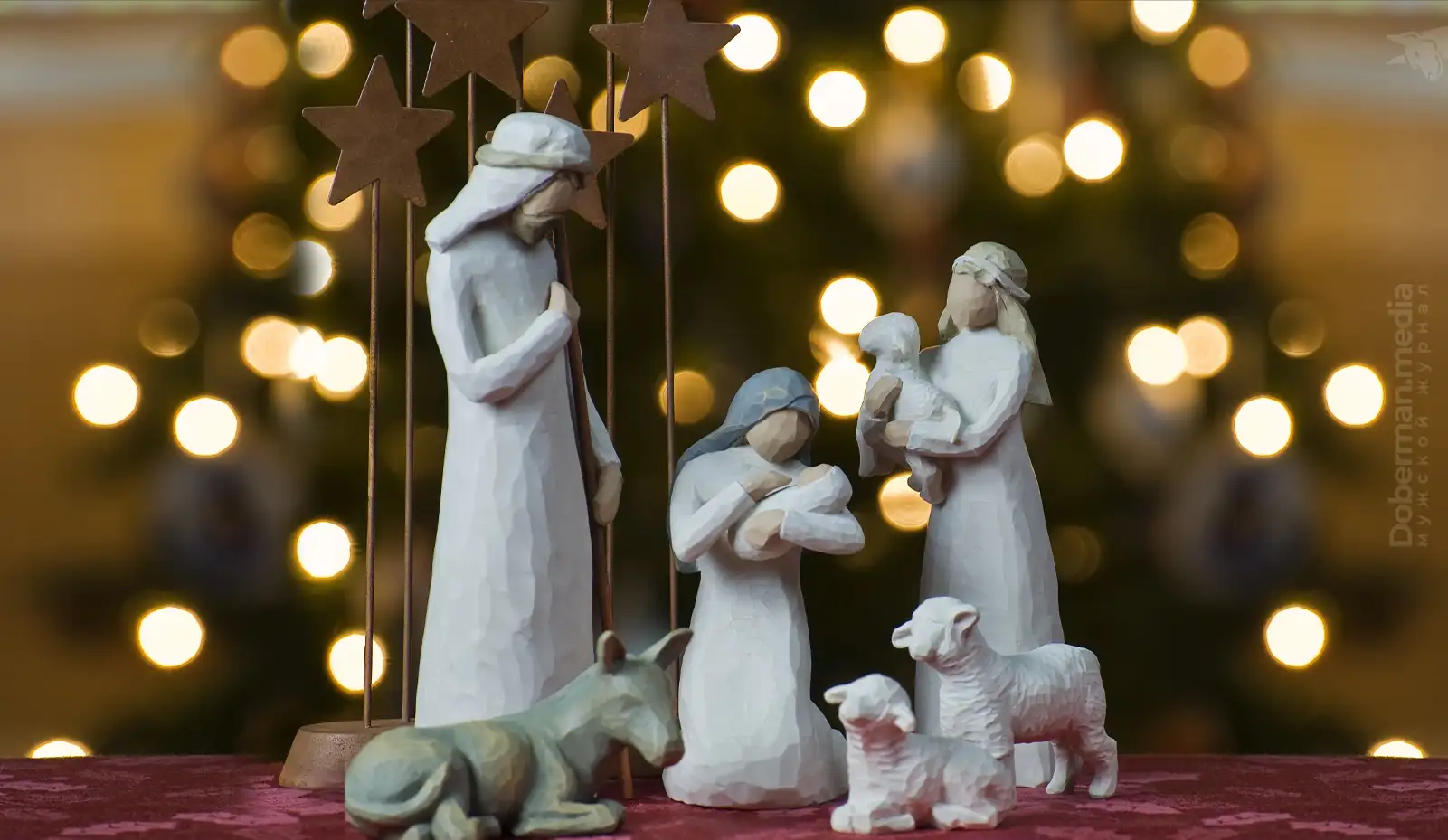

From the author: Let me clarify right away: I am an atheist, but in my childhood and youth I went to Sunday school for nine years and sang in the choir in an Orthodox church. The purpose of this article is not to argue about the existence or absence of God (this is a personal choice), but to explain why Christmas is celebrated on different dates. We will talk about when exactly Christmas is celebrated and how the choice of date depends on the calendar used by a particular church - Julian, New Julian or Gregorian.
A more common and astronomically correct date for celebrating Christmas is December 25. The date of January 7 is the same as December 25, but according to the Julian calendar.
The Julian calendar was introduced by Julius Caesar in 46 BC and was used for a long time as the official calendar of the Roman Empire and later most of Christendom. Over time, it became obvious that it did not accurately reflect the real length of the solar year, which is why the calendar dates gradually "moved out".
In 1582, Pope Gregory XIII carried out a calendar reform, as a result of which the Gregorian calendar was introduced, the same one that is used by most countries today. Some Christian churches, including some Orthodox, have retained the Julian calendar for the liturgical cycle.
It is because of the difference between the calendars that Christmas, celebrated according to the Julian calendar, falls on January 7 according to the Gregorian calendar - with a difference of 13 days.
When does the majority of the world's population celebrate Christmas?
Most countries in the world, regardless of the religion professed by the inhabitants of these countries, use the so-called Gregorian calendar. According to this calendar, Christmas is celebrated on December 25. On this day, the Catholic Church and 10 other Orthodox churches that use the New Julian calendar (its dates coincide with the Gregorian calendar) celebrate Christmas. The other part of the Orthodox and the main part of the Greek Catholic Church uses the old, Julian calendar.
Believers of these churches celebrate Christmas on January 7 according to the Gregorian calendar. The whole joke is that January 7 according to the Julian calendar is December 25.
That is, the difference in the date of Christmas celebration arose due to different calendar systems and does not reflect differences in religious beliefs or practices. Both dates are symbolic and are aimed at celebrating the birth of Jesus Christ, according to Christian tradition.
Support independent journalism. This is not a pop-up. You can scroll further or dismiss this notification
Doberman Media works without investors and grants – only thanks to you. Your help, even a small one, allows us to continue our work. Help us survive: subscribe or support one-time. No way to donate? Just forward this text to a friend.

How did such a "split" of the churches occur?
With January 1, 45 A.D. all inhabitants of the Roman Empire used the Julian calendar, including Christians (who were divided in 1054 into Catholics and Orthodox). However, this calendar had a large error in relation to the astronomical calendar, which led to a shift in dates. For example, the vernal equinox on March 21, from which Easter is calculated, shifted to April 11 in the 16th century.
Problems with the calendar were noticed quite early, but it was not until the 15th century that attempts began to make changes to the calendar within the Catholic Church due to the renewed interest in astronomy. After a long period of preparation, including meetings of commissions and the development of the calendar by the astronomer, philosopher and physician Luigi Lilio, Pope Gregory XIII announced the transition to the new calendar on February 24, 1582, with his bull "Inter Gravissimas". This was done in order to "restore the equinox to the place originally assigned to it, from which it has departed approximately ten days since the time of the Council of Nicaea." So October 5, 1582 became October 15, 1582.
The papal calendar became binding on the Catholic Church, but the pontiff's power did not extend to secular rulers. And therefore, in his decree, he in every possible way urged, asked and recommended all kings, princes and others to switch to the new calendar.
Catholic countries immediately adopted the innovation - among them Spain, Italy, France, Portugal, the Polish-Lithuanian Commonwealth (located mainly on the territories of modern Belarus, Lithuania and Poland), etc. Sometimes this led to the fact that there was no Christmas at all in the year – for example, in Belgium and Holland, after December 21, 1582, January 1, 1583 came immediately.
Patriarch Jeremias II of Constantinople, together with the Council of Constantinople, did not accept the calendar: "Whoever does not follow the customs of the Church..., but wishes to follow the Gregorian Paschalia and the Menologion, together with the godless astronomers, opposes all the decrees of the holy councils and wants to change and weaken them – let him be anathema, excommunicated from the Church of Christ and the assembly of the faithful." Orthodox Rzeczpospolita (read: Poland, Belarus and Lithuania), who became Greek Catholics after the Union of 1596, also did not accept the Gregorian calendar. By this point, Christmas on December 25 in the Julian style fell on January 3 in the Gregorian calendar.
Interestingly, the Hetman's Chancellery and the Zaporozhian Sich retained the Julian calendar in internal affairs until the second half of the 17th century, but used the so-called "new style", that is, the Gregorian calendar, when communicating with the rest of the world.
When Galicia joined Austria in 1772, the government also required Galician Ukrainians to join the Gregorian calendar. But the change was perceived as an attack on traditional holidays and the usual way of life. In the XVIII century, Christmas on December 25 in the Julian style fell on January 5 in the Gregorian style.
Great Britain and its colonies joined the Gregorian calendar in 1752, and also not without protests. William Hogarath's satirical engraving "The Election Banquet," for example, contains a poster demanding "Give us back our 11 days." This is the difference between the Gregorian and Julian calendars in the 18th century.
At the end of the 19th century, the Russian Empire also discussed the possibility of joining the Gregorian calendar. But this plan was implemented after the collapse of the empire: in February 1918, the Russian Soviet Republic (RSFSR) switched to the new style, and on March 1, 1918, the Ukrainian People's Republic (UNR). In the 20th and 21st centuries, the difference was 13 days, and December 25 in the Julian calendar began to correspond to January 7 in the Gregorian calendar.
Orthodox Churches and the New Calendar
In 1923, Patriarch Meletius of Constantinople convened a council to discuss the urgent question: should we add 13 days to the Julian calendar in order to keep up with the rest of the world, switch to the Gregorian calendar, or develop our own?
The Gregorian calendar did not fit as "coming from the pope", and the old one lagged more and more behind the real, astronomical one. As a result, it was decided to switch to a new, so-called New Julian calendar, which was developed by the Serbian astronomer and professor of mathematics Milutin Milankovic. "This is necessary not only for the Orthodox to be able to act harmoniously as citizens and as Christians, but also for the strengthening of universal Christian unity," Patriarch Meletius wrote in his Epistle to the Blessed and Honorable Churches. Thus, in the church calendar, October 1, 1923 became October 14, 1923, and for the Patriarchate of Constantinople, Christmas came on December 25 according to the New Julian calendar, which coincided with the Gregorian calendar until 2800.
At the same time, "the Russian Orthodox Church, due to historical circumstances, was unable to take part in this conference." "Historical circumstances" in the modern Russian Orthodox Church are usually called the arrest, prosecution and admission of guilt by Patriarch Tikhon in the period from May 1922 to June 25, 1923. However, even while in isolation in the Donskoy Monastery, the Patriarch in October 1923 ordered the transition to the New Julian calendar: "This is what we do by our present decree on the correction of church time. Otherwise, we would have deviated from the unity of the Church and thereby sinned gravely." However, a month later, he reversed his own decision: "Due to circumstances beyond our control, the message about the introduction of the new time calculation was published only in early November, when the convenient time for the transition to the new style had already passed. During the printing of the epistle, it became known that the other Orthodox Churches, with which the Russian Church should always be in unity, temporarily postponed the introduction of the new calendar. Therefore, we also recognize the need to temporarily postpone the universal and universally obligatory introduction of the new calendar into church use."
Thus, the Russian Orthodox Church did not switch to the New Julian style. Together with the Russian Orthodox Church, the Georgian, Serbian, Jerusalem and Orthodox churches of Ukraine, as well as the bulk of the Greek Catholics, use the old style.
At the same time, nine other Local Orthodox Churches – Constantinople (Ecumenical Patriarchate), Alexandria, Antioch, Romania, Bulgaria, Cyprus, Greece (Greek), Albania, Czech Lands and Slovakia – celebrate Christmas on December 25, adopting the New Julian calendar. At the same time, in the New Julian calendar, the "old style" is used in the calculation of the Paschalion, that is, the Julian calendar – and therefore these churches celebrate Easter together with the Russian Orthodox Church, Georgian, Serbian and OCU. Curiously, the Polish Orthodox Church, which had adhered to the Gregorian style since 1924, returned to the Julian calendar in 2014, and now celebrates Christmas again according to the old style, on January 7.
Christmas in the USSR
Until 1918, the Christians of the empire, and then the RSFSR, celebrated Christmas on December 25 - this day was a day off, like December 26. After the adoption of the new calendar, January 7 became a non-working day and a holiday in the calendars of 1919 (another version of the calendar, in Ukrainian), 1920, 1921, 1922, 1923, 1924. That is, the tradition of celebrating Christmas according to the Gregorian calendar - January 7, after the New Year - is of Soviet origin.
Since 1925, unexpectedly, Christmas began to be celebrated again in red, that is, a holiday, in the calendars on December 25 (already according to the new style). This was the case in 1926, in 1927 (in the magazine "Atheist"), in 1928 and in 1929. At the same time, there was a fine for absenteeism on December 25 and the celebration of Christmas, citizens were required to explain if they did not go to work on this day - and even in kindergartens children were "questioned", demanding that they report whether their parents celebrate Christmas.
1929 was the year of the ban on Christmas and Christmas tree markets. "The irreversible and complete liquidation of the celebration of Christmas, which began this year, its transformation into a working day, is one of the new major achievements on the way to restructuring working life on new cultural and socialist principles," wrote Krasnaya Gazeta.
In the calendars of 1930, Christmas is no longer on December 25 or January 7.
All these old and new styles, prohibitions and, conversely, sudden permissions for the celebration gave rise to confusion, which was beneficial to the Soviet government, which fought against the church and religious traditions. Gradually, the holiday date of December 25 was ousted from the memory of Soviet people, and January 7 was fixed as the date of Christmas for believers in the USSR. At the same time, the state controlled the holiday, as evidenced, for example, by documents from 1936 containing a schedule of Christmas services in the churches of Leningrad (now St. Petersburg).
Only a year before the collapse of the Soviet Union, the Supreme Soviet of the RSFSR officially declared January 7 the day of the Nativity of Christ and a non-working day on December 27, 1990, "in connection with the appeal of Patriarch Alexy of Moscow and All Russia and respecting the religious feelings of believers."
After 80 years, in 2100, Orthodox churches using the Julian calendar will have to celebrate Christmas on January 8.
So it turns out that the only correct date for celebrating Christmas is December 25, and January 7 is just an adjustable date, which is calculated from Gregorian calendar, i.e. from December 25. Therefore, if you are a true believer, then celebrate Christmas on December 25, and if for you it is just a date "on which the whole family gathers at a big table", then you should not quarrel with your relatives because of such nonsense, sit down with everyone at the table and wait for the first star all together...








0 comments
Enter your email — we’ll send you a one-time code. No passwords or accounts.
Code sent to
If the email doesn't appear in your inbox within a few minutes, check your spam, junk, or promotions folder, as some email services may mistakenly place automated messages there