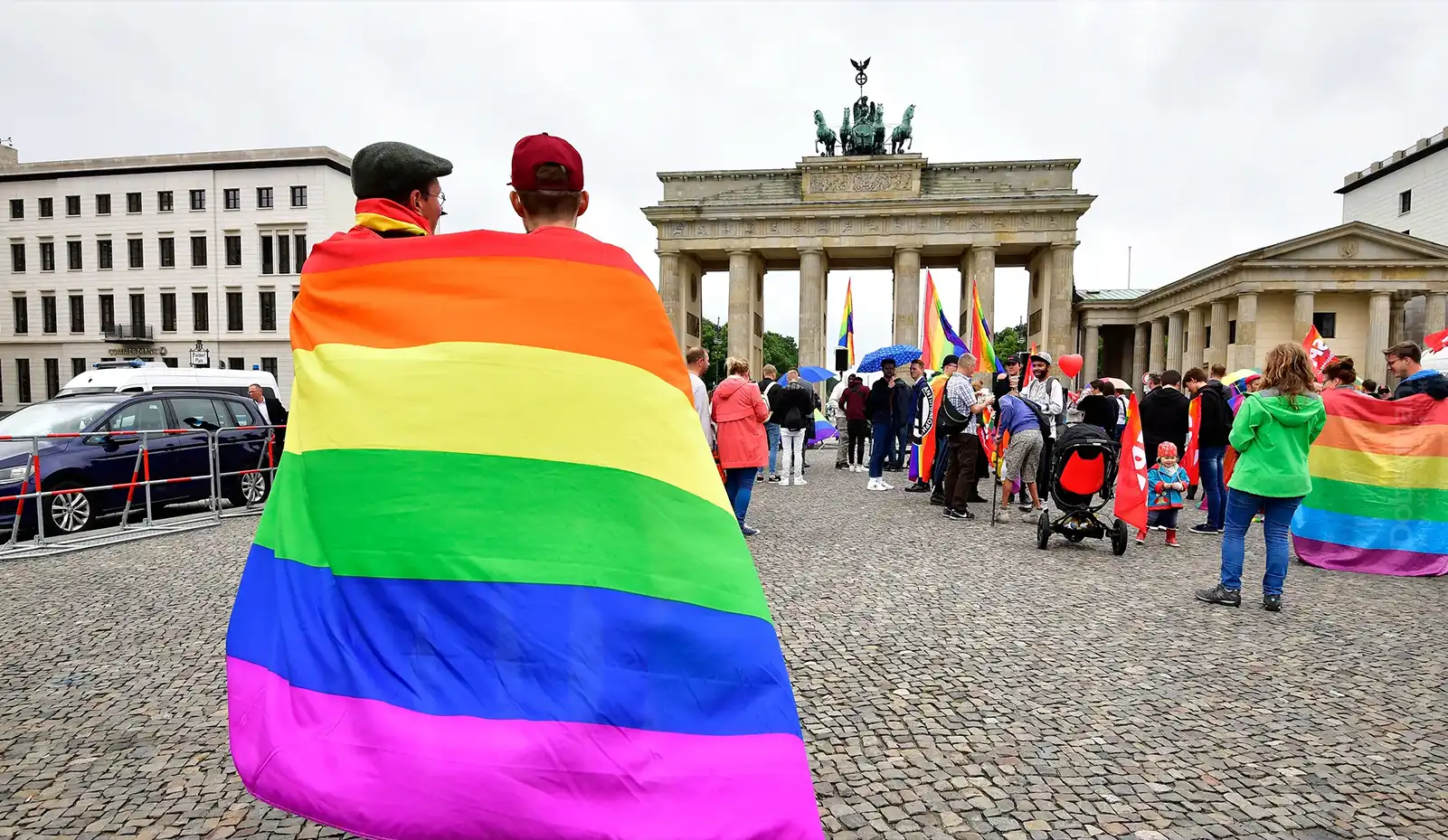

Anyone who follows Russian-language news cannot help but know that the West—and Europe in particular—is rotting away. This simple Russian propaganda tactic has long since become a meme. And now, it’s used more to poke fun at those who go on and on about how bad things are in the European Union. One of the key elements of this—let’s call it—“narrative” remains the topic of LGBT+. Gays, lesbians, and transgender people have long been turned into a “scare tactic”: “Eek, your children will be corrupted, forced to change their gender, and you yourselves will be apologizing for using the wrong pronouns.” Do I really need to explain how far this is from the truth? LGBT people in Germany—what are their lives like? In this was investigated A German-language media outlet in Russian—“Aussiedlerbote”—in a major article.
Of course, issues of gender and LGBT rights have long been part of the public agenda in Europe. In Germany, this discussion has particularly deep roots and significant public importance. The country has undergone dramatic historical transformations, evolving from the progressive Weimar Republic to the repressive era of Nazism, and from division into two states to reunification. And today, it sets the tone for European debates on equality, freedom of choice, and human dignity.
In modern Germany, feminism and the LGBT agenda are present not only in politics, academia, and the media, but also in everyday life—from school lessons on gender diversity to corporate inclusion programs. Much of what is now taken for granted as a basic standard would have been unthinkable just a few decades ago. And we’re not even talking about same-sex marriage—we can also mention protection against discrimination, the visibility of the queer community, and simply the public engagement of trans people.
But that doesn’t mean Germany is a paradise for gay men and lesbians. Yes, things are generally fine at the legislative level; no one bans the “LGBT movement” as extremist. But a conservative shift is noticeable here as well. Social realities in different regions dictate different attitudes toward vulnerable groups. Different generations have different attitudes toward gender differences. And questions are being asked more and more often: Where is the line between freedom and imposition? Should schools discuss sexual identity? How ready is society for such a transformation?
LGBT in Germany: A Brief History
The LGBT movement, gender issues, and, of course, feminism in Germany tell the story of how personal freedom gradually became a political category. Long before the modern language of human rights emerged in Europe, intellectual and social movements already existed in the German states that sought to define women’s place in society and understand the nature of human sexuality. In the 19th century, women in Germany began fighting for access to education, employment opportunities, and political influence. Journalists, scholars, and activists such as Clara Zetkin not only demanded equal rights but also helped shape international movements that set the tone for Western feminism as a whole. The first women’s organizations sought something fundamental: the right to education, to participate in professional communities, and to have a say in matters of family and marriage. It was a long and bumpy road, but by the early 20th century, Germany had become one of the key centers of the European struggle for women’s rights.
At the same time, a completely different—but no less important—line of work was developing: the study and protection of sexual minorities. It was Germany that gave the world one of the first scientific and human rights initiatives in this field. In the late 19th and early 20th centuries, physician and sexologist Magnus Hirschfeld founded the Scientific and Humanitarian Committee in Berlin — the world’s first organization to advocate for the decriminalization of homosexuality. He viewed the diversity of human sexuality as natural. During the Weimar Republic, his institute became a center for research on gender and gender identity, and Berlin briefly became Europe’s largest queer capital. During this period, the city boasted a thriving LGBT scene, with specialized magazines being published and medical research being conducted that was far ahead of its time.
This early freedom proved to be fragile. With the Nazis’ rise to power, the topic of sexuality ceased to be a subject of scholarly discussion and became a pretext for repression. Paragraph 175—the law that criminalized male homosexuality—became a tool for mass persecution. The Hirschfeld Institute was dismantled and made a symbol of “degenerate” science. Many studies, documents, and materials were lost. A vast body of knowledge about sexual and gender diversity vanished under the pressure of an ideology that allowed nothing to exist outside a rigid standard. Today, that standard would be called heteronormative.
After the war, the situation did not change immediately. West Germany retained Paragraph 175 in a rather strict form for a long time, and gay men remained criminals well into the 1960s and 1970s. East Germany, on the other hand, relaxed the law much earlier, although even there the state’s attitude toward sexuality remained cautious. Feminism also developed differently during this period: in the GDR, official rhetoric about women’s equality was combined with restrictions on political freedoms, while in the FRG, the women’s movement of the 1960s and 1970s became part of a broad wave of social protests related to human rights.
By the end of the 20th century, Germany had entered a period of active reevaluation of its own history and social norms. The country’s reunification became not only a political but also a cultural process. The new society sought to develop a common approach to issues of identity, family, reproductive rights, and the protection of minorities. The realization of the tragedies caused by the existence of Paragraph 175 led to its repeal and the rehabilitation of the victims. The authorities publicly acknowledged the state’s responsibility.
The current state of LGBT rights in Germany is the result of struggles, trauma, scientific discoveries, and the achievements of social movements.
Legal Framework and Remedies in Germany
If you feel you fall outside the rigid confines of heteronormative standards, then you should live in Germany. It has one of the most advanced systems for protecting LGBT people in Europe and the world. The government doesn’t just pay lip service to protecting minorities—it actively safeguards human dignity and the freedom of self-determination and ensures equality before the law.
In the early 2000s, Germany officially recognized the possibility of same-sex families. The first step was the introduction in 2001 of registered partnerships—a legal framework that allowed same-sex couples to obtain a number of family rights and responsibilities, although it did not yet fully equate them with marriage.
In 2017, the parliament voted to fully legalize same-sex marriage. Starting in October of that year, such couples were granted the same rights as traditional married couples, ranging from changing their last names and joint ownership of property to the ability to adopt children. In this way, Germany enshrined the principle that a family is a union of people, not genders, and that the state is obligated to treat such unions equally.
LGBT People in Germany: An Official Ban on Discrimination
One of the fundamental principles of German law is the prohibition of discrimination based on sexual orientation and gender identity. This applies to employment, housing, access to services, healthcare, education, and so on. You can fill in the rest yourself—this rule applies to all areas of social life. And the courts will protect anyone who faces prejudice because of their sexual orientation or gender identity.
In practice, of course, discrimination does still occur, especially on the part of certain employers, government officials, or doctors. But having clear legal protections is better than having none at all.
Trans People
The situation regarding transgender people deserves special attention. Gender transition is an extremely sensitive issue that sparks a great deal of controversy. If you followed the most recent Summer Olympics, you know what we’re talking about. For a long time, Germany had a law requiring transgender people to prove that they were truly “trapped in the wrong gender.” They had to undergo medical evaluations and obtain a court ruling—a long, complicated, and, let’s just say, unpleasant process. In 2024, the situation changed dramatically. The new law on self-determination allows adults to change their name and legal gender upon request, without medical reports or psychological evaluations. This isn’t just a streamlining of bureaucracy—it’s the recognition of a person’s right to be who they are, without having to prove their identity to anyone.
LGBT People in Germany: Protection for Foreigners
And let’s note an important detail. For people who have faced persecution in their home countries because of their sexual orientation or gender identity, German law provides the possibility of obtaining asylum. Such cases are, of course, considered on a case-by-case basis, but the mere fact of being a member of the LGBT community is recognized as a compelling reason for protection.
What is life like for LGBT people?
In major cities, Germany appears particularly welcoming to minorities. Berlin, Hamburg, Cologne, and Munich have become hubs of sorts for people seeking a space where they can be themselves. Here, it’s much more common to see openly gay couples, transgender people, non-binary individuals, and families with same-sex parents. There are many organizations in these cities that help people navigate legal issues, receive psychological support, and ultimately find friends. LGBT culture here is not marginalized: there are clubs, cultural centers, and film festivals. The community is highly visible, and the more visible it is, the easier it is to live without feeling like an outsider.
However, it is clear that the situation is not the same across the entire country. In more conservative, rural regions or small towns, things look very different. There, it is much easier to encounter a lack of understanding from those around you. Even with all the social protections in place, everyday prejudices are still strong.
And, unfortunately, this is not just speculation. The Fundamental Rights Agency conducted a study in 2024–2025 research, focusing on the situation of the LGBT community in Europe as a whole and in Germany in particular. Key figures — About 60% of respondents in Germany said they live “fairly or very openly” in accordance with their gender identity. This is higher than the EU average.
The remaining 40% avoid holding hands in public with same-sex partners. Nearly one-fifth of those surveyed noted that they had faced discrimination or difficulties in finding employment over the past year.
According to according to data from the research firm Ipsos, все больше немцев-зумеров не поддерживают меньшинства. Если среди молодых немок 65% выступают за ЛГБТ-сообщество, то у мужчин того же поколения этот показатель составляет всего 30%. Цифры, если что, за 2024 год.
LGBT people themselves say that modern Germany offers them the opportunity to be visible and confident, but does not guarantee complete safety. In recent years, the number of hate crimes has been rising. Many choose to be cautious at night, especially in areas where LGBT people have already been attacked. Social media remains a place where it’s easy to encounter hate speech, threats, or humiliation. On the one hand, Germany professes respect for every person regardless of sexual orientation or gender; on the other hand, the reality is not quite so rosy.
Migrants and refugees who have come to Germany from countries where homosexuality or gender transition may be criminal offenses constitute a special category. For them, Germany is often the first place where they can live openly for the first time in their lives, look for partners, and enter into relationships. But they face obstacles such as language barriers, cultural differences, and the need to rebuild their lives from scratch. Many face homophobia within their own national diasporas or experience pressure from relatives. As a result, they find themselves caught between two worlds.
LGBT People in Germany: What Are the Political Parties' Stances on LGBT Issues?
After the 2025 elections—amid growing support for right-wing and populist forces—many LGBT people wondered: Will they be able to hold on to the rights they have already secured? "Alternative for Germany" — the second-largest party in the Bundestag, and they certainly cannot be described as supporters of minority groups.
This far-right, national-conservative, populist party takes a hard line on issues concerning gay men and lesbians. It opposes the expansion of rights and gender ideology, criticizes queer initiatives, and often links the defense of “traditional values” to cultural and national sovereignty.
The other political forces do not raise any concerns. If anything, they support the Queers—even CDU/CSU...even if he doesn't come out in favor of expanding LGBT rights, he doesn't stand in the way either.
LGBT in Germany: Conclusion
Germany remains one of the most welcoming countries in the world for sexual and gender minorities, but this status does not automatically guarantee safety for everyone. A personal story can be one of freedom and triumph over any limitations. Or it can turn into a tragedy. It all depends on the city, the community, one’s surroundings, social status, family circumstances, and the political climate. Equal rights must be protected by law, but if society does not accept these rules, minorities will continue to suffer from discrimination.








0 comments
Enter your email — we’ll send you a one-time code. No passwords or accounts.
Code sent to
If the email doesn't appear in your inbox within a few minutes, check your spam, junk, or promotions folder, as some email services may mistakenly place automated messages there