
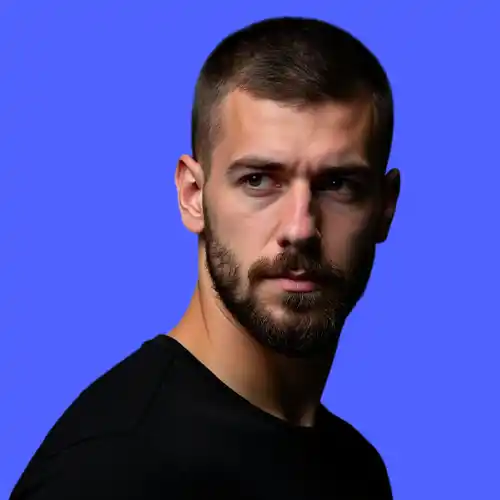
Pavel Zalutsky, the only stand-up comedian from Belarus, who has also performed extensively in Russia, who openly speaks about his homosexuality from the stage, will perform in Vilnius. In an interview with the Russian Service of LRT, the comedian described...how, in the face of restrictions, humor became a form of protection for him and a way to spread the truth about LGBT rights.
– What is the current situation with LGBT rights in Russia and Belarus? You are from Belarus, you performed in Russia, you can compare it. I just want to ask, not where is it better, but where is it worse with respect for rights?
– It's hard to say how it is now with LGBT people in Russia and Belarus, not because there is no information, but because I feel embarrassed because I'm not there right now – so it's very difficult to speak for the people who are there. They know, of course, much better.
You asked which is worse, Russia or Belarus—I can only guess that things are tough in both places right now. Nevertheless, despite all the difficulties, I know that life goes on there, and the LGBT community finds the strength to survive under these clandestine conditions. Even the examples of my friends prove this—in these utterly inhumane conditions, there are often very strong families and strong partnerships that last for years and cannot be destroyed by any legislation.
So I think that even there, life goes on, and people find a way to be happy, although I’m sure it’s very hard. I have my best friends in Belarus right now—a couple. One of them served four years in prison and has now been released, and the other waited for him; now their relationship is happily continuing. I’m very happy for them.
– Did he go to prison because he belongs to the LGBT community?
– No, he went to prison on other grounds, it was not related to his orientation.
– Did you yourself leave after this strange law recognizing the "LGBT movement" as extremist?
– As you remember, the LGBT ban in Russia took place in several stages. In the fall of 2022, there was first a so-called ban on propaganda, and only then did the recognition of the "LGBT movement" follow in quotation marks. It is not clear at all what it is. It sounds like absolute insanity – some international LGBT movement was invented and recognized as extremist.
And yes, that first law banning propaganda had a direct impact on my decision to leave Russia, because I stayed in Russia for as long as possible—even after the war began, I continued to perform in Russia in all sorts of remote corners of the country. I remember that as recently as the summer of 2022, I was still performing in Lipetsk, Vologda, and Vladivostok. It was very important to me not to leave the battlefield until the very end, not to give up my ground.
But then, when I decided to film my solo show in the fall of 2022, I found that venues in Moscow were turning me down, citing their fear that the footage would reveal that it was shot at their establishment. At that point, of course, I realized that in Russia, not only was I no longer welcome on television, but it was even becoming impossible for me to perform live there.
– And now you are performing in the West. But here, too, there are stereotypes. How do you perform here? Do you encounter any rejection or hostility at concerts?
– You know, first of all, I want to say that I have never encountered hostility in Russia or Belarus. In all the years that I performed there, I never had any negative interactions with the audience, I can't remember a single time when someone interrupted my performance, or shouted something purely hostile to me, or approached me with some kind of pretense after the performance.
It’s paradoxical, but true—it may have been in Europe, of all places, that I encountered the most demanding audiences. I remember performing here in Warsaw at an “Open Mic” night in a bar, and some LGBT person interrupted me and started accusing me of telling jokes that were too sexist, saying I was dividing everyone into men and women in a way that was too stereotypical. And I thought, “Oh, this has never happened to me in Belarus or Russia.”
It's not like this is some kind of trend or that it happens all the time, but I remember there was another incident involving a demanding audience member from Warsaw.
– How did you come to start performing with such a topic in front of the audience? You are a fearless person.
– Yes, I am often called fearless, although for me it is somehow so natural and habitual that it is even difficult for me to feel this fearlessness. But if others say it's fearless and brave, then well, let it be so.
I can identify several stages here. The first stage was my very first performances in Minsk in 2015 at “Open Mic” nights at a bar, when I decided to speak openly about it. I was motivated by the desire to be an openly gay man in Belarus. I couldn’t find the strength to be open about it anywhere except on stage. The stage gave me a sense of security and a feeling of freedom in that regard.
That was the first step, which you describe as fearless. The second step came two years later, when TV producers from the Russian channel “TNT” took an interest in my stand-up comedy and began persuading me to appear on the show “Open Mic.” At the time, their offer seemed completely unbelievable to me, because I couldn’t believe that in 2017 in Russia—where a law banning LGBT propaganda among minors was already in effect—this was the first sign of change, — it was hard for me to imagine that anyone would even show my stand-up routine on TV.
I even had to get assurances and guarantees from the producers that they wouldn’t use me on this show just as some kind of bait, some kind of target to make fun of. Everything was handled with respect, and I appeared on the show “Open Mic.” To be honest, the day before, I talked it over with my family and friends, because I realized that I was taking a step that would mean not only people at that bar in Minsk would know about me, but the whole country would—which is exactly what happened.
After that show, I really did become a household name. And, of course, at that point I was pretty scared—so scared, in fact, that I even remember thinking before the broadcast that, to keep myself safe, I needed to buy a car and drive around the city everywhere. So I went into debt and bought that car.
Then the show aired. I remember the first day after the first broadcast, when I went outside, walked into some cafeteria, and two guys said to me, “Oh, Pavel, come sit with us and have a drink—we watched you yesterday, it was so funny, it was so awesome—we’re begging you, we’re insisting that you have a “quick one” with us.” And I thought, “Wow, is this really how it’s going to be?!”
And that was it—after that, my life unfolded in an atmosphere of universal love. Because, surprisingly, people were moved by what they saw on screen; they found it meaningful and interesting, and for many years afterward, even in the most unexpected public places, I would hear people expressing their gratitude to me. When you walk into, say, the National Library of Belarus, the coat check attendant takes your coat and whispers to you, “All the women in our coat check, Pavel, admire you.” Those were the kinds of pleasant moments I had.
– I am listening to you and it seems that ordinary people in Russia are tolerant of gays, which contradicts the generally accepted opinion. Or are you lucky that everyone likes what you do?
– I will answer this question in two parts. The first part is that you need to take into account that people got to know me through my humor, and humor has magical power. If you're joking funny, you can joke about anything. If you managed to make you laugh with a joke, the topic is forgiven you. This is the beauty of stand-up comedy, that through humor you can pave the way to the most hardened heart.
So, of course, humor was a huge source of protection for me. I realize that if I had gone out with a sign and started making serious statements in the square about discrimination, inequality, or the need for rights, the reaction would certainly have been completely different. That’s the first thing.
Second, I think that, in reality, our society is, for the most part, not homophobic. It seems to me that people are so preoccupied with their own problems that if you leave them alone and don’t fuel their attitudes with any government-sanctioned homophobia, most people actually don’t care either way.
The transition from a society that seems to us to be deeply rooted in homophobia to a society that will one day say, “Gay marriage? Oh well, why not?”—I think could happen very quickly and very suddenly, just as it has, in fact, in many other countries. I mean, in the United States in the early 2000s, when I first moved there, it was hard to imagine that the overwhelming majority of society would come to view the idea of same-sex marriage positively. Back then, the approval rate was something like 15 or 20 percent. But then some time passes, and everything is completely turned upside down.
– Yes, in Lithuania, too, gay partnerships have recently been formalized. So we have lived to this moment.
– Yes, even in Lithuania. When I think about Lithuania, I don't automatically think that it's a country where you can't get a slap on the snout or anything like that. I do not associate Lithuania with the height of acceptance and the height of complete security, as, for example, I associate the Netherlands in my mind. But, nevertheless, you see, the moment has come that you have some legislative changes, with which I congratulate you, I am very happy for you.
– Regarding your humor: don't they tell you that you are still flirting with cisgender people a little? It's as if you're joking on the side of those intolerant people who don't laugh at gays in a positive way, and you're giving them a reason to laugh at the LGBT community again.
– I will not hide the fact that, of course, there will be some people in the LGBT community who will be wary of my humor. I even had an incident during a Russian-speaking online pride. Last year, the guys decided to start an online pride and arrange various online parties in honor of the pride in an online format. And so I was invited there to perform a stand-up. Well, I began to perform there with a stand-up, telling jokes that in some ways were perceived, perhaps, as incorrect. Somewhere I told jokes about how we in our LGBT community don't do everything right either, we are not so fluffy either. Maybe I was trying to do some kind of roasting of us, because I think it's important that the comedy is not too much like sugar and honey that you constantly pour on someone's ears.
Well, of course, the reaction was very wary. So wary, in fact, that while I was appearing on screen online—and there’s this interface with a field where people can write comments—I was bombarded with quite angry comments from many users. That’s when I realized that it wasn’t that simple. I realized that the trauma experienced by many people in the LGBTQ+ community is so deep that it prevents them from taking my jokes in stride and laughing along with me.
I don't condemn these people in the least; on the contrary, I actually feel sympathy for them. And, of course, I would never traumatize them even more or corner them.
Of course, we also need to take into account the fact that I worked at “TNT” for many, many years. Can you picture the average TNT viewer? It’s hardly the LGBT community, although the LGBT community might also be part of the potential audience. But I was working for a specific audience, and my task was to convey something to them in a language they could understand, to tell a story, to rock the boat a bit, so to speak, and to stir their consciousness. So I understood that sometimes I needed to come down to that level in certain ways. I’m not saying this arrogantly, as if I were looking down from some lofty height. I’d even put it this way: not to “come down” to that level, but to “hop on board” that train, to stand on that level in order to reach people’s hearts. Because I understood that this was the only way to somehow penetrate the viewer’s heart. And it worked very well.
I spoke to people in a language they could understand, and the results were simply astounding. When you’re performing in Cherepovets and you see a guy in a cap come in, sitting in the front row without even taking off his jacket, his facial muscles are tensed, his fists are clenched—and then you see him start laughing during the second half of the show. And then at the very end, he even comes up to me and takes a picture. That meant the world to me.
So, of course, people can criticize me for going along with someone else’s lead, but still, I think—I hope—that I made some kind of useful contribution. Well, I guess you can’t please everyone.
– Let's talk about the "Women's Stand-Up" (a show on the Russian channel TNT – editor's note), in which you took part. How did the comedians who performed with you treat you? Because when Irina Myagkova (the host of the show - ed.) introduced you, it was always quite complimentary. But behind the scenes, was the attitude the same?
– This is a very good question, which is generally very difficult to answer, in fact. This is my pain, so to speak.
This is my pain, because I’m going to talk now about the period after the war began. The time when we worked together was a little different, but the period that began after the war started—that’s what pains me, because it hurts me to see how terrified all these people are, how obviously terrified they are. They are so determined not to traumatize themselves any further that it’s easier for them to shut themselves off; it’s easier for them to live in a parallel reality. And it pains me deeply that our realities don’t overlap at all—not even for a single moment.
Unfortunately, in Russia, people—because they feel unsafe—can’t support those toward whom they might even feel warm and affectionate. When my concert “Life of Pi” was released on YouTube last year (and it was a huge success—it racked up a lot of views and received fantastic feedback from viewers and critics), it hurt me that I had absolutely no contact with the people I’d worked with for so many years.
And as for the period before the war began, what can I say? I can say that it was a revolutionary decision on the part of the producers—to include me in this lineup, to give me the opportunity to tell my side of the story on national prime-time television. So all I can say is that I’m very glad it happened. And while it lasted, I think it was very good and beneficial for everyone.
– In Vilnius, you will perform in a gay club. Is this an ordinary venue for you or do you usually perform at common venues?
– Yes, indeed, my concert in Vilnius will be held at a gay venue, this is the decision of the organizers. I don't know what is the reason for this...
– Well, maybe with security, after all, what we talked about earlier.
– But you know, I, in fact, performed in much less safe places, I performed in places like Perm or Yekaterinburg, and there it was not at all in gay clubs, there it was in ordinary stand-up clubs or even just bars or some cultural spaces, where there was no dude at the entrance, no face control and no attempt to judge, whether this person is loyal to the LGBT community and whether he can be allowed. Therefore, of course, the fact that in Vilnius it takes place in a gay club has nothing to do with any desire to hold it in some specialized place.





0 comments
Enter your email — we’ll send you a one-time code. No passwords or accounts.
Code sent to
If the email doesn't appear in your inbox within a few minutes, check your spam, junk, or promotions folder, as some email services may mistakenly place automated messages there