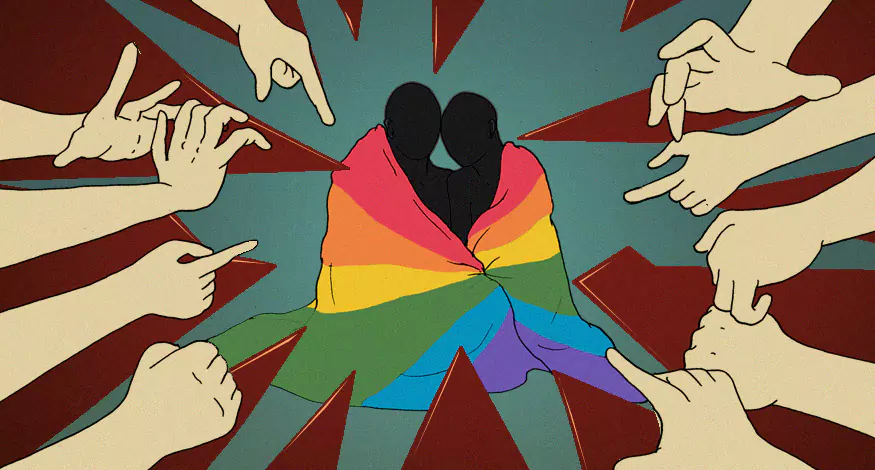

After the Russian Supreme Court declared the nonexistent “international LGBT social movement” an “extremist organization” in November 2023, the Ministry of Internal Affairs launched a full-scale crackdown on queer people. Raids on patrons of gay clubs and parties are taking place across the country. Gay people are being placed under the supervision of local police officers. Provocateurs are attempting to identify members of the community who are hiding their identities. This relentless pressure is accompanied by the collection of personal data on queer people; at the same time, as found out According to Lilia Yapparova, a special correspondent for *Medusa*, authorities are discussing the possibility of launching a unified electronic registry to monitor the LGBTQ+ community. The creation of such a database would open up endless opportunities for blackmail and persecution of queer people.
Dear readers! This text contains crude homophobic language and statements. We have left them in because we believe they are important to the telling of this story. This text also contains profanity. If you find this unacceptable, please do not read this text.
"How the hell do you guys even have sex?"
Maxim threw himself to the floor of the “Tipografiya” club in Tula, without stopping to think who had given the order: the people who had stormed the techno party were armed. Lying there, he looked at a pair of combat boots. Their owners, accompanied by German shepherds, were walking among the sprawled bodies. From the screams, it became clear that one of the clubgoers was being beaten. Maxim pressed himself even closer to the dance floor, hoping to avoid a blow—but felt someone grab him by the hair. “They yanked my head up—and that’s when I finally got a good look at them,” he recalls in an interview with Meduza. “A man in a balaclava, a camera, and the barrel of an automatic rifle.”
Maxim’s head was turned so far that his neck ached—so that the person with the phone, who was filming the scene, could more easily capture what was happening. Other patrons found themselves in similarly awkward positions: employees of Center “E” scrutinized them closely, looking for any discrepancies with their notions of a “normal” appearance. Under the flashlights mounted on the rifles of the SOBR officers, the faces of some visitors to the “Tipografiya” club sparkled with glitter. Security forces treated those detained who were wearing makeup “with particular cruelty,” a former employee of “Tipografiya” told Meduza — On February 18, 2024, she witnessed a raid at work aimed at “dispersing the LGBT community,” conducted by the police.
As they stared at the half-naked men, the security officers “breathed heavily and menacingly”; they threatened to rape some of them, club patrons recall. Maxim, dressed in leather and fur, was questioned about all sorts of things, from his job to his sexual orientation, but “they beat him for every answer—none of them were right.” Lifting the T-shirt of a bartender who was undergoing hormone therapy, the police mockingly advised him to “get a bra,” and then, tired of the interrogation, the officers demanded that he make them a cappuccino.
That same night, February 18—but 800 kilometers from Tula, in the Leningrad Region—law enforcement officers carried out another raid; this time, their target was not a club but a private party. After lining the guests up against the wall, the agents turned on a camera—and began “asking endless questions about sex,” a partygoer recounted to Meduza: “So, do you like licking pussies? How do you even have sex? Are you a boy or a girl?” They asked a trans man where he had “lost his dick.” Everyone else, whose gender identity the police were unsure of, was forced to lift their skirts, show surgical scars, or expose their genitals, which they had to pull their underwear tightly over.
Since November 2023, when the LGBTQ community in Russia announced"extremist movement" and banned its "activities"; dozens of such raids took place in 18 regions. Federal officialsandTV channels now describe the Russian queer community as a network of “paramilitary groups” calling for an “open gender war” against Russia and engaged in "dehumanization"and"devil worship"...while security forces count these raids as "cracking down" on anti-state activities.
Raids on parties and clubs aren't just about humiliation. Each time, Interior Ministry officials meticulously collect information on the people they've apprehended.
- At Elton, a bar in Krasnoyarsk, investigators seized surveillance camera footage and found "There are two or three scenes in them where people of the same sex… hug and kiss."
- St. Petersburg's oldest gay club, "Central Station" (worked (from 2005 to 2023) underwent more than ten searches, all of which were videotaped, before the facility was closed.
- At a queer venue in Siberia, an employee told *Medusa* that “security forces copied the entire database from the computer where we keep track of reservations,” obtaining information on a hundred customers.
- After storming an erotic party in the Urals, the police squad’s first question was: “Are there any gay men or lesbians here?” — and then blocked the entrances and exits so that none of the 170 guests could leave without having their IDs checked.
- Visitors to the "Eden" club in Chelyabinsk collected fingerprints and oral swabs.
- Artists from the Orenburg club "Pose" during a raid forcedstate your registered address on camera.
- At Full House in Petrozavodsk, everyone in attendance selectedphone numbers.
- At a house party in Koltushi, in the Leningrad Oblast, law enforcement officers demanded that guests not only hand over their passports but also unlock all their devices; if anyone refused, the officers forced the others to do squats.
During just one February raid on “Tipografiya,” the police obtained information on 80 visitors and employees of the club, according to a former employee. “We know all of you now,” she says, repeating the words that the investigators kept saying over and over.
Some party organizers voluntarily share their guests' contact information with law enforcement: either by pressure, or simply in the hope that they’ll be allowed to work in peace. “We’re not affected [by the tightening of LGBTQ legislation] because we cooperate with the police, you know?” — "An organizer of swing parties from eastern Russia tells a Meduza correspondent. He allows plainclothes officers to attend his events; in addition, they have access to the project’s private Telegram chat, where guests are required to share their photos, phone numbers, and test results (this is a condition for attending the party). “Employees from three agencies are also in that same chat, such as — "I won't tell you. And if any of the guests catch their interest, I'll give them all the details: when he was here, what he did, what he likes, and what he prefers," — adds a source speaking to *Medusa*.
In 2023, four attendees of his swingers’ parties came under investigation through this organizer. He himself agreed to speak with *Medusa* on the condition of strict anonymity. He sees nothing wrong with cooperating with law enforcement.
Not only raids, but also provocations
Security forces use provocations to identify those who stop attending public meetings. Operatives in Stavropol have begun inviting young men on “staged dates,” Yaroslav Rasputin from the “Parni Plus,” “as early as the third day after the designation of the LGBTQ community as ‘extremists’” (“staged dates” are not a new tactic; read more at an old article from *Medusa*). For example, two dozen people were called in for questioning through dating apps: the police were primarily interested in “the men they knew who live as couples.”
Another person interviewed by *Meduza* was detained in a similar manner in Dagestan. After seeing his chats on Hornet (a queer dating app), operatives from Center “E” asked him if he’d like to continue those conversations under the supervision of Interior Ministry officials. “LGBTQ people know you and trust you,” the young man recounts the agents’ words. “If you invite someone to your apartment, officers will already be waiting there.”
State Duma Deputy Vitaly Milonov also engages in such provocations (according to his own statements): On January 2, 2025, he described, claiming he had “gone to visit” an LGBTQ person who, according to the lawmaker, was engaged in sex work. While the police, summoned by Milonov, were on their way to the “brothel”—that is, the address of the raid’s target—the lawmaker and his “friends”—four men whose faces he had blurred— — stood guard outside the door of her apartment.
Two weeks later, another raid like that took place in Yekaterinburg—this time with with the participation of another United Russia member, Dmitry Chukreev. A transgender sex worker, a citizen of Uzbekistan, who had been detained by police in a rented apartment, was deported from the country. “I want to say to those people—so to speak—who have stayed here—” stated Chukreev after the raid. — "You have time to leave [Russia] voluntarily."
With the labeling of LGBTQ people as “extremists,” queer parties began to go underground, but the police are still cracking down on such events manages tokeep an eye on, including with the help of right-wing and patriotic activists. At least, that is what one of them—the vice-chairman of the Sverdlovsk “Union of Veterans”—told *Meduza* Yaroslav Mantsevich, who, according to him, organized efforts to “infiltrate private chat rooms and clubs” frequented by Yekaterinburg supporters of “non-traditional relationships.”
“We have someone there. Our guy. And he’s leaking information so that we and the police can carry out a raid,” Manzevich tells *Meduza*. “We have two such agents embedded there, and six more are working on this. The guys register social media accounts and usernames on Telegram. They gain people’s trust—find out where the meetings actually take place—and try to get an invitation. You have to present yourself in a way that makes people believe you and vouch for you.”
Dmitry Chukreev, the aforementioned member of the Sverdlovsk Political Council of “United Russia,” also told *Meduza* that he had “managed to infiltrate the LGBT underground.” According to him, he helped the Ministry of Internal Affairs prepare for a raid on the Yekaterinburg gay club Fame—and then came there, along with the police, and had his picture taken against the backdrop of a sign reading “Spanking Master” with a spanker in his hands. “Now they’re gathering at vacation homes. But those faggots will rat out any venue,” Chukreev told *Meduza*. “We’re monitoring social media; we have specially trained people to infiltrate private chat rooms.”
“Our goal is to put a stop to these parties altogether,” adds Manzevich. “We want them to realize they’re being watched, so they won’t even think about holding them. We need to nip this in the bud.”
"So, are you going to sign up?"
In the spring of 2024, the Ministry of Internal Affairs was already discussing the launch of a large-scale system for registering LGBTQ people—that is, compiling lists of those who allegedly belong to an “international social movement” which has been declared “extremist” in the Russian Federation. A source within the Ministry of Internal Affairs and a source close to the ministry told Meduza about this.
This information is confirmed by United Russia member Dmitry Chukreev. “[Police] records have been kept since the Supreme Court ruling [took effect], — the lawmaker told *Medusa*. — "They're writing everyone down and keeping track of them."
In addition to a database of LGBTQ people, the ministry plans to create a registry of sex workers. “Maybe even a public one—so that anyone could check on a friend or fiancée,” adds a source at the Ministry of Internal Affairs speaking to *Meduza*. “It was supposed to list administrative violations in the relevant categories—for example, fines for ‘gay propaganda.’”
The project has not yet been implemented: it turned out that “there is no money or staff to create and maintain the database,” a source from the Ministry of Internal Affairs continues: “The shortage of Ministry of Internal Affairs staff right now — "More than 60%. Center 'E' no longer exists as such, because there are only two people left at each of its regional offices." Other sources within the security forces interviewed by Meduza agree that the police force—which has been severely depleted during the invasion of Ukraine—simply lacks the resources to maintain such records.
The police and the FSB had been monitoring some queer Russians even before that
Тех, кто уже попал в поле зрения властей, силовики пытаются держать под надзором. После признания ЛГБТК-сообщества «экстремистским движением» участковым «по линии Центра „Э“» спустили «распоряжения присматривать за новым „криминогенным элементом“ на [подотчетной им] территории», говорит собеседник «Медузы» из МВД.
There are few resources available for this kind of work (or for creating the database): as a source at the Ministry of Internal Affairs told *Medusa*, “There’s only one precinct officer left for every six districts.” “They’re not going to go knocking on doors saying, ‘Well, faggots, are you going to register?’” agrees another source close to the ministry.
However, according to three human rights activists interviewed by *Meduza*, local police officers have indeed begun visiting potential “participants” in the banned “movement,” as well as the doctors who are assisting them.
For example, at the very end of 2023, local police officers summoned several LGBTQ activists from the Pre-Ural region for questioning, a human rights activist currently in Russia told *Meduza*. At the police station, they were told only that “they are trying to identify everyone involved,” the source clarified; the Meduza correspondent knows nothing about the consequences of these interviews.
They called Transgender people from the Arkhangelsk Region and St. Petersburg have also been targeted in such surveys. Activist Yael Demedetskaya is aware of seven other cases in which the police searched for transgender people who had already left Russia at their registered addresses, supportive help such immigrants settle into life in the U.S. “In February 2024, a man from Vladivostok came to us; he is an FTM [that is, a transgender man], — says Yael. — And no sooner had he and his wife crossed the [U.S.] border than a local police officer showed up at his home [in Vladivostok]. He asked where he was now — "and whether he actually altered the documents."
Another human rights activist, who asked that his name not be disclosed, told *Meduza* about six similar cases that occurred in the Urals: “In late January 2024, people who had once been admitted to the psychiatric ward of a local hospital and diagnosed with [‘transsexualism’] were summoned to the police station and by their local police officers. None of them had come out publicly, and only two had changed their legal documents. They were questioned about the doctors who had treated them—and were told that ‘the investigation had come down from Moscow.’”
“Operatives also visited doctors who help LGBTQ+ people,” Demedetskaya and Evelina told *Meduza* (Evi) Chaika, founder of the LGBTQ human rights organization EQUAL PostOst, to whom “several medical professionals wrote at once” in February 2024. “Some received a call from their local police officer; others had child welfare officials come to their homes — “to see how the family lives”; someone received a summons asking them to appear as a witness or to testify in the case, — Chaika recalls. — "One doctor, who had previously served on the gender reassignment committee, simply took his family and left [the country]."
In the first few months following the Supreme Court’s ruling, FSB officers also began questioning people about their “LGBT identity,” “extremism,” and “plans to change their gender” — such questions are now being asked of some Russians returning to the country at the border, four human rights activists and another person who happened to witness such an interrogation at the airport told Meduza.
Sometimes these interviews last five hours, Chaika notes. Maxim Olenichev, who is aware of three such cases, believes that border guards may question people who have come to the attention of Center “E.”
“The FSB and the Ministry of Internal Affairs have established a system of cooperation,” Olenichev tells *Meduza*. “And if, when crossing the border, a ‘red flag’ set by the police lights up next to someone’s name, that’s a signal to the border guard: the person must be questioned using the list of questions sent by colleagues—to gather operational information.”
"So that nothing could be found"
In 2019, Yael Demedetskaya was staring at her laptop screen—she was watching medical records burn on the other end of a video call. In the 2000s, she and her husband Andrei first established a foundation and then opened a clinic for transgender people. By 2017, when, due to pressure from the police, the Demedetskys were forced to to leave Russia and close the surgical ward, where more than six thousand medical records had accumulated. Yael could no longer destroy them herself—from her exile. So she called a former colleague in Moscow from New York, and the woman went to the edge of a park in the capital, doused the stacks of charts with lighter fluid, and set them on fire.
“From the very beginning,” Demedetskaya explains to *Medusa*, “the records were kept on paper rather than digitally for a specific reason”: so that, if necessary, they could be destroyed, hiding from the Russian authorities the data of the trans people who sought help at the clinic. “So that nothing could be found,” Demedetskaya clarifies.
This decision proved to be entirely justified: immediately after LGBTQ people were labeled “extremists,” law enforcement began hunting down the medical records of transgender people, Yael explains. According to her, at the clinic run by her friend, a gynecologist—where surgeries that may be part of a transgender transition were performed (as of July 2023, such surgeries in the Russian Federation are prohibited Prohibited), “came to poke around in December 2023”: “But he’s a very elderly man, old-school—and, thank God, not very good with computers. So much so that his databases periodically crash and get wiped.”
Finding nothing, the investigators took the entire computer—including the cables and monitor—that had been sitting at the reception desk. After the inspection, the clinic stopped providing surgical assistance to transgender people.
О проверках медицинских организаций «Медузе» рассказали семь собеседников, в том числе правозащитники из разных регионов страны. В конце 2023 года, после объявления ЛГБТК-сообщества «экстремистским движением», преследовать стали и целые клиники, и отдельных помогавших транслюдям врачей. Например, «в рамках доследственной проверки» в СК вызывали «членов комиссий, которые выдавали справки, позволяющие смену гендерного маркера [в документах]», рассказал «Медузе» основатель Российской ЛГБТ-сети Игорь Кочетков.
Yan Dvorkin, director of “Center T” (an organization dedicated to helping transgender people), is aware of four institutions that have been subject to inspections. Security forces approached doctors in the Moscow region with questions “about the validity of the 087/u medical certificates they issued,” says Maxim Olenichev. For the same reason, investigators made “a great many visits” to one of the clinics in Moscow, adds lawyer Ekaterina Dikovskaya of the human rights foundation “Sfera.” A queer activist who requested anonymity told Meduza how local authorities “harassed” a hospital in Yekaterinburg, which was ultimately “banned from treating transgender people.”
But the security forces were primarily interested not in the medical staff, but in the patients: during inspections of clinics, “they requested information about who visited them, how, and when—that is, information constituting medical confidentiality,” says Dikovskaya. Meduza’s sources are not aware of any clinics complying with the security forces’ demands and handing over such data.
However, an incomplete list of people who have transitioned ended up on the gray market for Russians’ personal data. A copy in *Meduza*’s possession (the list is currently not publicly available) is likely a data dump from the Civil Registry Office, where a transgender person—after passing a medical examination and obtaining Form 087/u—can apply to change the gender marker on their birth certificate and passport. Civil registry office employees are required to notify the Ministry of Internal Affairs of such changes within five days, Olenichev notes.
“Medusa” was unable to determine the origin of the list, but human rights activists who have reviewed it believe that the police could have compiled it. “All they had to do was log into their databases and press a button,” Dvorkin explains.
It is likely that potential employers are using these government databases—which have been leaked online—to screen transgender people, wrote "Mediazona"—only to later deny them employment. "Medusa" is not aware of any other ways in which such lists are used.
“There is a list of transgender people in the hands of operatives at Center ‘E,’” claims Evi Chaika, founder of EQUAL PostOst, “as well as in the hands of those close to the presidential administration, the State Duma, and lobbying groups that are pushing for the implementation of conversion therapy.” Chaika knows this from security officials and propagandists who have recently been reaching out to her organization.
"They were hoping to 'catch' lawmakers and other prominent figures at an orgy"
In December 2023, following the ban on the “international LGBT movement,” the management of the Krasnoyarsk gay bar “Picasso” decided it was time to remove the rainbow bow ties from the bartenders. They were thrown into the trash, after being wrapped in several layers of paper and plastic—so that the “extremist symbols” would not be visible, even if the police were to rummage through the trash.
Drag artists, who used to take the club stage to the sound of fanfares, were forced to give up their fake hips, sequins, and wigs—and perform to pre-recorded tracks by Shaman, Leshchenko, and Leps. On February 23, Russian Army Day, a transgender female singer was forced to cover her breasts and perform dressed as a man. “It was a nightmare, absurd, and humiliating,” recalls a regular at the club in a conversation with Meduza.
Getting rid of the drag show didn’t help the bar. In March 2024, the management of “Picasso” was summoned to the police station. Immediately afterward, all the drag divas—Karina Angel, Leodana Russo, Selena Lux, and Tatu Lilas—were fired from the club. The wigs and costumes the performers had accumulated over years of performing were removed within three days. Male patrons were forbidden from holding hands and were warned to maintain a “distance of one and a half meters.” At first, guests who arrived wearing makeup were simply asked to wash it off in the club’s restroom, but later they were no longer allowed in at all—just like the rest of the old clientele. “Even I, who worked there for 13 years, am on the blacklist,” complains Maxim, who performed at “Picasso” under the stage name Victoria Panasonic.
Posters urging people to sign up for the Special Military Operation were hung in the former dressing room, and campaign materials were posted at the entrance campaigning and a reminder of the ban on “gay propaganda,” while portraits of Putin have appeared inside “Picasso.” One of the bar’s owners now “never takes off her cap with the capital letter Z.” “She never takes it off at all,” says one of the bar’s former regulars in surprise. “A person who is queer themselves—someone who is banned in this country and considered an extremist—is posting things like, ‘Guys, I voted for our president! He’s the best’… To me, it’s a mystery.”
Queer venues across Russia prohibit for guests to show each other public displays of affection and cancel drag shows, and some projects even state regarding the transfer of a portion of their revenue toward the “rehabilitation of participants in the special military operation.” This, of course, is a form of forced loyalty: following the ban on the LGBTQ community, any club could be deemed a cell of an “international movement” that is banned in the country, and its bartenders and managers could be accused of extremism, human rights activists tell Meduza. This is precisely what it happened involving the Orenburg gay bar Pose, whose employees have become defendants in a criminal case.
Attorney Maxim Olenichev, who currently represents several individuals accused of “LGBT extremism,” believes that during the raids, the authorities have already “gathered evidence” against both the club staff and their patrons—but for some reason, they are not proceeding with the case. It is likely that the Interior Ministry’s lists could serve as a basis for repression against the “extremist movement” described in the Supreme Court’s ruling, which has “cells” in dozens of regions. “We have the impression that such a high-profile case is currently being prepared,” Ekaterina Dikovskaya of “Sfera” tells Meduza.
If the “state’s war on sex”—as one human rights activist who spoke with *Medusa* described it—does indeed lead to mass arrests, it could also affect members of the establishment. Party organizers and human rights activists told “Medusa” that during raids, the police primarily target LGBTQ people who work in government agencies—especially those in high-ranking positions.
At an erotic masquerade held in the Urals, the police immediately demanded that the guests “take off their masks.” “I was told that they were hoping to ‘find’ lawmakers and other prominent figures ‘at the orgy,’” — says the event organizer. During the raid at “Tipografiya,” Tula investigators asked club staff, “Does any of the guests work in the civil service?” “Maybe someone’s mom works there? Or is anyone connected to the police through relatives?” Security forces from Karelia who stormed the queer party “threatened the organizer with jail time” to force her to hand over the guest list — "particularly well-known figures [in the republic]," including employees of the Ministry of Internal Affairs, the tax service, and the Federal Penitentiary Service, wrote"Mediazona"; in the local media following this raid mischief-mongered and also a “well-known athlete.”
In April 2024, in the State Duma twice proposed to vet the sexual identity of officials in order to prevent “apologists for perversions” from entering the civil service (Speaker of the lower house Vyacheslav Volodin also issued a statement regarding the “purity” of his ranks). At the same time, — for displaying “extremist” LGBTQ symbols — One of *Meduza*’s sources was fired from the parliamentary body. “They held an emergency videoconference to distance themselves from me within a single day, — the source recalls. — I know high-ranking LGBT figures, and many of them toe the party line while at the same time leading active sex lives. I am reminded of the cases of People’s Commissars [Heinrich] Yagoda and [Nikolai] Yezhov, who in the 1930s—while orchestrating the Great Terror and banning homosexuals—themselves actively practiced "same-sex relationships." A source for *Meduza* describes this persecution as "political madness," to which queer Russians working in the government system have "already grown accustomed."
Officials known to another source interviewed by *Meduza* also remain in power, while “continuing to attend very exclusive events.” “Many are living on their suitcases, but they have nowhere to run: they’re already under sanctions, and no one in Europe will take them in,” says the source. “But I sometimes write to these people and ask them, how can they support all of this? When, to the state itself, they’re just some incomprehensible nonsense that needs to be destroyed? And none of them has ever really explained it to me.”
Although few have been affected so far, human rights activist Evi Chaika is convinced that repression targeting the LGBTQ community will inevitably spread within government structures as well. “‘Because now, to get rid of someone, all it takes is the word “faggot”—and that person will be removed, fired, have their children taken away, sent to the front lines, committed to a mental hospital, or imprisoned,’ says Chaika. “People from the teams of major propagandists, from legislative assemblies, from the Ministry of Defense, and from the FSB have already reached out to our organization. Many in the prosecutor’s office and the Presidential Administration also fall under this article. Their numbers will only grow, because their colleagues—who have long been mired in hatred and theft—are actively using such tools.”
Chaika takes a “cold” approach to complaints from civil servants, as she herself admits to *Meduza*: “Let’s look at this from the outside—and hope that they’ll just fizzle out on their own.”






0 comments
Enter your email — we’ll send you a one-time code. No passwords or accounts.
Code sent to
If the email doesn't appear in your inbox within a few minutes, check your spam, junk, or promotions folder, as some email services may mistakenly place automated messages there