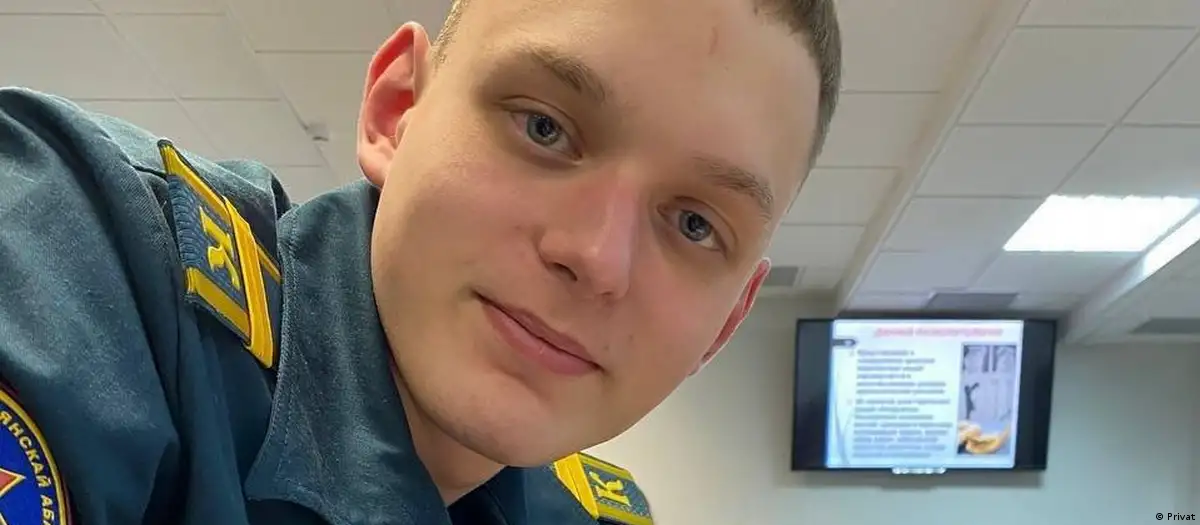
Queer people in the Belarusian security services are rarely discussed. Former Ministry of Emergency Situations cadet Alexey Pavlyukov decided to break the silence and told DW how he was forced to leave Belarus after being questioned by a KGB officer.
“When you’re gay (and work in the security services. — Ed.), you feel like you can’t be yourself. You can’t date anyone normally, you can’t love anyone. The risks are very high”, — admits Belarusian Alexey Pavlyukov. He enrolled in the military medical program, dreaming of becoming a doctor in Belarus’s Ministry of Emergency Situations and helping people.
During his studies, he had to conceal his sexual orientation. The turning point, he says, was an interrogation by a KGB officer, who forced him to admit that he was gay and name other queer people among the cadets. After that, Alexey decided to leave Belarus.
“We couldn’t tell anyone anything”
Alexey graduated from the lyceum affiliated with the Ministry of Emergency Situations. As one of the top cadets, he was then invited to continue his studies in the military medical program at the medical university (now the Military Medical Institute. — Ed), which trains doctors for the security services. “I simply wanted to become a doctor with the Ministry of Emergency Situations, to help people and do something good despite everything that is happening,” the interviewee says.
According to Alexey, from their very first days of study, the cadets were made to understand that any sign of disloyalty would have consequences. They were questioned about their political views and possible involvement in protests, and their phones were regularly searched, often without warning.
Alexey also recalls the story of a Belarusian-speaking cadet who was taken to the police station after one of his conversations with security officers: “He did not stop speaking Belarusian after that, but he began switching to Russian much more often.”
For Alexey, the start of his studies coincided with a period of self-acceptance, his first serious relationship, and the need to hide it: “I was only beginning to understand who I was at the time. I was dating a guy who was also from the ‘military academy.’ That’s the kind of country this is—we couldn’t tell anyone anything.”
According to the interviewee, all of this, combined with strict military discipline and demanding studies, caused him severe stress. The conversation with a KGB officer became the trigger that ultimately made him decide to leave Belarus.
“He forced me to come out”
“It was a very traumatic event in my life,” Alexey admits. He recalls that the security officer initially asked questions about politics and the events of 2020, then began pressuring him: “If you don’t tell us, we’ll find out everything ourselves.”
The KGB officer then told him to unlock his phone and disable the additional security in Telegram. Alexey says he later realized that his account had been accessed from another device. The security officer also saw that Alexey had downloaded a gay dating app. “He forced me to admit that I was gay and asked which other cadets I knew,” Alexey recalls.
According to Alexey, throughout the conversation the KGB officer used abusive language and claimed that he already knew about other LGBTQ+ people in their department. At one point, Alexey named someone who had been interrogated before him and whose surname was written on a sheet of paper in the security officer’s folder.
“He found my messages with an acquaintance, laughed at them, and took photos of the messages with his own phone,” Alexey says.
At the end, the KGB officer said that he would not be the one deciding the cadet’s fate, but that he would visit him again soon. “I walked out and realized that I was leaving Belarus. I was tired of all of it. That was the final straw,” the interviewee says.
“Their goal is to force people to cooperate”
Alexey believes that the KGB officer found him through a chain of acquaintances and contacts among other queer people. He assumes that one of them may have come to the attention of the security services after taking part in the protests.
“They detained one guy, took his phone, and then used his messages to track down others,” the interviewee surmises. – They (the security services. – Ed.) come in, start asking questions, digging around, looking for connections. I think their goal is to make people more loyal or force them to cooperate.” Alexey is certain that if he had remained in Belarus, he too would probably have been blackmailed and pressured into cooperating.
“I’m afraid to imagine what would have happened if this situation had occurred now, after the law was passed (introducing administrative liability for “propaganda of homosexual relations.” – Ed.),” says Alexey.
He notes that there are quite a few queer people in the security forces and government agencies, but they are forced to hide it and adapt.
“I wouldn’t want anyone else to go through what I did”
Why do queer people enroll in programs related to the military and security services? Alexey believes that many simply have no idea what awaits them. “There’s no information anywhere about how much pressure they put on queer people there. Sometimes they don’t come for you right away: they came for me after a year, and for my friend after four years,” he says.
According to Alexey, many cadets are also held back by financial obligations to the state: they sign a contract, and the state pays for their education, accommodation, uniforms, and living expenses. If they are expelled, they may be required to reimburse some of these costs. “It’s just an unaffordable amount of money,” says Alexey.
After moving to Poland, Alexey needed time to recover from what he had been through. He has now enrolled at the Jagiellonian University in Kraków, where he will study biotechnology.
Alexey decided to tell his story publicly because he believes the issue of queer people in the Belarusian security services is virtually invisible. “My story is probably one of the first to be told by someone who experienced it firsthand. It’s important to me that people hear about this,” Alexey notes. “I wouldn’t want anyone else to go through what I did.”
Tatyana Gargalyk / Deutsche Welle



0 comments
Enter your email and we will send you a one-time code. No passwords, no accounts.
Code sent to
If the email does not arrive in your inbox within a few minutes, check your Spam, Junk or Promotions folder — some mail services may wrongly place automated messages there.