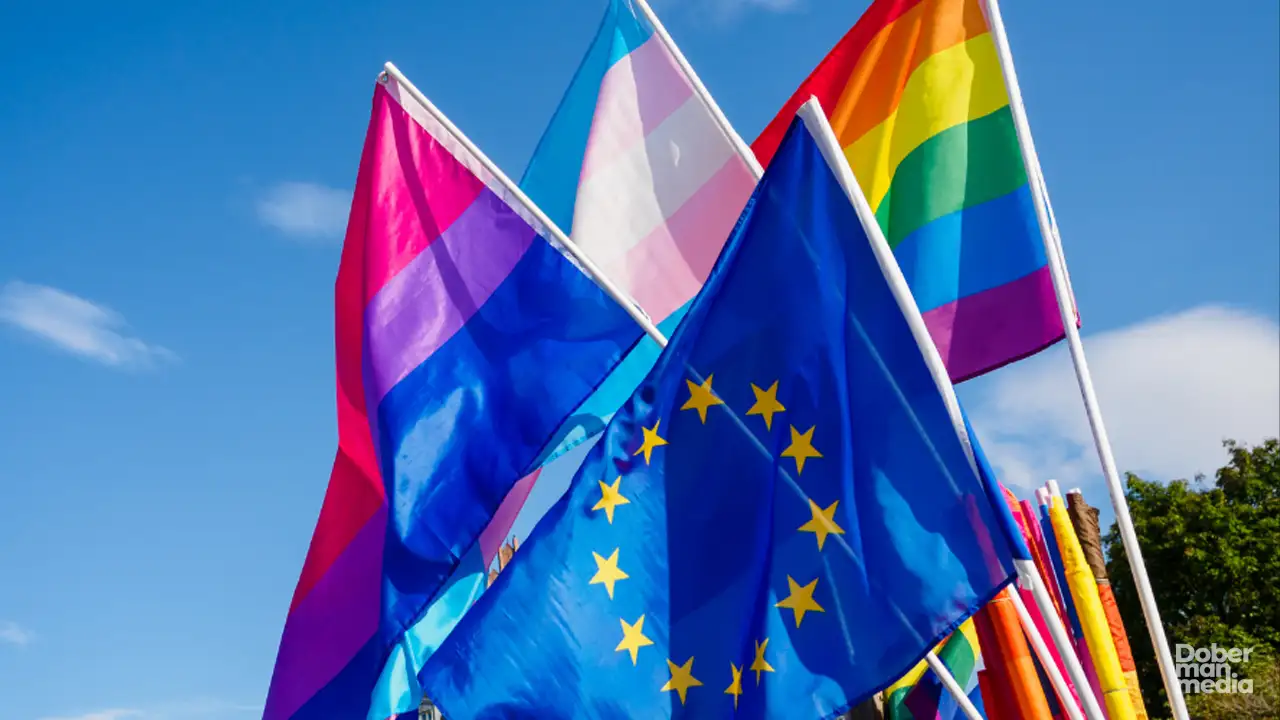

Russian diplomats and lawmakers have touted the success of the new migration policy: according to them, residents of Western countries are supposedly seeking en masse to move to Russia because of the economic crisis, the destruction of the middle class, and “LGBT propaganda.” However, Doberman Media examined the statistics, and the agencies’ hard numbers paint a very different picture—the scale of this phenomenon is close to the margin of statistical error.
How did it all start?
Citizens of European countries want to move to Russia because they disagree with their governments, LGBT propaganda, and social inequality. This was reported by Igor Popov, Russia’s Consul General in Geneva.
“They point out that they are unhappy with the policies of the local authorities, the growing and increasingly visible economic and social inequality, and the erosion of the middle class. They are dissatisfied with the situation here”, Popov told RIA Novosti.
In addition, Europeans oppose LGBT propaganda and want to shield children and future generations from it, Russian propaganda claims.
Earlier, Russian Foreign Ministry spokesperson Maria Zakharova also noted that “residents of Western countries are showing interest in moving to Russia.”
On providing humanitarian support to individuals who share traditional Russian spiritual and moral values 🤦
In August 2024, Russian President Vladimir Putin signed Decree No. 702 “On Providing Humanitarian Support to Individuals Who Share Traditional Russian Spiritual and Moral Values”.
The program offers citizens of “unfriendly” countries (the list includes the entire European Union, the United States, the United Kingdom, Canada, and others) a highly simplified process for entering the country and obtaining legal status. To move, they no longer need to:
- Pass a Russian language proficiency exam;
- Demonstrate knowledge of Russian history and the fundamentals of Russian law;
- Wait their turn under the annual government quotas for temporary residence permits (TRPs).
Those wishing to apply are issued a special three-month private visa to enter Russia and subsequently submit their TRP application from within the country.
According to official data from the Consular Department of the Russian Ministry of Foreign Affairs and the Ministry of Internal Affairs:
- During the program’s first full year (2025), the so-called “traditional values visas” were issued to 1,112 people from across the West.
- The leading countries by number of documents issued were Germany (168 visas) and France (140 visas), followed by the United States (105 visas) and Italy (100 visas). Several dozen people arrived from the Baltic states (mainly Russian-speaking residents of Latvia, Estonia, and Lithuania).
- By mid-2026, the total number of applications submitted by Western citizens had risen to approximately 3,400.
Why don’t these figures amount to a “mass exodus”?
The population of the European Union is approximately 450 million people.
Even if we take the total number of applications submitted over the entire period (3,400 people) and compare it with the EU population, the proportion who have left is approximately 0,00067% — that is, about seven people per million Europeans. From a demographic and sociological perspective, this is not a migration trend but a handful of isolated cases.
Most of those relocating under this program are either individual conservative activists and bloggers seeking to monetize their views through pro-Kremlin media, or ethnic compatriots with dual identities—not a broad segment of Europeans who have decided to radically change where they live because of their countries’ domestic policies.
How propaganda manipulates the facts
News stories like these are a classic example of state propaganda at work, skillfully inflating isolated, eccentric cases into a “global trend.”
No sensible European would willingly trade a comfortable life for the realities of Russia amid an ongoing war, isolation caused by sanctions, a severe economic crisis within the Russian Federation, and a shattered legal system.







0 comments
Enter your email — we’ll send you a one-time code. No passwords or accounts.
Code sent to
If the email doesn't appear in your inbox within a few minutes, check your spam, junk, or promotions folder, as some email services may mistakenly place automated messages there