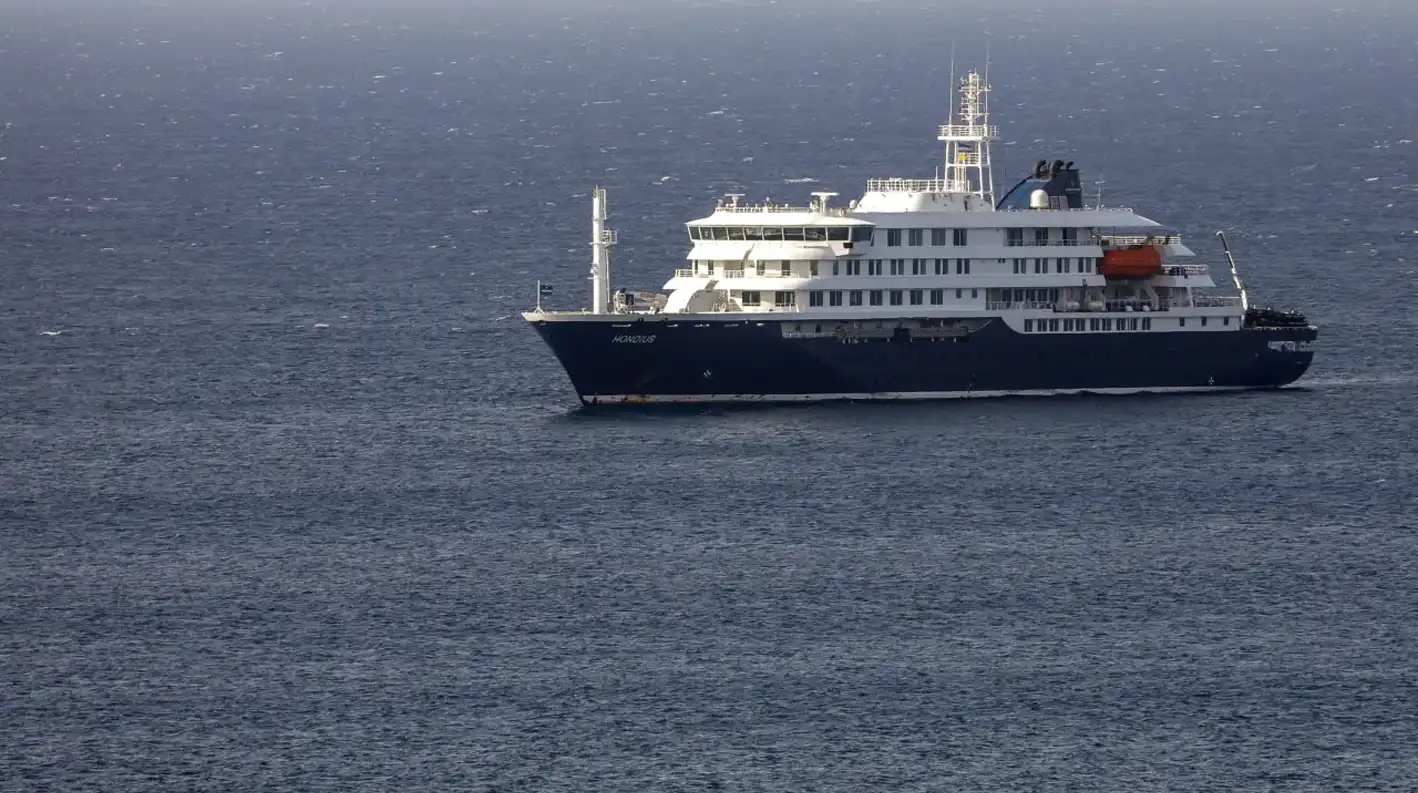

Three dead. Eight infected. The ship is anchored off the coast of Cape Verde, which refuses to let it dock. The virus has already reached Europe. Here’s what we actually know about the hantavirus outbreak on the MV Hondius—and why it’s both alarming and no cause for panic.
Table of Contents
What happened, anyway?
In early May 2026, the WHO received a notification from the Netherlands regarding a cluster of severe respiratory illnesses on the cruise ship MV Hondius. By that time, two passengers had already died, and another was in critical condition in an intensive care unit in Johannesburg.
The cruise ship departed from Ushuaia, Argentina, on April 1 and was sailing through Antarctica and the islands of the South Atlantic toward Cape Verde. There are 149 people from 23 countries on board: tourists and crew members. One of the crew members is a Russian citizen.
The first symptoms appeared among passengers as early as the beginning of April. But at first, the illness looked like the flu—and no one suspected anything.
How events unfolded
On April 6, a passenger from the Netherlands developed a fever, headache, and mild diarrhea. It looked like a typical upper respiratory infection. On April 11, his condition deteriorated rapidly, leading to respiratory failure and death. His wife disembarked on Saint Helena to accompany his body back to their homeland—and soon died herself from the disease in South Africa.
- On April 27, a British citizen fell ill. He was evacuated to Johannesburg, where he tested positive for hantavirus.
- On May 2, a German citizen dies on board. The Netherlands notifies the WHO and the European Union. The ship drops anchor off Cape Verde—the country’s authorities refuse to allow it to dock.
- On May 5–6, laboratory tests confirm the strain—the Andes virus (ANDV). Three infected individuals are evacuated by air ambulance to the Netherlands and Germany. In Switzerland, a passenger who had already disembarked from the ship is diagnosed with the virus. Reports emerge of an infected Frenchman who had never even been on board.
What is the Andes virus—and why is it worse than the “typical” hantavirus?
Hantaviruses are a large family of viruses carried by rodents. In Europe, they cause hemorrhagic fever with kidney damage. In South America, they cause hantavirus pulmonary syndrome, which is far more deadly, with a fatality rate of up to 40%.
The Andes virus is a South American strain, and it has one characteristic that no other hantavirus has: it can be transmitted from person to person. This happens rarely, only during close and prolonged contact—but it is possible. All other hantaviruses are transmitted only by rodents.
The symptoms follow the same pattern: At first, there are several days of fever and gastrointestinal symptoms, which can easily be mistaken for the flu or food poisoning. Then, the condition deteriorates rapidly: pneumonia, acute respiratory distress, and shock. The incubation period ranges from one week to one and a half months, most often around two weeks.
There is no specific treatment: only intensive supportive care, mechanical ventilation, and resuscitation. There is also no vaccine.
How did the virus get onto the ship?
No one knows for sure yet. The itinerary included Antarctica and islands in the South Atlantic, which are home to abundant wildlife and active rodent populations. The WHO speculates that one of the passengers became infected before boarding or during one of the shore excursions. Argentine authorities claim that no one had any symptoms when the ship departed from Ushuaia.
But there's a paradox: Several people died at once, even though the hantavirus “should not” spread inside the ship. Either everyone had an independent source of infection, or transmission between people did occur after all. The investigation is ongoing.
Why the incident in France is important
A French citizen has been hospitalized with suspected Andes virus—and he was never on board the MV Hondius. According to one account, he was on the same flight as the widow of the first passenger to die—the very woman who disembarked on Saint Helena and later died in South Africa.
If transmission via air travel is confirmed, it will be a documented case of ANDV transmission through brief contact. This won’t change the biology of the virus (it’s still not the flu), but it sets a troubling precedent. For now, it’s just a theory. Health officials are tracing all of the deceased’s contacts.
Is this a new strain of COVID-19? Should we be afraid?
No. SARS-CoV-2 spread through airborne droplets with tremendous efficiency and did not require any direct contact with animals. The Andes virus works differently: it does not “linger” in the air, is not transmitted by sneezing on a bus, and has no mechanism for mass transmission.
The Main Danger of ANDV — Its severity once infection has occurred: a 40% fatality rate, rapid progression, and no treatment. However, this is a disease with a high threshold for transmission, not a high reproduction number. Both the WHO and the ECDC assess the risk to the general European population as very low.
What is happening now is a serious epidemiological event that requires attention. It is not a precursor to a pandemic.
What does this mean to me personally?
Unless you were on board the MV Hondius and had close contact with one of the passengers, the likelihood of infection is close to zero. There is no natural reservoir for the Andes virus in Europe.
If you have acute respiratory symptoms and have recently traveled to South America or been in contact with potentially infected individuals, see a doctor and report this immediately. Early diagnosis and intensive supportive care significantly improve your chances of survival.
Panic doesn't protect you. Information does.
This material was prepared based on data from the WHO, the ECDC, and public sources as of May 7, 2026. We will update it as new data becomes available.








0 comments
Enter your email — we’ll send you a one-time code. No passwords or accounts.
Code sent to
If the email doesn't appear in your inbox within a few minutes, check your spam, junk, or promotions folder, as some email services may mistakenly place automated messages there