
Sometimes the most accurate articles aren't written by the editorial staff, but by you. One of our readers sent us this text. We’re publishing it with almost no edits—we just ran it through an AI to correct minor errors. The author didn’t want to give their name and asked us not to use a pseudonym—so that this text could speak to anyone who has found themselves in this situation. If you also have a story you'd like to share, please send it via this form — anonymously or not.
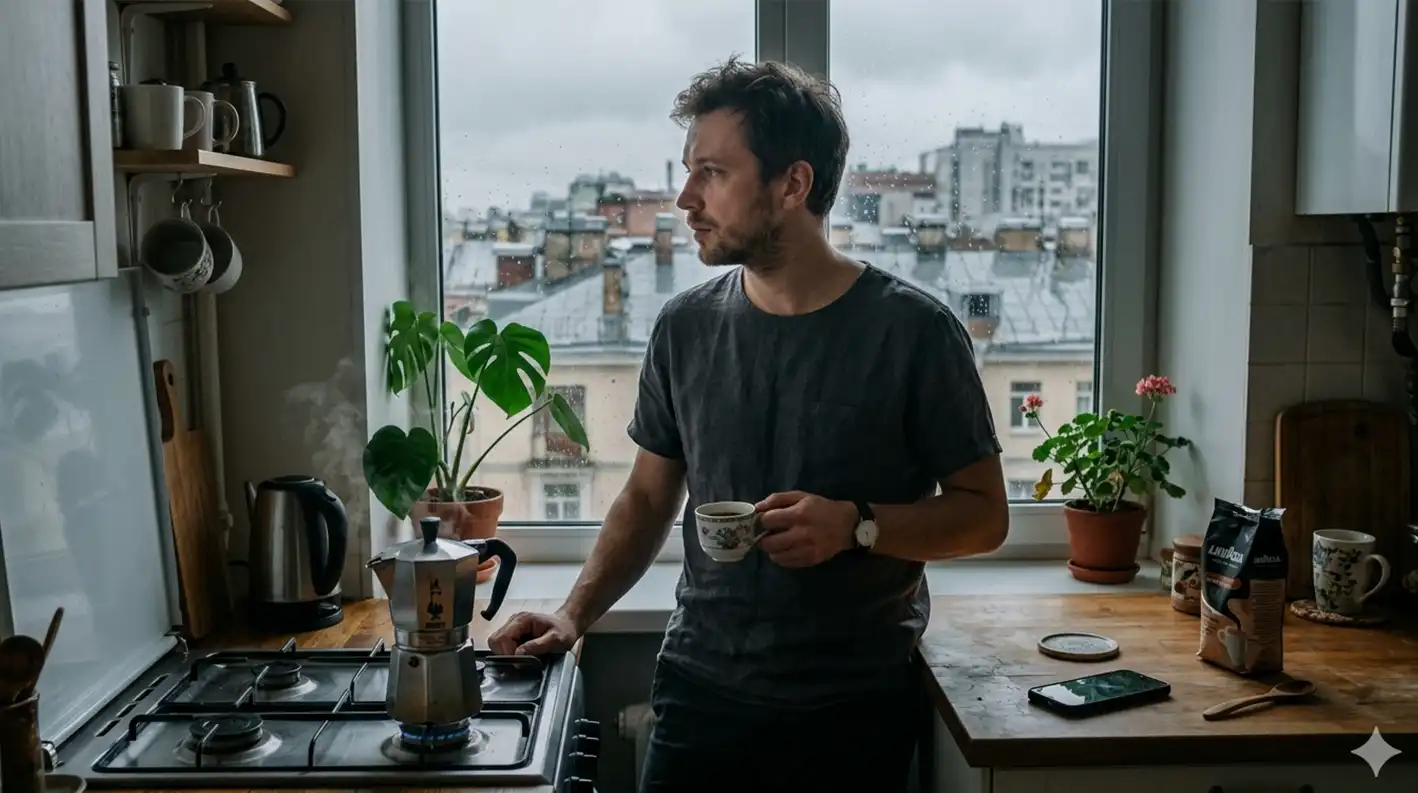
I’m thirty-four years old, I live in Moscow, and every morning, when I turn on my VPN and open Instagram, I read about how my friends are having breakfast in Tbilisi, strolling through Berlin, or complaining about the rain in Amsterdam. I tap the heart icon. I write: “Cool, I’m jealous.” I put my phone away. I go to the kitchen to make coffee.
I'm doing fine.
That’s exactly how I answer when people ask. Everything’s fine, I’m working, I’m getting by. Sometimes I add something specific—a new project, a good movie I watched over the weekend. The details make it sound more believable. I didn’t set out to learn this—I just realized at some point that I was doing it automatically, like brushing my teeth.
The problem is that I don't know exactly when it started. And I don't know if it's true—that everything is fine with me.
I was supposed to leave in the spring of 2022. I had a plan—not really a plan, more like an intention that I nurtured like a houseplant: someday, when the circumstances were right, I’d pack a suitcase and leave. Berlin. Or Barcelona. Or just somewhere where I could breathe.
The right circumstances arose—and I didn't leave.
First there was one reason: my mom—she has a heart condition—I can’t abandon her. Then another: work—my contract runs until the end of the year—I can’t let people down. Then a third, a fourth, a fifth. The reasons were real—I wasn’t making them up. But I noticed how, with each passing month, they became more and more elaborate, more and more convincing. It was as if some part of me was acting as a lawyer for my inaction—and winning the case every single time.
My friends were leaving. I stayed behind. And I told myself: I made a conscious choice. I'm not a coward. It's just that my circumstances are different.
Maybe. But sometimes at three in the morning, when I can’t sleep, I wonder: what if I was just afraid? What if behind all those reasons lay a simple fear—the fear of the unknown, the fear of starting from scratch, the fear of finding myself alone in a foreign city, without the language, without context, without my usual way of being myself?
I don't know the answer. I try not to think about it for too long.
There’s a word called “dissociation.” Psychologists use it when they talk about a state in which a person seems to be observing their own life from the outside. Not living—just observing. I came across this word by chance while reading an article, and suddenly thought: Oh. So that’s what it’s called.
Because that’s exactly how I’ve been living for the past two years. A little on the sidelines of my own life. Everything happens—work, get-togethers with friends, rare dates, movies on Fridays—but it all feels slightly muted. As if a thin film were stretched between me and what’s going on.
You can't tell from the outside. That's the whole trick.
I look fine. I function normally. I’m witty in social situations—that’s basically my superpower: making jokes in any situation. It’s always served as a kind of armor. People see someone who’s doing just fine. And I see their relief—they don’t have to worry about me, they don’t have to offer help, they don’t have to sit there awkwardly, not knowing what to say. I’m doing them a favor. I’m comfortable in my own well-being.
Last fall, I was talking to Pasha—he moved to Vilnius a year and a half ago, and we've been friends for about ten years. He asked, as usual, “So, how are you doing over there?”
I started to answer out of habit—“I’m fine, I’m working”—and then suddenly stopped. The pause ended up being too long.
"Pash," I said, "to be honest, I don't know."
He paused. Then he said, “That’s more honest than usual.”
I laughed. But after the call, I sat there thinking about that line for a long time. More honestly than usual. So he knew. So everyone around here knows, more or less—and they just go along with the rules of the game because it’s easier that way for everyone.
We live in a culture that doesn't know how to treat people who are suffering. Especially when things are bad but not dramatic—not a crisis, not a catastrophe, just quiet and dreary and somehow off. There’s no language for this. No protocol. There’s only awkwardness and the desire to hear as soon as possible that everything’s okay and to breathe a sigh of relief. And I follow that protocol.
I catch myself constantly thinking about my own melancholy—and immediately snap out of it: People are at war, people have real problems—what are you whining about? It sounds like modesty, but really it’s just a way to shut myself up.

Effective and socially acceptable.
My psychotherapist—yes, I have a psychotherapist; that’s a whole other story—calls this “devaluing one’s own experience.” He says that pain isn’t measured by comparison. That my anguish doesn’t become any less real just because someone else’s anguish is greater.
I nod. Then I walk out of the office and start comparing again.
There’s something I don’t talk about openly with anyone—not even with Pasha, not even with my therapist, not completely. I’m afraid I’ve missed out on something important. Not just the chance to leave—something bigger. That while I was standing still, convincing myself that everything was under control, life went on without me. That my peers in Berlin and Lisbon are building something—new connections, a new version of themselves, a new understanding of who they are—while I’m stuck in the old one.
That's irrational. I know. You can build a life for yourself in Moscow, too. You can live a full life here, too.
But sometimes I go on Instagram and see a photo of Dima—we went to school together, and he moved to Prague—at some kind of queer event, laughing, with strangers around him, and everyone looks like they’re truly having a good time. Not in the sense of “I’m doing okay,” but in the sense of “really good”—physically, without any pretense.
And I feel something sharp and ugly. Not envy—or rather, not just envy. Something like grief.
I was talking to a friend of mine, Kostya, the other day—he’s still here, too. We were drinking beer in his kitchen, and at one point he said—as an aside, staring at the table—“Sometimes I think I’m just waiting. I don’t know what for.” Just waiting. I looked at him and thought: me too.
We didn't pursue that topic any further. We switched to something else—I think we were talking about a TV show. But I remembered it. I'm just waiting. Because it was the first completely honest, unvarnished statement I'd heard from any of the others in a very long time.
We're all waiting. But no one is saying out loud what exactly we're waiting for.
I don’t know how this story ends. It has no resolution—I didn’t leave, I didn’t make any fateful decision, and I didn’t reach any epiphany. I’m still here, still making coffee in the mornings, still leaving heart emojis under photos from Berlin.
But something has changed—just a tiny bit. I’ve stopped automatically replying, “I’m fine.” Not always—sometimes I still say it anyway, because the situation isn’t right or because I’m too lazy to explain. But sometimes I pause. I think for a second. Sometimes I say something else.
It seems insignificant. But I’m starting to think that this is exactly where it begins—with the pause before the usual response. From the moment you stop doing people a favor by putting on a show of well-being.
I'm thirty-four. I live in Moscow. I don't know what will happen next.
And for the first time in a long while, that's actually true.









0 comments
Enter your email — we’ll send you a one-time code. No passwords or accounts.
Code sent to
If the email doesn't appear in your inbox within a few minutes, check your spam, junk, or promotions folder, as some email services may mistakenly place automated messages there