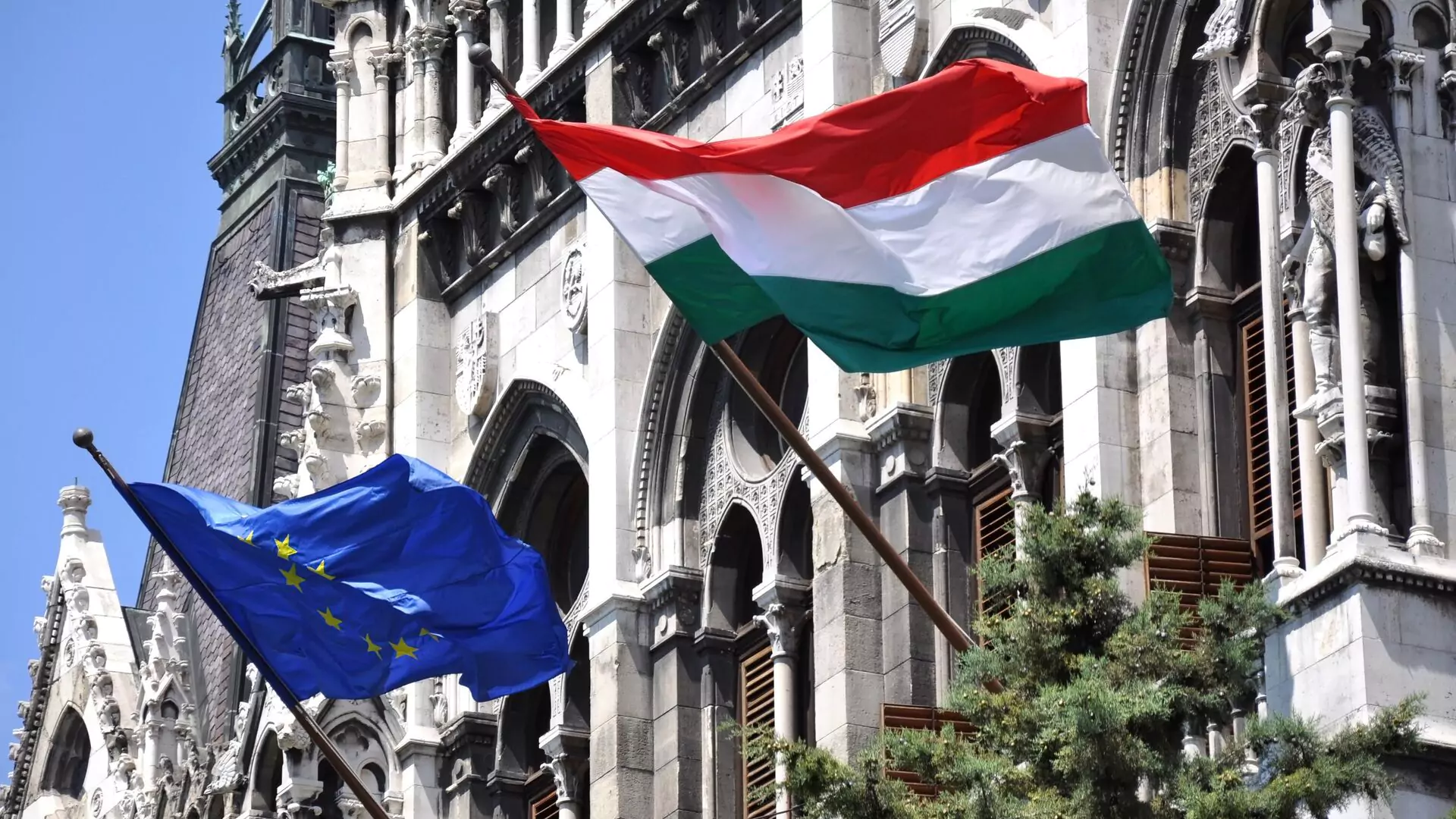

In late June in Budapest The 30th anniversary Gay Pride parade took place, the oldest in the former Eastern Bloc. It was not supposed to take place: a few months earlier, Viktor Orbán’s government had passed amendments allowing any LGBT events to be classified as violations of the Child Protection Act. This led to results that were quite the opposite of what Orbán had expected. On Pride Day, tens of thousands of people took to the streets for an “unauthorized march.” — not only—and not so much—in support of the LGBT community, but rather in defense of free speech. According to polls, 68% of Hungarians are dissatisfied with what is happening in the country. And the long-serving Orbán now faces a serious rival — Péter Magyar. The question of whether Hungary will remain the last dictatorship in the EU may be decided as early as next year’s parliamentary elections.

An Attack on Journalists
The dismantling of democratic institutions in Hungary began in the mid-2010s, but this process did not attract widespread international attention until 2020, when Viktor Orbán’s government began exploiting the COVID-19 pandemic for its own ends. On March 30, 2020, the parliament passed the so-called “coronavirus law,” which granted the government the right to issue decrees without parliamentary approval for an indefinite period.
From March 30 to June 18, 2020, more than 150 decrees were issued under this framework—and by no means were all of them related to the pandemic or public health. In particular, criminal liability for “spreading false information” was introduced at that time.
Officially, it was claimed that the law was needed to combat disinformation and the spread of panic during the pandemic; however, its wording was as vague as possible, which provided ample opportunities to persecute independent journalists.
However, by that time, there were few independent media outlets left in Hungary. In 2020, pro-government business entities orchestrated the takeover of the website Index.hu, one of the largest independent media outlets (part of the old team later launched a new project—Telex.hu), while the government media regulator revoked the license of the last major radio station that had been critical of the government—Klubrádió. Most of the country’s media assets ended up concentrated in the hands of people close to Prime Minister Viktor Orbán and his inner circle. In 2024, Reporters Without Borders ranked Hungary 68th on its World Press Freedom Index.
Family values come first
The LGBT community is yet another target of Viktor Orbán’s attacks. “There is a global radical-conservative movement targeting the LGBT community and gender issues, and it is not unique to Hungary or Russia,” says Zsuzsanna Selenyi, program director at the CEU Democracy Institute Leadership Academy and author of the book *Tainted Democracy: Viktor Orbán and the Undermining of the Hungarian State*. According to her, conservative politicians use a narrative that plays on public fears related to transgender issues, especially in the context of children and pedophilia.
The law passed by the Hungarian Parliament on June 15, 2021, was formally aimed at combating pedophilia, as had previously been the case in Russia. However, in addition to this, it prohibited the “display of homosexuality and gender transition” by minors. The law was condemned by 16 EU member states and the European Commission as a violation of the right to freedom of expression. In April 2022, the Hungarian government organized a referendum on the law with four questions:
1) Do you support holding educational events on sexual orientation for minors in public schools without parental consent?
2) Do you support the promotion of gender reassignment procedures among minors?

3) Do you support unrestricted access by minors to sexually explicit material that could affect their development?
4) Do you support the display of media content related to gender-affirming procedures to minors?
Референдум был признан недействительным: ни по одному вопросу не удалось достичь требуемого порога в 50% действительных голосов, поскольку в результате активных действий правозащитных организаций многие избиратели решили бойкотировать референдум либо портили бюллетени. Тем не менее закон остался в силе.
The next crackdown began in March 2025, when the ruling majority amended the law on public assemblies. Now, a march featuring LGBT symbols in broad daylight in the city center was considered a violation of the Child Protection Act. This was intended to put an end to the annual Budapest Pride parade.

However, it didn’t just take place—it became the largest political demonstration in the country in the past decade and a half—despite the authorities’ warnings that they would use facial recognition technology to identify participants and hold them accountable. According to various estimates, between 200,000 and 250,000 people took part in the protest.
The Opposition: Old and New
The 2025 Budapest Pride parade was led by the capital’s mayor, Gergely Karácsony, who had been re-elected to a second term the previous year. Karácsony is a representative of the old Hungarian systemic opposition: from 2010 to 2014, he served as a member of parliament for Green Parties, then became head of Budapest’s 14th district and founded his own political movement, “Dialogue” (Dialogue).
His victory in the 2019 Budapest mayoral election was the result of a joint effort by all of the country’s major opposition parties. Many expected Karácsony to head the united opposition’s ticket in the 2022 parliamentary elections as well, but he withdrew his candidacy in favor of a far less well-known and popular candidate—Péter Márki-Zay. As a result, the ruling Fidesz party remained in power with 135 seats in parliament. The united opposition secured 57.
"In my opinion, that was a respectable result, — political analyst Adam Zoltan notes in an interview with The Insider. — Back then, in 2022, the regime was in a much more favorable position — both from an economic standpoint and in light of the international situation. To win 35–36% of the vote under those conditions — "Not bad at all."
However, after the parliamentary elections, the opposition coalition fell apart. On its own, none of the existing parties could have competed with Fidesz. It seemed that at that moment, Hungary’s future had been decided once and for all. However, a new and completely unexpected player soon appeared on the political scene: Péter Magyar.
"Against All" Candidate
Ironically, the government—which champions family values—has found its strongest opponent in recent years as a result of a pedophilia scandal. In 2016, following an investigation by the RTL television network, it came to light that János Vasharheyi, the director of an orphanage in the small Hungarian town of Bicske, had been sexually abusing the children in his care for decades.
In 2011, staff members at the children’s home first reported their suspicions to the authorities, but nothing came of it at the time: the affected children refused to testify. As it later turned out, they did so under pressure from Deputy Director Endre Konya, who helped the director cover up the crimes.
It was not until 2019 that both the director and his deputy were sentenced to prison. However, in early 2024, it was reported that President Katalin Novak had signed a decree pardoning Konya. This decision sparked a storm of outrage.
“From the perspective of Hungarian society, this was a huge political mistake—and not just a political mistake, but a moral sin,” explains András Bozoki, a professor of political science at CEU. The scandal led to the resignation not only of Novak but also of Justice Minister Judit Varga. “Orbán wanted to use this to stem the tide of public discontent, but that was already impossible—because that was precisely when Péter Magyar appeared on the scene,” says Bozoki.
The President of Hungary pardoned a person involved in a pedophilia scandal—the director of an orphanage—and resigned as a result
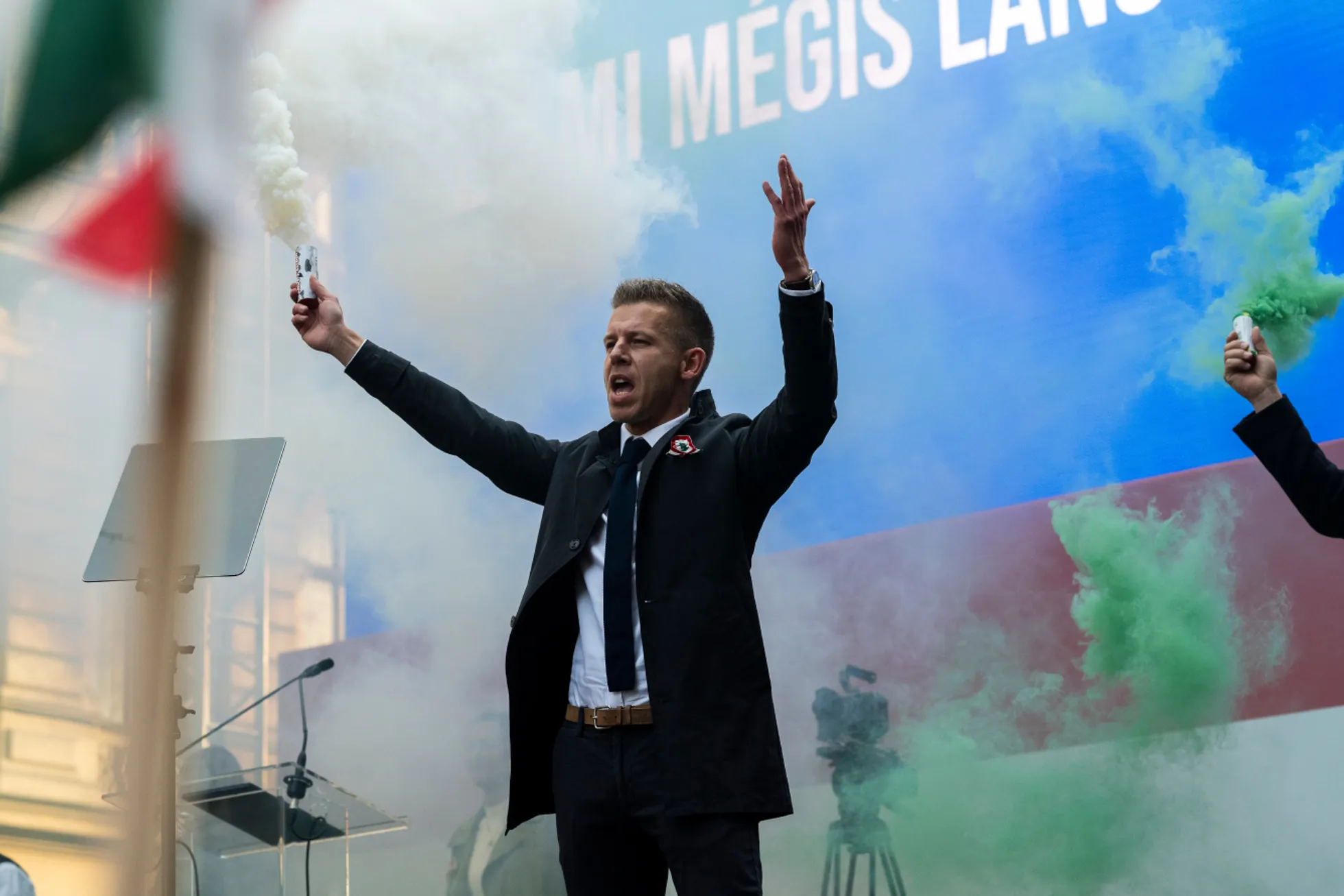
At the time, Magyar was virtually unknown to the public. All that was known about him then was that he had been married to Judit Varga for nearly twenty years (they divorced a year before the scandal) and had been a member of the Fidesz party for even longer — in short, he was a typical beneficiary of the regime. However, shortly after his ex-wife’s resignation, he unexpectedly announced Interview on the independent YouTube channel Partizán, where he announced that he was stepping down from all government posts so as not to be part of a system where “the real leaders hide behind women’s skirts,” while those responsible for the scandal remain in the shadows. In the interview, he also spoke out sharply against the corruption that pervades the regime.
“Corruption among those in power has been on the Hungarian opposition’s agenda for the past 15 years because its scale is simply unbelievable,” notes Zsuzsanna Selenyi. “But the thing is, when someone from within the system speaks out about this, it sounds much more convincing to many people. And Magyar suddenly became very popular.”
"In early February 2024, his popularity was at zero — "No one knew anything about him. But in early June, he won 30% of the vote in the European Parliament elections. It is unprecedented in Hungarian history for someone to gain such widespread support and sympathy in just three or four months," — adds András Bozoki. Unlike the old opposition, which is popular mainly among the educated residents of Hungary’s largest cities, Magyar targets the core electorate of Orbán’s Fidesz party, who live in small towns and villages.
Magyar is targeting the core voters of Orbán’s Fidesz party, who live in small towns and villages
“He knows this party inside and out and is essentially using its own tactics against it. He acts very quickly, with incredible efficiency and in a provocative manner. He is tireless. He travels to small towns. He specifically targets Fidesz supporters. This is a new tactic, and it’s making him very successful—and therefore very dangerous to the regime,” explains Bozoki.

The Failure of “Greater Hungary”
Magyar even flirts with Orbán’s most controversial idea—support for “Greater Hungary,” which existed within the borders prior to 1918, when the country’s territory was drastically reduced as a result of the Treaty of Trianon. Of course, Orbán had no intention of attempting to annex former Hungarian territories (at least, he did not voice such plans); his idea was different: to create thriving Hungarian autonomous regions in neighboring countries. In 2010, Orbán passed a law granting the right to obtain citizenship through a simplified procedure not only to ethnic Hungarians but also to any descendants of subjects of the Kingdom of Hungary.
Millions of people in Ukraine, Romania, Slovakia, Croatia, and Serbia have been affected by this law. In just the first four years of the law’s implementation, the country’s population grew by more than 700,000 people. Only a small fraction of them decided to move to Hungary after obtaining citizenship, but attracting new residents was never Orbán’s goal.
He tried to create what sociologist Tamás Kish called "ethnic parallelism" — a system of institutions in which Hungarians living abroad can go about their daily lives as if they were in Hungary: receive an education in Hungarian, consume Hungarian-language media content, and so on. Kish used this term when speaking about Transylvania — a region of Romania where Hungarians make up more than 17% of the population. But it is also entirely applicable to other countries.
The ideas of “Greater Hungary” strained Orbán’s relations with neighboring countries, whose governments, predictably, were not particularly keen on having national autonomous regions within their territories—potential sources of separatist sentiment. However, this, along with his strongly negative stance toward migrants from the Middle East, helped him gain the support of those who espouse right-wing ideas.
For many years, the far-right wing of Hungary’s political spectrum was occupied by the Jobbik party, which was not on the best of terms with the Orbán government. The leader of Fidesz resolved the issue of competition in a radical way: he began to drift to the right, attracting the more moderate segment of Jobbik’s electorate, while creating a separate party for the more radical faction. a controlled alternative — the “Our Homeland” Movement (Mi Hazánk Mozgalom). As a result, Jobbik—which as recently as 2018 was the country’s second-largest party—lost its influence.
However, in 2025, the balance of power shifted once again. On May 9, at the opening ceremony for the renovated Tihan Benedictine Abbey, Orban unexpectedly spoke out in support of George Simion (at the time a candidate for the Romanian presidency), who had previously anti-Hungarian protests. This was seen as a betrayal of Romania’s Hungarian minority and caused many on the right to turn away from Orbán. Magyar, meanwhile, seized the moment and, just a few days later, as a sign of support for the Romanian Hungarians set off on a march from Budapest to the Romanian border.
Will Orbán opt for the “Russian scenario”?
In Russia in 2012, following the rallies at Bolotnaya Square and Sakharov Prospekt, the authorities decided to prevent the opposition from gaining strength at any cost. This led to violent crackdowns on political gatherings, arrests, and murders. Could it be that Orbán, having closely studying and using Will it follow in the footsteps of its “big brother”? Experts interviewed by The Insider believe that won’t happen.
And the initial fallout from the Pride parade confirms this. On July 3, the first administrative case was filed against a Pride participant—the defendant was a young activist named Lily Pankotai. However, the case was closed as early as July 9, and the police officially stated that they would not prosecute Pride participants. A Hungarian “Bolotnoye Case” did not materialize—at least not yet.
The Hungarian “Swamp Case” Didn’t Pan Out After the Pride Parade
“It’s very important to understand: Orbán never uses overt force,” says András Bozoki.
“In Hungary, no one is imprisoned, beaten, or killed. And there are two reasons for this. First, there is simply no need for it. Those in power already have a constitutional supermajority secured through elections—even if those elections were dishonest and unfair, they were still, formally speaking, elections. And it is extremely important for Orbán to maintain a certain distance. Second, this has to do with Orbán’s own background. After all, he isn’t a former secret service agent, not a “KGB man.” He comes from the democratic opposition of 1989. His entire political career began with a stand for democracy—with that very speech on June 16, 1989, when he publicly spoke out against the regime. Therefore, no matter what happens, he must maintain this narrative. His image must always remain that of a freedom fighter. He cannot openly turn into a dictator; his charisma would crumble instantly, and he would lose everything in literally the blink of an eye if he resorted to violence.”
Adam Zoltán points out that the only time in the country’s post-socialist history that serious violence was used against protesters was in 2006, when Socialist Party leader Ferenc Gyurcsány was in power. “And here’s an important point: the Orbán regime actively uses 2006 as an example of ‘hostile action,’” the political scientist notes. “Orbán and his government are building their own legitimacy by contrasting themselves with the police violence of 2006. This is also a kind of political constraint—they cannot afford to use force because they themselves have opposed it for so many years. That would lead to a loss of support. I don’t think they’re ready to go that far.”
Instead of overt force, Orbán uses political and economic pressure. In particular, in May 2025, a draft law titled “On Transparency in Public Life” was introduced, which would grant the government broad authoritarian powers to punish those it considers a threat to national sovereignty.
Organizations that receive foreign support—whether in the form of private donations or grants (including European Union grants, on which most Hungarian NGOs depend in one way or another)— — without government authorization, may be fined an amount 25 times greater than the funding received, and refusal to pay will result in a ban on their activities and forced closure.
Thus, there is no doubt that Hungary has gradually transformed from a “partly free” country into an authoritarian one—one that remains within the EU. The Orbán government has systematically dismantled democratic institutions, using any crisis as a pretext to expand its power.
However, the success of the 2025 Budapest Pride and the rise in Péter Mályar’s popularity show that Hungarian society is not prepared to meekly accept this authoritarian drift any longer. According to a sociological Research, проведенному в начале года институтом Republikon, 79% венгров в случае референдума о выходе из ЕС проголосовали бы за то, чтобы остаться в Евросоюзе. В другом research, результаты которого были опубликованы 1 июля, 68% опрошенных заявили что недовольны происходящим в стране. Но действительно ли наступила точка невозврата, покажут новые парламентские выборы, которые пройдут в Венгрии уже в следующем году.





0 comments
Enter your email — we’ll send you a one-time code. No passwords or accounts.
Code sent to
If the email doesn't appear in your inbox within a few minutes, check your spam, junk, or promotions folder, as some email services may mistakenly place automated messages there