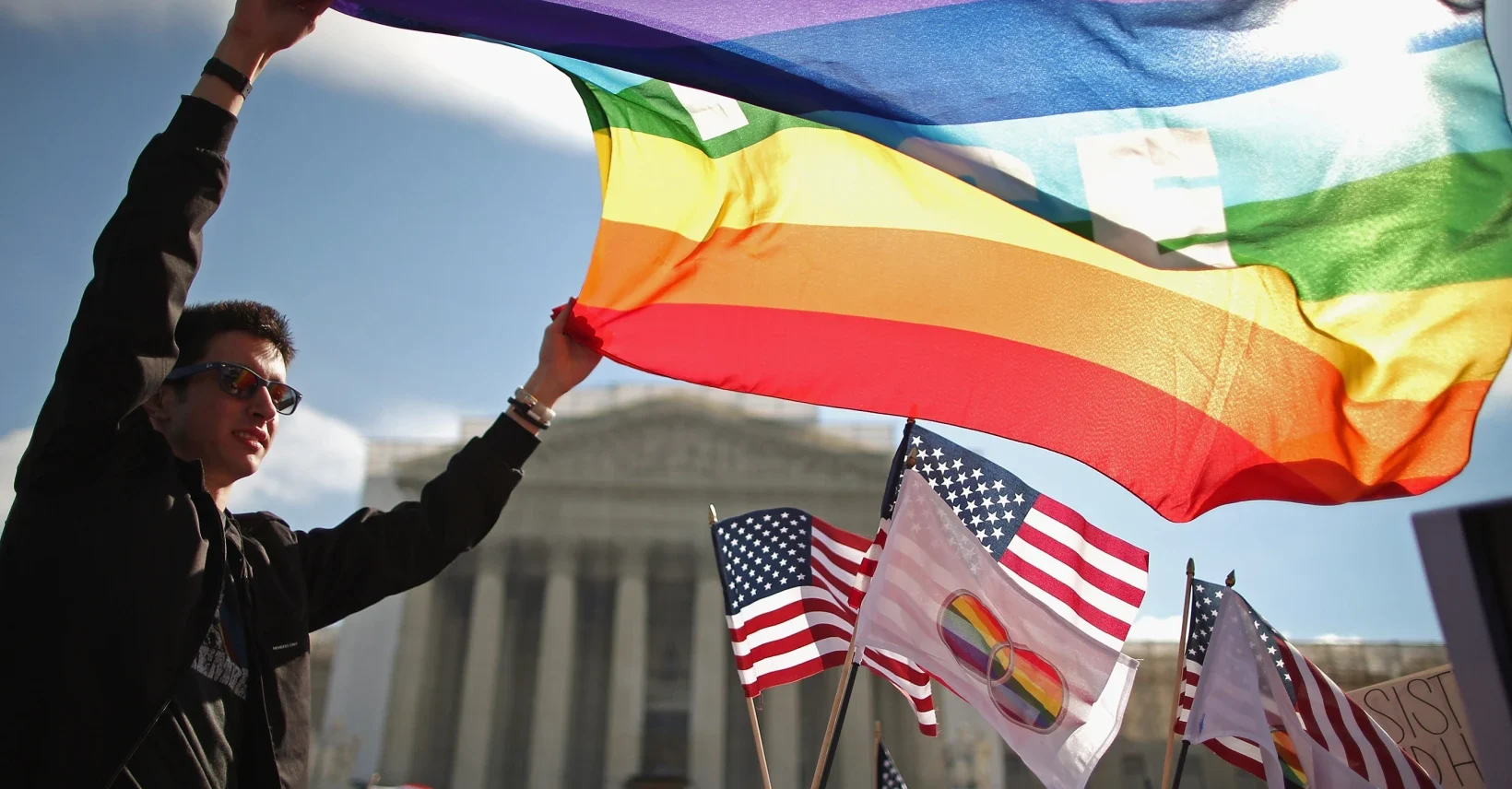

In this episode, we gathered in Brooklyn in a warm and cozy lineup: me, Oleg, and two Dimas — to frankly and without embellishment discuss a topic many prefer to keep silent about.
It would seem that by moving from Russia and the CIS countries to the USA, we get everything we dreamed of: the right to officially register marriages, walk hand in hand with the person we love, attend gay pride parades, and live without fear. But what happens next? Why, after the first two years of "hunger syndrome," sauna visits, and endless cruising, does saturation set in, and why does building strong, deep relationships in New York turn out to be more difficult than living under harsh Russian restrictions?
We spoke candidly about how an excess of freedom devalues romance, why after winning equal rights the community fragments into individualists, what material realities (and rents starting at $2500) immigrants in New York face, and what we should now unite around — from helping newcomers and taking joint trips to San Francisco to shared dreams of having children.
Watch the episode to the end, write in the comments what brings you together, and don’t forget to leave our secret fruit in the comments!
"Hunger syndrome": from repression to psychological overdose
For someone who came from the post-Soviet world, encountering American levels of personal freedom feels like a sudden decompression sickness. Years of living in an atmosphere of secrecy, when meeting in a park or a gay club required caution and conspiracy, are replaced by full legality. In the first months and years of immigration, this leads to a phenomenon that the podcast participants themselves call "hunger syndrome."
The initial urge to rush headlong into freedom shows up everywhere: from visiting every gay bar and joining pride marches to freely going to nude beaches in Miami or saunas without worrying about judgment. But euphoria is quickly followed by saturation. As host Oleg notes, when absolutely everything is available to a person, the value of any individual experience drops sharply.
Freedom without internal boundaries and the habit of it often takes a toll on mental health. Immigrants are overwhelmed by possibilities: the ease of sex without commitment, access to substances, and the absence of external taboos lead to a blurring of personal values. If in Russia illegality and social pressure forced people to hold on to the partner they had found — one of the speakers recalls his past relationship in Moscow that lasted ten years — then in New York, endless cruising and rapid partner changes replace stability.
"We fought for rights, but lost each other": The paradox of achieved equality
The main institutional problem of the modern gay community in the USA is that its basic political goals have already been achieved. The right to register marriages, openly express feelings, and walk hand in hand through the streets of New York has become the norm.
Minor political and social tensions — such as conservative administrations shutting down gender-neutral bathrooms at universities or canceling equality programs in schools — provoke irritation rather than spur mass activism. Local city initiatives, such as New York Mayor Eric Adams’s program to install modern heated public toilets in Brooklyn parks, solve everyday problems but do not offer a global idea to unite people.
When the common external enemy disappears, society breaks down into separate individuals. The discussion participants note: without a shared external threat, people inevitably become selfish. In the absence of social discrimination, everyone turns inward toward their own interests, personal career, and everyday comfort.
Dating as a fast transaction: From Tinder to Sniffies
An abundance of choice combined with digital dating infrastructure has radically changed the mechanics of romantic relationships. The metropolis offers the full spectrum of apps: from classic Tinder to specialized services like Grindr or Sniffies, geared toward quickly finding partners by geolocation.
However, easy access to meetups has led to a decline in commitment. Podcast participants admit that regular dates in New York often turn into “a year and a half of casual sex” with no obligations or plans for the future. Why build complex relationships and make compromises with one person if the app offers hundreds of new options the next day?
A further barrier is the cultural gap when trying to build relationships with Americans. Differences in mindset, financial expectations, and habits of interaction create tension. At the same time, memories of life in Russia preserve an image of romantic pursuit: dates in night parks, long efforts to win trust, and a strong emotional bond grown out of overcoming difficulties together. In New York, this romance gives way to pragmatism and separate living.
Brooklyn survival economics: Rent from $2,500 and the middle-class trap
Alongside romantic atomization, immigrants are pressured by New York’s harsh economy. The financial factor becomes decisive in how a person manages their time and energy.
The cost of renting even a one-bedroom apartment or studio in Brooklyn and Manhattan starts at $2,000–2,500 a month, and with utilities and living expenses, the figure rises to $3,000. Podcast participants estimate the lower threshold for entering New York’s middle class at $5,000–10,000 in monthly income.
At the same time, income level in the U.S. is often determined less by a degree or formal experience than by the ability to sell oneself. One guest, a hairstylist, gives an example: a specialist with the same qualifications can charge $20 an hour or $120 an hour — it all depends on charisma and self-presentation skills.
However, the pursuit of financial stability requires sacrifices. High taxes, working 50–60 hours a week, and constant professional hustle drain emotional resources. By the end of the workweek, a person has no energy left for either romantic courtship or participation in public life.
A new axis of unity: Why meet if there’s nothing to fight for?
If the political struggle is over, what can Russian-speaking gay immigrants build community around today? In the discussion, the podcast participants outline several practical directions:
The first direction is grassroots mutual aid for newcomers. In the first years after moving, immigrants are united by the shared task of survival: legalizing documents, finding their first home, learning the language, and getting a job. LGBTQ centers and unofficial group chats become the main resource for adaptation.
The second direction is shared leisure and travel. Instead of political rallies, the unifying force becomes group outings — for example, shared house-sharing in San Francisco or trips to Miami, group karaoke nights, or dinners in Asian restaurants in Brooklyn.
The third direction is parenting and family issues. The desire to build a family and raise children becomes a new point where interests intersect. Podcast guests note the growing trend of co-parenting — a partnership between gay men and lesbians for jointly having and raising children without medical procedures or surrogacy.
In the end, American freedom does not guarantee automatic happiness. It merely removes external prohibitions and puts a person before an adult choice: the ability to consciously limit one’s selfishness, make compromises, and build deep human connections where there are no longer any external barriers to doing so.





0 comments
Enter your email and we will send you a one-time code. No passwords, no accounts.
Code sent to
If the email does not arrive in your inbox within a few minutes, check your Spam, Junk or Promotions folder — some mail services may wrongly place automated messages there.