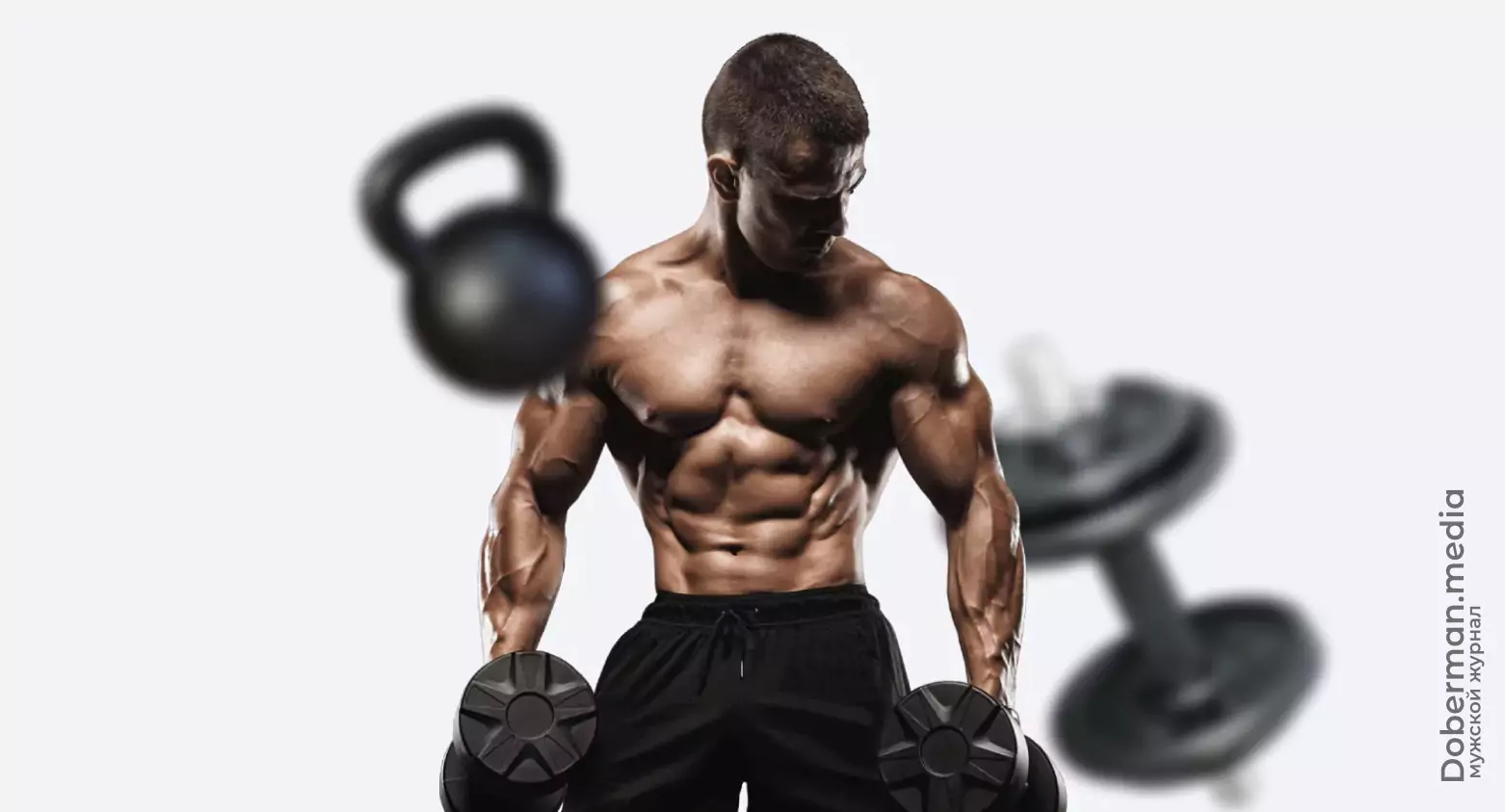

We debunk the most common myths that repel people from strength training.
Content:
- If you stop pumping, muscles will turn into fat
- One muscle group should be pumped on the same day
- Muscles grow only when working with heavy weights and a small number of repetitions
- You need to strain only with heavy weights
- Strength training worsens stretching
- Machines are more effective than free weights
- Slow, controlled movements give better results
- Protein-carbohydrate window
- Nothing can be done between sets
- Strength training is bad for your joints
1. If you stop pumping, muscles will turn into fat
Muscles cannot turn into fat, just as your bones cannot become muscles or connective tissue. These are different tissues of the body that simply cannot physically become something else.
But it is possible to get fat after stopping strength training. During and even after training, the body burns calories intensively. When you stop exercising, calorie expenditure is drastically reduced. If you don't change your eating habits and the number of calories you consume, you risk gaining excess fat.
Кроме того, без тренировок вы начинаете терять мышечную массу уже через три недели. Одно исследование показало, что после семи недель без тренировок наблюдается атрофия 37,1% всех мышечных волокон.
Thus, your muscle mass decreases, and due to the excess of calories, the fat layer grows. This is where this myth comes from. The sculpted body becomes soft and loose, it seems that the muscles have turned into fat.
However, this can be avoided. Of course, without training, you will not be able to maintain muscle mass in the same amount, but if you reduce the calorie rate, you will not gain excess weight and maintain an attractive figure.

Calculation of protein per day*
In order to accurately calculate the daily intake protein intake for a man, you need to use our calculator.
*Based on recommendations from Donald Layman, Professor Emeritus of Nutrition at the University of Illinois. We recommend that you agree on your daily protein dosage with your doctor and/or trainer.
2. One muscle group should be pumped in one day
Many people still believe that the greatest progress can be made by pumping one muscle group once a week. However, this method of training is not the most effective.
Since you need time to recover and pump all the muscles, this mode reduces the amount of load on one muscle group, slows down progress and can cause a training plateau.
Instead, try to load three to four muscle groups in one workout. This way you will be able to load your muscles more often and at the same time not neglect rest. Periodically arrange high-intensity interval training or circuit training. These techniques help build strength, build endurance, burn more calories, and avoid a training plateau.
3. Muscles grow only when working with heavy weights and a small number of repetitions
Training with low weights and numerous repetitions has been proven to be as effective for muscle growth as exercises with heavy weights and low reps. The main thing is to perform the exercise until you get tired in the muscles.
Moreover, some experts consider 6-15 repetitions to be the ideal number for muscle hypertrophy.
Brad Schoenfeld, author of books on bodybuilding and fitness, claims that this number of repetitions creates the perfect balance between muscle tension and metabolic stress, which has a positive effect on muscle growth and strength.
In fact, progress can be made by exercising with your own bodyweight. Looking at the embossed fans of calisthenics - a system of exercises with your own weight on horizontal bars, parallel bars and wall bars - it is quite possible to believe in this.
4. You need to strain only with heavy weights
If you put a lot of weight on the barbell, you will have to strain all your strength to move it. However, many athletes believe that exercises with lighter weights do not require much exertion. This opinion prevents them from achieving better results.
By creating strong tension in the muscles, you ensure optimal communication between the sensory and motor parts of the nervous system. This means that your body has a better sense of its position in space, which allows the brain to provide more strength and power.
For example, if you grab the bar as hard as you can during barbell exercises, it will command the brain to use more muscles. Use this when working with any scale.
When you work with the bar, grab it as if you are trying to twist the barbell's neck, in regular squats, tense your buttocks as if you have a barbell of 100 kilograms on your shoulders. Do any exercise with maximum effort.
5. Strength training makes stretching worse
It is believed that strong muscles are necessarily stiff and compressed, so pumped people cannot reach the floor with their hands. In fact, the study confirmed that resistance training improves flexibility as well as static stretching.
However, strength exercises can only improve stretching if you perform them in full range. For example, if you do a squat with a barbell, perform it until your hips touch your shins, as in weightlifting, and not a quarter, as some athletes do.
The same goes for upper body exercises: if you are doing a dumbbell press lying down, go through the entire range of motion, stretching your chest and shoulder muscles at the lowest point.
6. Machines are more effective than free weights
Some athletes avoid training with free weights, believing that isolated exercises are better at loading and pumping specific muscles.
In fact, exercises with free weights are simply necessary in strength training. Simulators limit the range of motion, do not allow you to develop functional strength and do not train the interaction of different muscle groups.
What's more, one study found that free weight exercises were better at loading muscles. During a typical squat with a weight in the quadriceps, there was 43% more activity than during squats in the Smith machine.
7. Slow, controlled movements give better results
Many people believe that only conscious and controlled slow movements will help maintain proper technique and increase muscle growth.
This is only half true. The eccentric phase of the exercise, in which the muscles stretch under load (when you lower yourself into a squat or lower the bar in a bench press), really needs to be slow and controlled.
However, it is better to accelerate the concentric phase. This allows for the use of more fast type II muscle fibers, which have a higher growth potential.
8. You need to be in time for the protein-carbohydrate window
It is generally accepted that in the first 30-40 minutes after training, the body is very hungry for nutrients, and you can get the greatest benefits from eating a meal with protein and carbohydrates. Carbohydrates will become fuel for the body, and protein will be absorbed faster and will be used to restore muscle tissue.
However, the study did not find a link between the time of protein intake. The strength, power, and body composition of athletes taking protein supplements at different times had no significant differences after 10 weeks of the experiment.
Another study designed to determine whether this post-workout anabolic window even exists found that it is much wider than is commonly believed. After a workout, you have about 1.5 to 2 hours to eat a meal rich in protein and carbohydrates.
9. You can't do anything between sets
It is believed that between heavy sets, you cannot do any exercises to give the muscles a complete rest and recovery. However, this does not mean that you need to stand at the window with your phone or just walk around the hall.
If you want to improve your technique and increase your performance, perform filler exercises in between sets. These are light exercises, mainly dynamic stretches, that will help keep your muscles warm up and at the same time increase joint mobility, improving your technique.
10. Strength training is bad for your joints
This is a very common myth that pushes people away from strength training. It would seem that squats and deadlifts with heavy weights should wear out the joints and cause degenerative changes over time.
Однако это не подтверждается ни исследованиями, ни опытом стареющих спортсменов. Например, в одном исследовании 25 атлетов проверили на наличие остеоартроза и обнаружили существенные дегенеративные изменения только у пяти человек. Это 20% от общего количества участников, а это не больше, чем у людей, не занимающихся спортом.
Strength training can cause damage to your joints if you don't warm up well, do exercises with poor technique, or take on too much weight when your muscles aren't ready for it.
If you have created a strong muscle corset and follow the technique, you risk getting osteoarthritis and wearing out the joints no more than ordinary people who do not do sports.









0 comments
Enter your email and we will send you a one-time code. No passwords, no accounts.
Code sent to
If the email does not arrive in your inbox within a few minutes, check your Spam, Junk or Promotions folder — some mail services may wrongly place automated messages there.