

You may have already heard of MAX—a new Russian messaging app that’s being marketed as a replacement for Telegram. In reality, it’s not a “killer app,” but rather a digital watchdog with a chat interface. It demands your biometric data, geolocation, access to maps, and even your nasal breathing—all in the name of “convenience” and “security.” In this article, Doberman.media examines what’s wrong with this app, who’s behind it, and why installing it is like voluntarily handing over your personal data to the authorities.
📱 What is the MAX messenger?
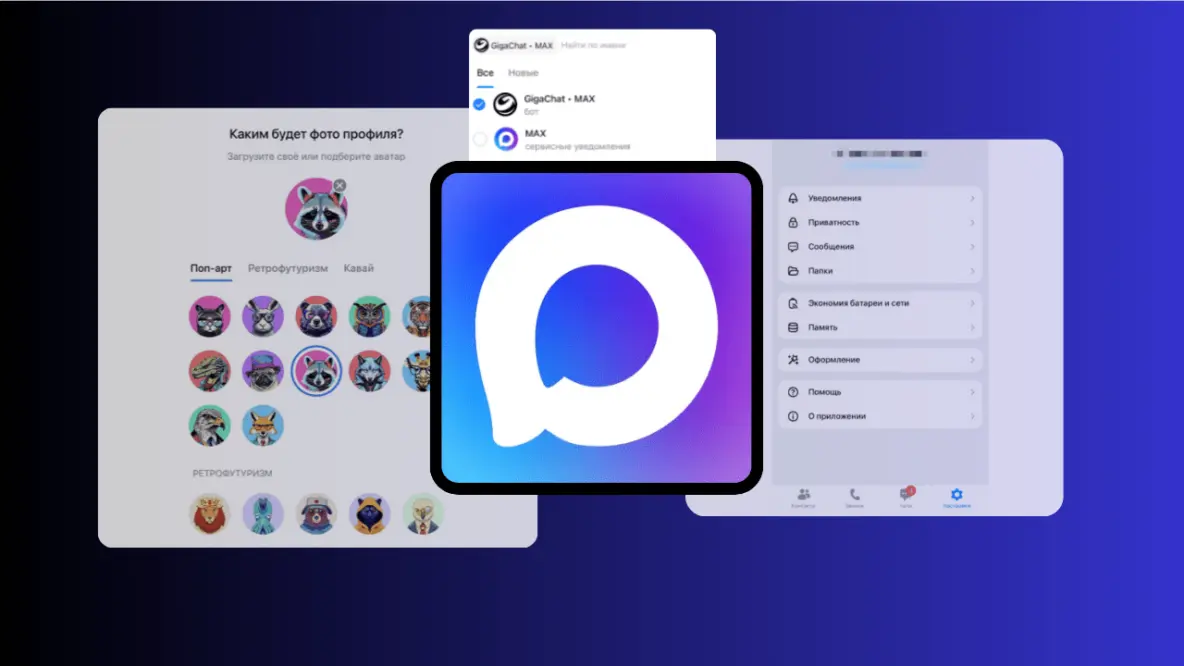
A Russian messaging app developed by VK, marketed as a “super app”—similar to WeChat—that combines chat, calls, payments, government services, and the GigaChat neural network. It has been in beta testing since March 2025. It considers itself the “killer” of Telegram, with approximately 1 million accounts registered as of the end of June. Despite these figures, the app can hardly be called popular. First and foremost, this is because the platform’s capabilities are still very limited: in three months, Max has yet to acquire the standard set of features expected of a modern messaging app, and continues to suffer from bugs.
Max is similar to the Chinese app WeChat, which combines a messaging app, a social network, a search engine, and a payment system, and which has repeatedly been accused of spying on users and censoring content.
On June 10, the State Duma passed a law establishing a national messaging app. On June 24, Vladimir Putin signed a decree “on a multifunctional information exchange service,” which provides for the creation of a national messaging app in Russia.
🚩 Warning Signs
Let's get right to the point and talk about the red flags associated with the MAX messaging app.
1. There is no actual encryption
Despite claims that it uses AES-256 and GOST, it dares to Do not use end-to-end encryption in private chats, stores metadata, IP addresses, and contact information / saasmarket.ru.
There is no certificate pinning; MITM attacks are possible / vc.ru.
2. Government surveillance is already built in
Requires the collection of biometric data (selfies, passport), bank cards for transaction monitoring, and GPS tracking—even in the background / vc.ru.
Keyword filtering (#war, LGBT, Navalny) and automatic reports to Roskomnadzor / vc.ru.
Installation is mandatory for government employees; uninstalling the app may result in the loss of access to government services / vc.ru.
3. Technical shortcomings
Users are reporting bugs, channels being unavailable, and the inability to search for anything / dtf.ru.
Some people report, “Everything is lagging—just the menu and nothing else” / otzovik.com.
4. Low ratings and widespread distrust
One user stated outright: "There are too many vulnerabilities in the security system—you have to be a truly brave person…" / bolshoyvopros.ru.
Users Slammed the Max Messaging App. The new Max app has come under heavy criticism—users are giving it one-star ratings en masse, accusing it of copying Telegram’s interface, lacking privacy, having numerous bugs, and artificially inflating its ratings. Despite the flood of fake “five-star” ratings, its rating continues to plummet.
In Google Play rating — 1.7★, 87% 1-star ratings.
In App Store rating — 3.6★, 90% 1s.
💡 An alternative? Stay on Telegram (with caution):
Even when attempts are made to block it, Telegram holds its ground. It has proven end-to-end encryption (in private chats), its servers do not share data with third parties, and it is regularly checked for vulnerabilities.
Do not set to MAX — a messaging app that is officially being rolled out for the sake of control, not convenience. MAX Is Not a Killer Telegram is essentially a potential spy in your smartphone, disguised as a convenient tool. If you value your privacy and aren’t willing to share your location, biometric data, or financial information—stay away.








0 comments
Enter your email — we’ll send you a one-time code. No passwords or accounts.
Code sent to
If the email doesn't appear in your inbox within a few minutes, check your spam, junk, or promotions folder, as some email services may mistakenly place automated messages there