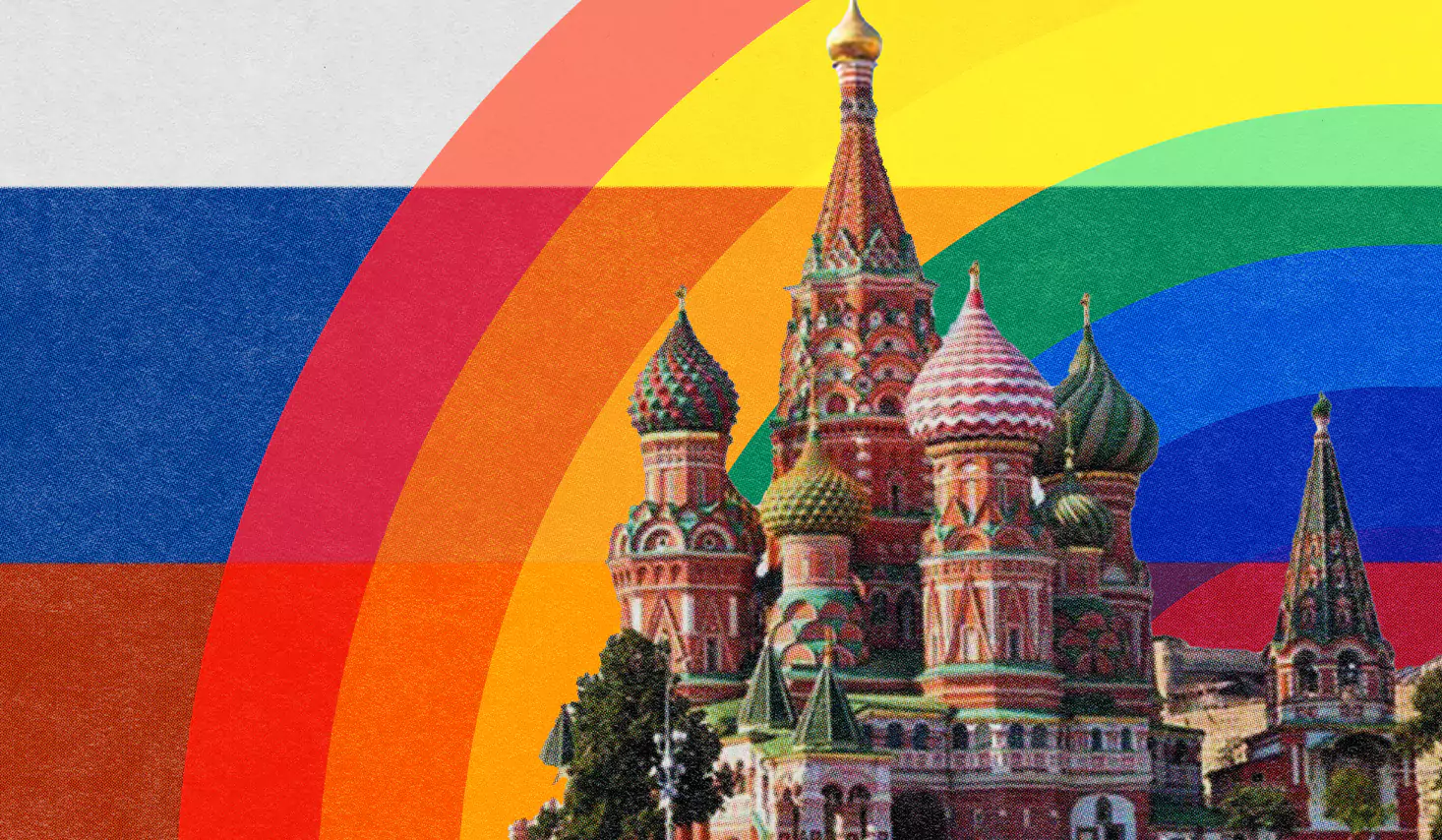

In 2013, Russia passed a law banning “propaganda of non-traditional sexual relationships” among minors—and Article 6.21 was added to the Code of Administrative Offenses. In December 2022, Russian authorities banned “gay propaganda” among people of all ages—Article 6.21 of the Code of Administrative Offenses was expanded and renamed, and a ban on “propaganda of pedophilia” and the dissemination of information “capable of inducing minors to change their gender” was also added to the Code (Articles 6.21¹ and 6.21² of the Code of Administrative Offenses). In the fall of 2023, the “international LGBT social movement” was outlawed in Russia—the Supreme Court of the Russian Federation announced his “extremist organization.”
Until 2022, the law banning “LGBT propaganda” was rarely enforced, says Katya Dikovskaya, head of the legal department at the Sfera Foundation. And it was mainly directed against those who openly disagreed with it. The first fine under Article 6.21 of the Code of Administrative Offenses was imposed in December 2013—Astrakhan activists Nikolai Alekseev and Yaroslav Yevtushenko were found guilty of “propaganda” for holding solo pickets and displaying a sign that read: “There is no such thing as gay propaganda. You don’t become gay—you’re born gay.” However, after the law was expanded, Dikovskaya continues, the number of administrative cases rose sharply.
According to statistics from the Judicial Department of the Supreme Court of the Russian Federation, in 2024 Russian courts heard 221 administrative cases under articles prohibiting “non-traditional sexual relations” and “gender reassignment,” “propaganda of pedophilia,” and the dissemination of information “capable of inducing minors to wish to change their gender.” In 2023, the courts issued rulings in 186 such cases. By comparison, in 2014 and 2015, only 12 cases were heard under Article 6.21 of the Code of Administrative Offenses.
Previously, Article 6.21 provided for a fine of up to 100,000 rubles for individuals and up to one million rubles for legal entities, as well as the suspension of a company’s operations and the deportation of foreign nationals who committed the offense. In 2022, the penalties were tightened. The fine for “propaganda of non-traditional relationships and gender transition” for individuals was increased to 400,000 rubles. At the same time, “propaganda” targeting minors became an aggravating factor, as did the use of the media or the internet. In such cases, the maximum penalty can be 800,000 rubles—a record fine for individuals under the Code of Administrative Offenses. Penalties for legal entities have also become harsher—ranging from 800,000 to 10 million rubles.
In 2024, according to data from the Judicial Department of the Supreme Court of the Russian Federation, Russian courts imposed 146 fines under articles related to “gay propaganda,” totaling more than 37 million rubles. The previous year, there were 101 fines totaling nearly 26 million rubles.
Most often, it is individuals who are punished for “LGBT propaganda.” For example, in 2024, 108 individuals, 18 legal entities, and 25 public officials were found guilty of this offense. “Ordinary people suffer as a result—people who may have no connection to activism whatsoever, who may not even identify as LGBT,” says Katya Dikovskaya, head of the legal department at “Sfera,” referring to those found guilty. “But they may care about the issue and speak out in support or share a post.” In that same year, 2024, in addition to the 146 fines, Russian courts imposed five administrative arrests and deported four people—all of whom were foreign citizens or stateless persons—from the country.
Most cases involving “propaganda” are related to online posts, Katya Dikovskaya and a lawyer from the LGBTQ+ group “Vykhod”—who requested anonymity—told Meduza. “This can apply to any material that contains visual depictions of non-heterosexual relationships: videos, films, and photographs. Such materials may also include any texts related to the LGBTQ+ community or addressing socio-political issues,” explains the “Vykhod” lawyer. “There are rare cases of administrative liability being imposed for dating ads posted by gay or transgender people. In such cases, the basis for prosecution can be either the ad itself or, more often, subsequent communication with the person who responded.”
Not only posts published after the law completely banning “LGBT propaganda” was enacted, but also earlier posts, can serve as grounds for filing a report. Such violations are considered ongoing. “Since the law was enacted, the person has not taken any steps to remedy [the violation], so he or she may be held liable,” — Katya Dikovskaya explains the legal logic. “In and of itself, the concept of a continuing offense in administrative law is not a construct designed specifically to enable prosecution on political grounds, — says a lawyer for “Vykhod.” — It is intended to prevent a person from being held administratively liable more than once for the same act committed over an extended period of time. The apparent element of retroactivity in the law — "the flip side of this concept."
Despite the significant number of cases involving citizens, notes a lawyer who spoke with “Medusa” on condition of anonymity, “Vykhod” often focuses on cases where organizations—such as streaming services—are punished for “propaganda.” In a joint study by “Sfera” and the human rights organization “Civil Control,” published In 2024, prosecutions for “propaganda” in films or videos were also grouped into a separate, large category.
One striking example is the online movie theater “Kinopoisk.” Last fall, the Tagansky District Court of Moscow fined "Kinopoisk" was fined seven million rubles after determining that the film by Gaspar Noé posted on the site "Love" promotes pedophilia. At the same time, the online movie theater awarded a fine of three million rubles for “propaganda of non-traditional sexual relationships.” In 2024 alone, “Kinopoisk” attracted held accountable six times. Three more fines were imposed on Nikolai Buts, head of the video content team, and one on the CEO To Alexander Dunaevsky.
A lawyer with the LGBTQ+ group “Vykhod” speculates that most administrative cases involving “propaganda” are related to the internet because “offline activities” are harder for law enforcement to detect. “They sit there and monitor social media,” says Katya Dikovskaya, head of the legal department at “Sfera,” referring to law enforcement officials. The “Vykhod” lawyer also notes that sometimes a tip-off serves as the basis for an administrative case. According to the authors of a joint study by “Sfera” and “Civil Control,” from December 2022 to March 2024, the Ministry of Internal Affairs initiated at least seven cases based on complaints from the “Safe Internet League,” the “Veterans of Russia” movement, and the chairpersons of the State Duma Committee on Information Policy, Information Technology, and Communications.
Although the number of administrative cases involving “propaganda” is rising rapidly, it is difficult to understand exactly what the law considers an offense. “The wording in the law is very vague,” says Katya Dikovskaya of “Sfera.” “There’s no specific definition of what constitutes propaganda. So it could be anything.”
Expert opinions do not help to clarify this understanding either — for example, linguistic, — that are conducted as part of administrative proceedings. “Here’s how it works: the investigator calls on an expert to substantiate his application of [the law], — says Katya Dikovskaya. — "I don't want to accuse everyone, but investigators have their own experts who write what [the prosecutors] want to see." The courts, Dikovskaya continues, tend to take precisely these conclusions into account, rather than those prepared at the defense’s request by independent experts.
In many cases, says a lawyer with the LGBTQ+ group “Vykhod,” no expert evaluation is conducted at all—and the decision on whether there are signs of “propaganda” is first made by the police and then by a judge. “There is no requirement—either in law or in judicial practice—for a mandatory expert examination involving a specialist,” says the lawyer. “‘What exactly is propaganda?’—that’s the million-dollar question.”
The lack of clear wording in the law leads to confusion. For example, when is it a matter of “propaganda for non-traditional sexual relationships,” and when is it merely a “demonstration” of such relationships? The head of the legal department at “Sfera,” Dikovskaya explains that, depending on the region, a person staging a solo protest may be charged either under the article on “unauthorized public demonstrations” or under the article on “propaganda.”
The situation is further exacerbated by the designation of the “international LGBT social movement” as an “extremist organization.” “There is a well-established practice of imposing administrative penalties for displaying LGBT symbols, both under the article on ‘propaganda’ as well as under Article 20.3 of the Code of Administrative Offenses, ‘extremist symbols,’” says a lawyer from “Vykhod.”
“It’s sometimes ‘quite difficult’ to tell where ‘propaganda’ ends and ‘extremism’ begins,” the lawyer continues. Katya Dikovskaya of “Sfera” is convinced that neither investigative authorities, nor prosecutors, nor courts, nor experts “understand the difference at all.” “In the past, when a case was sent to court and the prosecutor’s office requested an expert opinion, the expert would say, ‘Yes, this is propaganda,’” says Dikovskaya. “Now the expert report says exactly the same thing, but the conclusion is ‘extremism.’”
Unlike “LGBT propaganda,” Russian law allows for prosecution for “extremism” not only through administrative proceedings but also through criminal proceedings (Article Section 282.2 of the Criminal Code; the maximum penalty is 12 years in prison). The first criminal case involving the organization of an “extremist community” due to involvement with the LGBTQ+ community was initiated in March 2024: Vyacheslav Khasanov, the owner of the Pose club in Orenburg, was arrested, and two other employees—Alexander Klimov and Diana Kamilianova—were placed under house arrest. In addition, they were added to the list of “terrorists and extremists.”
Those implicated in the so-called “book publishers case” are also accused of “organizing the activities of an extremist organization.” According to the Investigative Committee, current and former employees of Russia’s largest publishing house, “Eksmo” — Dmitry Protopopov, head of the Individuum and Popcorn Books imprints within the holding company; Artem Vakhliaev, head of sales for those imprints; and former sales director Pavel Ivanov — “out of self-interest, published and sold books promoting the activities of the LGBT movement, which is recognized as an extremist organization in Russia.”
Criminal cases involving “LGBT extremism” share common features, says a lawyer with “Vykhod.” As a rule, “propaganda” in these cases is linked to the organization of events for queer people. “Criminal cases are also brought against LGBT activists, and in those cases, mere involvement in socio-political activities related to promoting the idea of non-discrimination against LGBT people constitutes a criminal offense,” says the lawyer. However, as the person speaking with “Meduza” points out, not all criminal cases fall under this framework. “It’s unclear what criteria law enforcement officials use when they impose administrative penalties for certain actions but criminal charges for exactly the same ones,” the lawyer adds.
Another consequence of the ban on “propaganda of non-traditional sexual relationships” has been a reduction in queer people’s chances of receiving legal protection in Russia. “If an LGBTQ+ person reports to the police as a victim, it is not uncommon for the person who committed the unlawful acts against the LGBTQ+ person files a counterclaim alleging that the victim was engaging in ‘propaganda’ (sometimes simply by virtue of their existence) or even participating in extremist activities,” says a lawyer with “Vykhod.” “These ‘counter’ complaints are sometimes treated by police officers with no less—and sometimes even more—attention than the initial complaint.”








0 comments
Enter your email — we’ll send you a one-time code. No passwords or accounts.
Code sent to
If the email doesn't appear in your inbox within a few minutes, check your spam, junk, or promotions folder, as some email services may mistakenly place automated messages there