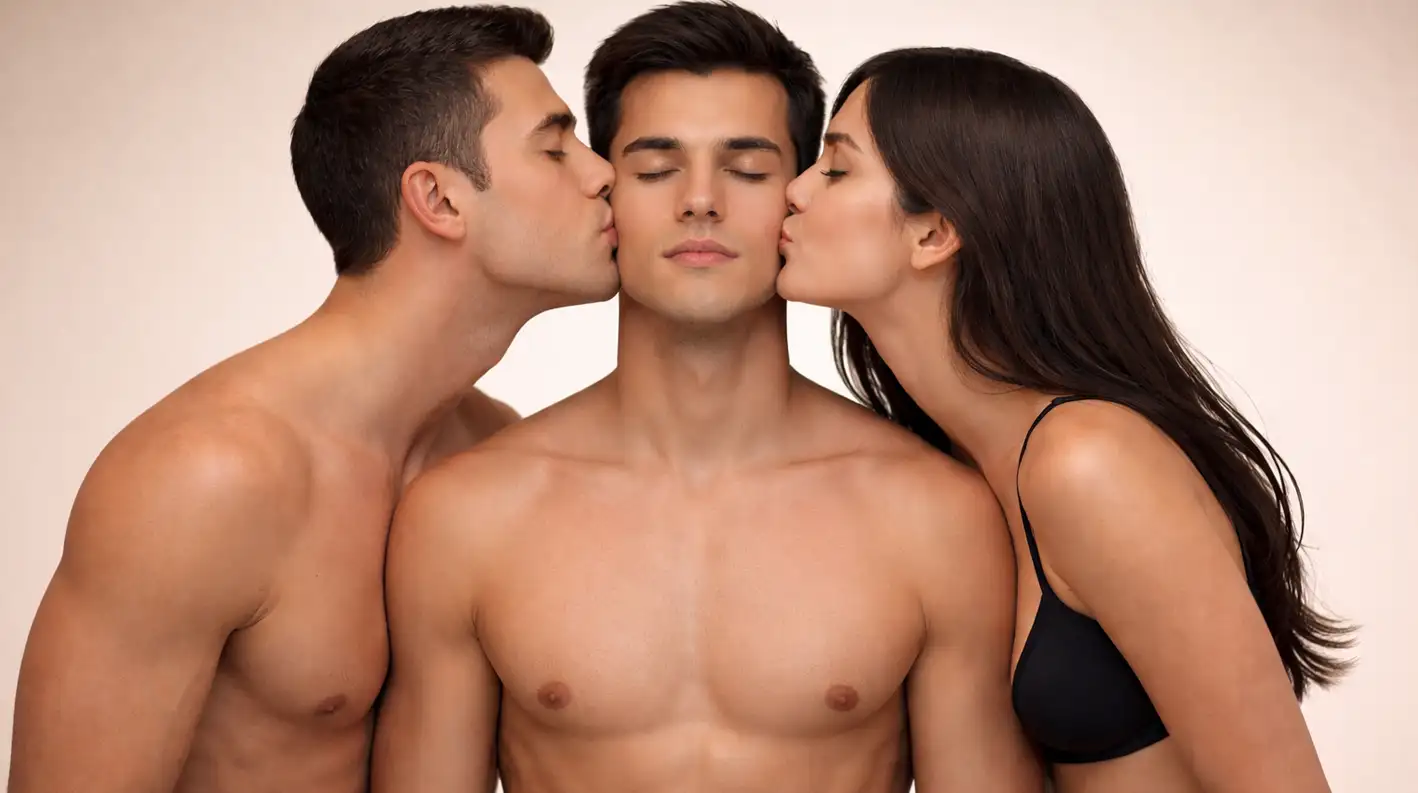

There is a realization that a bisexual person comes to again and again—not just once in a lifetime, but over and over. Because the first statement, “I’m bisexual,” is invariably followed by a second question: "But are you with a man or a woman right now?" As if the answer to that question settles everything. As if one’s current partner is the true measure of one’s orientation, and everything said before that is just a rough draft. Identity exists only to the extent that it can be confirmed by the presence of another person by one’s side.
It is commonly believed that discrimination comes from outside: from heterosexual circles, from legislative halls, from family conversations. Biphobia works differently. A significant portion of it exists within the queer community itself—the very place where people go seeking acceptance and safety. It is precisely this paradox that makes it particularly elusive: it masquerades as skepticism, as political caution, and as questions asked “out of curiosity.”
Table of Contents
Biphobia is prejudice, hostility, fear, or discrimination against people who are bisexual (bi people). It manifests itself in the denial of the reality of bisexuality and in stereotypes (such as the belief that bi people are “undecided” or dishonest) and can originate from both heterosexuals and within the LGBT community. // Doberman Media
The Paradox of Visibility
When a bisexual person comes out, something contradictory happens. On the one hand, their existence immediately becomes the subject of heightened interest: those around them want to know the history of their relationships, find out “which side is stronger,” and get an explanation for the nature of their attraction. On the other hand, the experience itself is systematically devalued. "You just haven't made up your mind." "It's just a phase." "Wait until you find true love."
This is the paradox of visibility. Recognition does not make a person more visible—it makes them more vulnerable.
His inner life becomes public property, and his own words about himself are merely a version that has yet to be verified. Psychologists describe this process as “identity erosion”: a person begins to doubt their own experiences under the pressure of others’ narratives. In the context of racial and gender discrimination, this phenomenon has been well studied. In the context of bisexuality—almost not at all.
Recognition does not make a person more visible—it makes them more vulnerable to others’ interpretations of who they are.
· · ·
The monosexual norm as a tool of control
Most criticisms of bisexual people are based on an unspoken norm: "Normal" sexuality is an attraction to one's own sex. Within this logic, homosexuality is considered an “alternative norm”—but one that is also clear and understandable. Bisexuality falls outside this framework: it is not fixed; it allows for fluidity. And in a culture that values certainty, this variability is perceived as a defect or as insincerity.
That’s exactly why bisexual people are so often accused of being dishonest—not because they lie, but because their reality doesn’t fit into convenient categories. “You’re with a man right now—so you’re actually gay.” “You’re with a woman right now—so you must be straight after all.” A partner becomes an ID card. The history of a relationship—into the body of evidence. The person himself remains a preface to someone else’s conclusion.
This mechanism replicates the very logic that the queer movement is fighting against: the right to identity must be earned. Only in this case, the demand is not being made by the heterosexual majority, but by the community itself—the very community that was supposed to offer an alternative to it.
· · ·
The Hierarchy of Queerness
The word “queer” was originally a hate term that the community reclaimed and turned into a badge of pride. Today, it denotes a position—outside the heterosexual norm. But gradually, this term, too, has become a filter. Queerness has turned out to be hierarchical.
Gay or lesbian—definitely queer. But is a bisexual person in a relationship with a partner of the opposite sex—already up for debate? "You're enjoying heterosexual privilege.", — they tell him. "You don't know what it means to be truly stigmatized". This statement contains several factual errors.
First, the so-called "heterosexual privilege" It doesn't work as a switch. A bisexual person in a heterosexual relationship still faces ostracism as soon as their identity becomes known. Second, Statistics refute the notion that bisexuals are in a “privileged” position.
Studies in the U.S., the U.K., Australia, Canada, Sweden, and Hong Kong show that bisexual people have higher rates of anxiety disorders, depression, and suicidal thoughts than gay people. This isn’t a competition in suffering. These are statistics that are extremely rarely mentioned in discussions about queer solidarity.
MacKay, Hawkins & Fehr (2017, Archives of Sexual Behavior) — A systematic review and meta-analysis of 52 studies revealed a consistent pattern: heterosexual people had the lowest levels of depression and anxiety, while bisexual people had levels that were higher than or comparable to those of gay men and lesbians. PubMed The authors cited three reasons: discrimination, bisexual invisibility, and a lack of affirmative support. → https://pubmed.ncbi.nlm.nih.gov/29099625/
Pompili et al. (2014, Crisis) — A systematic review of 77 articles: bisexual people show an increased risk of suicide attempts and suicidal thoughts compared to both homosexual and heterosexual people. Risk factors identified include victimization, peer condemnation, and family rejection. PubMed → https://pubmed.ncbi.nlm.nih.gov/24839908/
Chum et al. (2023, American Journal of Psychiatry) — A population-based study of 123,995 people in Ontario linked to medical data: the rate of suicide-related behavior was 224 cases per 100,000 person-years among heterosexuals, 664 among gay men and lesbians, and 5,912 among bisexuals. Psychiatry Online → https://psychiatryonline.org/doi/full/10.1176/appi.ajp.20220763
A meta-analysis of 46 studies (AATBS): Over a 12-month period, suicidal thoughts among bisexual people are 1.5 times higher, and suicide attempts are 1.25 times higher than among gay men and lesbians. AATBS
An Australian study (ScienceDirect, 2021): Bisexual people consistently report levels of anxiety and depression that are often twice as high as those reported by gay men and lesbians. ScienceDirect → https://www.sciencedirect.com/science/article/abs/pii/S0165032721010648
A study based on two representative surveys of the English population (Springer, 2023) showed that suicidal thoughts are particularly prevalent among bisexual people. Springer → https://link.springer.com/article/10.1007/s00127-023-02490-4
Queerness turned out to be hierarchical. And bisexual people often find themselves at the bottom of that hierarchy—within the very community that was supposed to accept them.
· · ·
Constant justification as a way of life
Bisexual people describe the same pattern: the need to have an explanation ready in advance. Not because someone is bound to ask—but because they’re sure to ask. "Have you ever been with a man?" — This issue functions as a pass. If the experience is recognized as "insufficient", the person is politely reclassified. If the experience turned out to be too "diverse", it is declared unreliable.
This is particularly devastating for those who are coming out of long-term heterosexual relationships. Their attraction to people of the same sex is dismissed with a single wave of the hand: "You're just curious," "That doesn't count," "You're opening up too late, so it's not serious". Each of these statements implies that there is a “correct” path to self-discovery—and that a bisexual person does not follow it.
Psychologists who work with this group describe the “double minority” syndrome: a person is rejected twice—by the heterosexual majority and the queer community at the same time. This is a literal description of a social reality in which there is not a single space where one can exist without reservations or having to prove oneself.
The “double minority” syndrome isn’t a metaphor. It’s a literal description of life without a single space where you don’t have to prove anything.
· · ·
Queer spaces are not immune to discrimination
One of the most painful realizations for people entering the queer community is this: This space also reflects power. It was created as the antithesis of the norm—but the norm has a way of seeping through any wall. Racism in gay clubs, transphobia in lesbian organizations, misogyny among gay men, biphobia everywhere—all of these are documented phenomena, not exceptions.
This is understandable. Communities are formed by people who grew up in the same culture as everyone else. Stepping outside the heterosexual norm does not automatically eliminate other prejudices. Acknowledging this is no reason for cynicism. It is a necessary prerequisite for an honest conversation about what kind of community we want to be.
Bisexuality challenges one of the fundamental categories upon which our understanding of sexuality is based: the binary nature of desire. This is precisely the source of the irritation. This is exactly why people try so persistently to explain it, rename it, and fit it into familiar frameworks. "He hasn't figured it out yet." "She just wants attention." "They avoid labels." None of these responses requires actually meeting the other person. They are all ways to avoid such a meeting.
· · ·
Identity does not require verification
Bisexuality is a distinct identity. It’s not a phase, not a compromise, not a refusal to make up one’s mind, and not a stop along the way to a “true” orientation. This is a description of real people’s real experiences—and that description is enough.
No one is required to document their relationship history in order to be entitled to call themselves bisexual. No one is required to explain the balance of their attractions. No one is required to choose between two communities or to prove that they deserve to belong to at least one of them. Demanding such proof is not a sign of skepticism. It is a form of discrimination.
Solidarity cannot be conditional. The queer movement was built on the idea that people have the right to define themselves—without the majority’s permission, without having to conform to others’ expectations. If this right is recognized only for some, it ceases to be a principle and becomes a privilege.
· · ·
In lieu of a conclusion
Queer spaces can—and do—get better through conversation, through a willingness to acknowledge our own blind spots, and through rejecting the very hierarchies that the community itself condemns in others. This doesn’t require heroism. It requires only one thing: to stop asking questions whose answers no one is truly interested in—and to start listening to the questions people ask in response.
Bisexuality has always existed. It doesn’t need permission, it doesn’t need validation from a partner, and it doesn’t need to be justified to a community that knows all too well what it’s like to have to prove one’s right to live one’s own life.




0 comments
Enter your email and we will send you a one-time code. No passwords or accounts.
Code sent to
If the email doesn't appear in your inbox within a few minutes, check your spam, junk, or promotions folder, as some email services may mistakenly place automated messages there