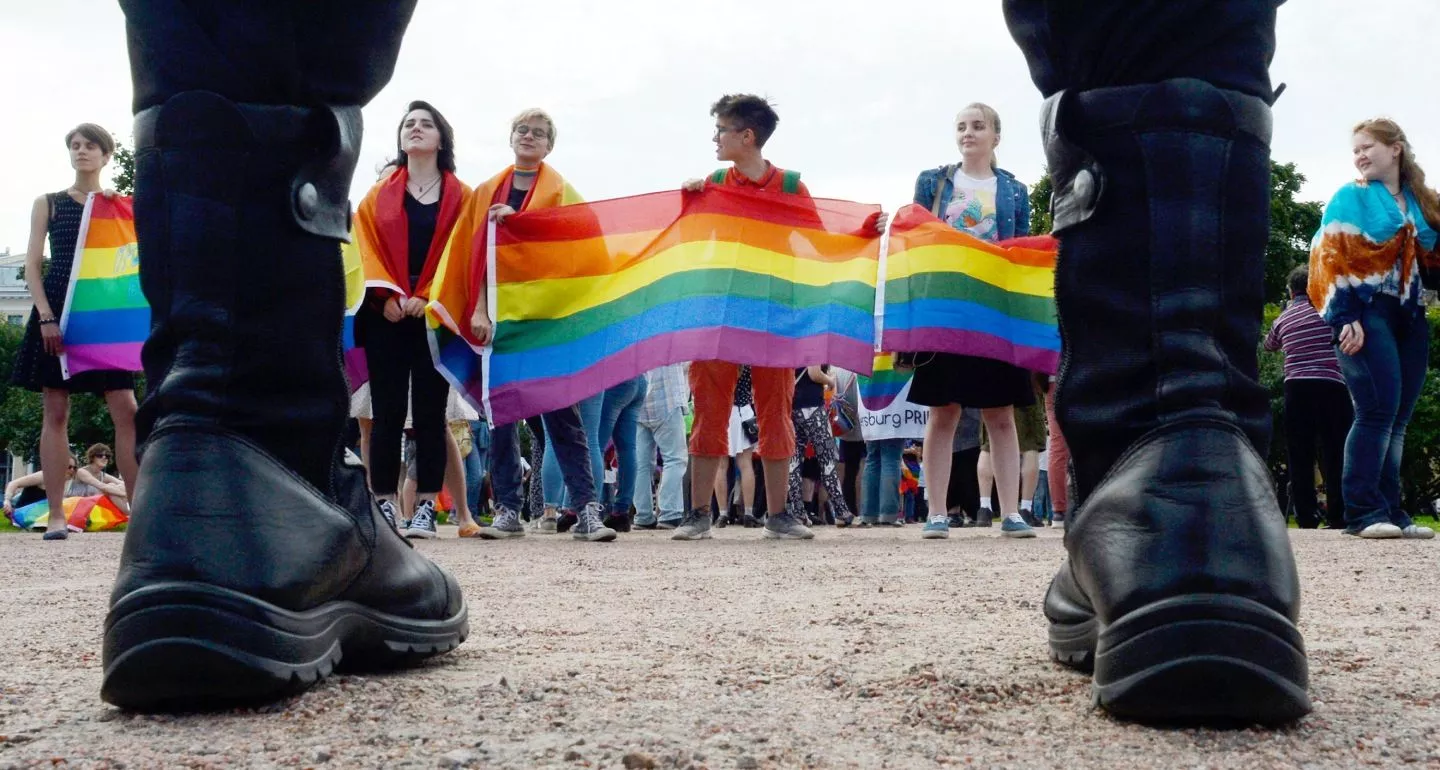
What connects a Catholic priest from Kirov, a pensioner from Kurgan, and the author of a little rhyme about "Porsche Cayenne on the road"? They are all homophobes who first welcomed the ban on LGBTQ+ in Russia as an "extremist organization," and then came under scrutiny for rainbow content in their social media.
Это материал “Медиазоны”. Оригинал текста читайте на сайте издания here.
"The right decision," said pensioner Vera Makeeva from Kurgan commented on VKontakte about the news that the Justice Ministry had asked that the "LGBT movement" be recognized as "extremist" and banned in Russia. Six months after the ban, a court fined fined Makeeva 1,500 rubles: the rainbow flag she once posted on social media has now been declared "extremist symbolism."
The reason for the protocol was reposts of homophobic posts with the hashtag #YourFavoriteUnicorn and a photo with the caption: “Welcome to the LGBT kindergarten! Who is a queer? Maybe I should join the LGBT too? Lesbians are so cool! Let’s draw a rainbow!”
«Сама виновата — 13 лет не наводила порядок в фотоальбомах. Нашлись люди, кому интересно было проверить, — сказала Макеева “Медиазоне”. — А по поводу этого фото — с телеграмм-канала взяла, не обратила внимания, что там целый шлейф ссылок тянется. Зачем вообще опубликовала фото? Потому что сама резко против этой дряни, в Кургане они тоже были».
After the Supreme Court ruling, the LGBTK+ topic became completely illegal: books, films and series are being censored outright, and at least 32 people in 14 regions have already includes faced criminal prosecution for “LGBT extremism”; the number of administrative cases for posts with “extremist symbolism” and “propaganda of non-traditional relationships” has long since reached into the hundreds.
Law enforcement is following a well-worn track, and Makeeva’s case is far from the only one: when authors of openly homophobic statements fall under the article on “LGBT extremism”.
“They locked me up for 24 hours, saying that I had called Zelensky and Macron fascists and gay”
So says Pyatigorsk resident Petr Voronin received one day of arrest for an image that showed both a swastika and a rainbow flag at the same time — both are equally considered “extremist symbolism”.
«Репостнул картинку где [Владимир] Зеленский, [Эммануэль] Макрон и еще несколько европейских лидеров с фашистской свастикой и радугой. ИИ ФСБ посчитал что я пропагандирую, — недоумевает он в разговоре с “Медиазоной”. — На суде я судье задал вопрос по поводу патриотических фильмов, где актеры зигуют и со свастикой на рукаве, и их не сажают в тюрьмы за исполнение ролей, а меня на сутки заперли с пояснением, что Зеленского и Макрона посчитал фашистом и голубым, что открыто афишируется в СМИ. Я спросил, может, мне извинится перед Зеленским официально? Короче, ИИ, который читает наши сообщения в интернете — полнейший тупица, и мы для него ничего не значим».
Voronin’s outrage recalls that in the 2000s and 2010s in Russia, people were often punished for posting swastikas and other symbols of the Third Reich, even if these were, for example, images from Soviet wartime newsreels or references to mass-culture phenomena: for example, a resident of Arkhangelsk was prosecuted for a photo from the Victory Day Parade in Moscow in 1945, and an Omsk designer defended his innocence in the case over reposting a parody of “Seventeen Moments of Spring”.
It was only in 2019 that the law added a clarification, allowing the publication of extremist symbols on the condition that the statement “forms a negative attitude toward the ideology of Nazism and extremism” and that there are no “indications of propaganda or justification of Nazi and extremist ideology”.
In some cases, courts now apply this same logic to homophobic statements in the context of prosecution for “LGBT extremism”.
“I dreamed of a country where life is luxurious”
Host of Yamal’s “Our Radio,” Alimardan Ruziev (apparently known there under the pseudonym Uncle Alik), published in January 2023 posted a verse on his VKontakte page:
In the article “I will sell God,” the author illustrated it with photos from a gay pride parade. Three years later, he was charged with an administrative offense for displaying extremist symbols because of those photos.
Uncle Alik was lucky. Right away, he added this note to the post with the poem and photos: “Please treat the images attached below not as propaganda, but as a photo demonstration to a quatrain that reflects my personal aversion to LGBT and fascism.” The court turned paid attention to this phrase and to the fact that the illustrations were “placed specifically in a negative context.” The case was closed.
“I made a clip criticizing LGBT, and the court didn’t even bother to look into it”
The same argument was made in court by Kuzbass pensioner Vladimir Sugakov, against whom a case was opened for “LGBT propaganda,” as he himself said said to “Mediazona” — over a slideshow of photos from pride parades, set to Sergei Trofimov’s song “Roosters.”
“I made a video criticizing LGBT, but [a police officer] took screenshots and sent them without any explanation, and then the court didn’t bother to look into it and issued me a fine. At first, they presented me with screenshots from the video. I didn’t see anything else. I tried to explain, but they didn’t listen to me,” — Sugakov complained.
He was fined 100,000 rubles. Judging by the page on VKontakte, the pensioner is indeed homophobic and, for example, seriously uses the word "evropediki". However, the courts are not inclined to delve into the peculiar humor of internet posts, whose authors then receive citations and are outraged that they meant something completely opposite.
Georgy Rezankov, a 21-year-old history, social studies, and fundamentals of safety and homeland defense teacher at School No. 14 in Veliky Novgorod, was fined fined 1,500 rubles for displaying "extremist" symbols — namely, a rainbow flag.
One picture with a flag showed the German communists Clara Zetkin and Rosa Luxemburg, with the caption: "Aunt Klara and Aunt Rosa congratulate you on International Women's Day. March 8: Kosher! Trendy! Youthful!"
Another featured the anthropomorphic frog Honkler (also known as Clown Pepe), wearing a rainbow wig. This is a meme character popular in the far-right milieu, and the court, following the security services, also deemed his wig to be "extremist" symbolism. Kommersant's report on his case was titled "Memes dissected in court."
Rezankov asked Mediazona not to publish his comment, emphasizing that he has an "earnest negative attitude" toward "men who have sex with men." "And how did you even find me on Telegram?" the schoolteacher wondered, once again demonstrating his antisemitism.
In St. Petersburg, the court ordered the blocking of the poem “Gee, It’s Cool to Be Gay” by an anonymous author bitard671, practically screaming about its abusive attitude toward LGBT:
Let’s duke it out,
As if they were billiard players.
But we’re not athletes,
And the gay-onanists
of a Muscovite were fined 100,000 rubles for a video just as homophobic, just as contemptuous toward neo-Nazis: in the recording “Initiation into Nazis (bona)” lasting just under two minutes, a simple plot is edited together: a young man shaves his head, puts on clothing popular with Nazi skinheads, and starts having sex with two men who look similar. The video ends with a frame showing a swastika and the slogan “Join our ranks!!!” The court deemed this “LGBT propaganda.”
A case was opened against a student from Karachay-Cherkessia for Hitler for a rainbow flag, against a man from Kurgan — for Putin against the same flag. In the first case, the court imposed a fine of 1,000 rubles; in the second, the case was eventually closed, ruling that law enforcement had not proved intent to "propaganda."
“I published an article against LGBT, it had a photo of Bishop Pezzi and a rainbow flag”
What is harsher, however, is how the court dealt with the Polish Catholic priest Father Grigory (Grzegorz Woliński), who lived in Kirov.
Father Grigory told Mediazona that he has long been in public conflict with Paolo Pezzi, the metropolitan of the Moscow Catholic Archdiocese, whom the Pole criticizes for supporting the LGBT community. In February, the Kirov priest published another post about the metropolitan another post, accompanied by a photo of Pezzi and a rainbow flag, in order to "draw attention."
“I was summoned to the migration service; it turns out there is an office of the KGB on the fourth floor. I always take someone with me, because people used to knock at my door back in the day, and there was a wiretap installed.” — “It’s a standard set; I know who it is — I’m a foreigner and I fought for the church for many years,” — recalls Father Grigory. — “They started accusing me right away; there was immediately a record saying that I had published an article supposedly against LGBT, but it actually had a photo of Bishop Pezzi and a rainbow flag.”
In court he tried to draw a parallel between his case and swastikas: «Imagine I published a book about fascism, with Hitler or a swastika on the cover, but it is against fascism!» The court did not listen to him and fined was fined a thousand rubles.
Later, the priest removed the photo of the rainbow flag and now hopes to get the administrative case dismissed in court. A Pole who lived in Russia for 24 years says he was «disgusted» by this story, but adds: in any country there are people «bought by the authorities».
Father Grigory's problems did not end there: for the court-confirmed offense, the priest had his residence permit in Russia revoked and was given a 50-year ban on entering the country. He is unsuccessfully trying to appeal it while already in Poland, from where he writes about the revenge of the «rainbow church».
Yegor Skovoroda / “Медиазона”






0 comments
Enter your email and we will send you a one-time code. No passwords, no accounts.
Code sent to
If the email does not arrive in your inbox within a few minutes, check your Spam, Junk or Promotions folder — some mail services may wrongly place automated messages there.