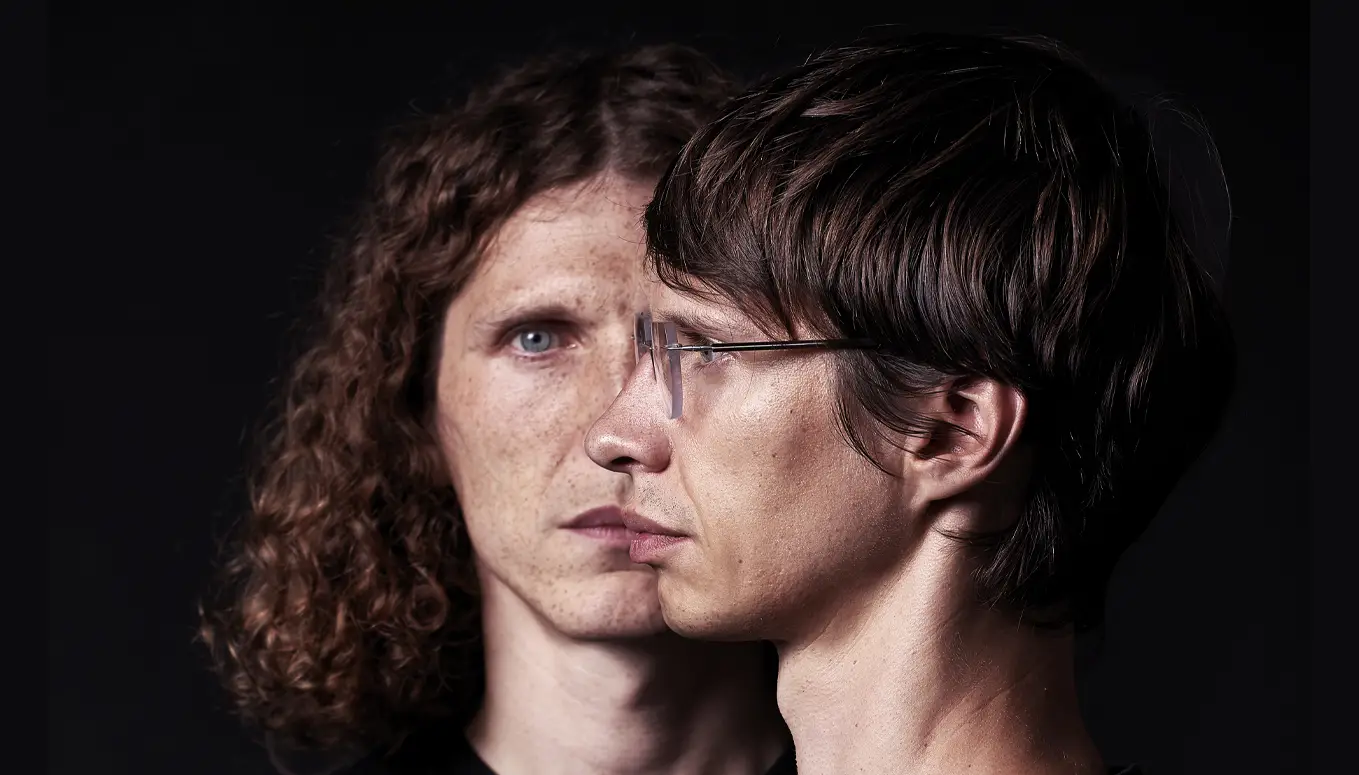

In a new interview for Forbes, serial entrepreneurs Daniil and David Lieberman explain why the modern economy no longer works from textbooks, how AI is related to your grandfather, and why "free" social networks are a trap. We have retold the main theses of this conversation in the style of analysis.
Daniil and David are serial entrepreneurs from Russia who have been living in Silicon Valley for ten years and during this time they managed to attract investments from Elon Musk, sell their company to Snapchat, launch several startups, and now they are trying to make an AI revolution.
Reference. Daniel (b. December 21, 1982) and David (b. February 22, 1984) Liebermans — brothers engaged in serial entrepreneurship, businessmen, investors. Founders and co-founders of Sibilant Interactive, Kanobu, Space of Ideas, Kernel AR, venture capital funds Reveality Ventures, Brothers Ventures, and the startup Frank.Money. The creators of the TV show Cartoon Personalities, Snapchat's Chief Product Officer.
Why is it more difficult for young people today to get rich than for their ancestors?
The main economic fault line today is not between the poor and the rich, but between the young and old. Wealth is concentrated in the hands of those who have already accumulated capital. Пенсионные фонды сегодня владеют от 50% до 90% крупнейших корпораций.
When young people buy goods or use services, they are actually paying for the growth of shares, the beneficiaries of which are retirees. In any crisis, states protect the savings of the elderly, because they are the economic and voting majority. As a result, the labor of young people becomes a "perishable product" that they need to somehow "freeze" and transfer to the future, but the conditions for this transfer are dictated by the old capital.
What is more expensive: the atomic bomb or artificial intelligence?
Creating infrastructure for AI is a "mega-construction" comparable in cost to the Apollo program (landing on the Moon) or the creation of an atomic bombif measured as a percentage of GDP. Today, corporations invest in data centers and chips not just billions, but hundreds of billions of dollars. This is an arms race, where the entrance ticket is so expensive that only a few can afford it.
How did it happen that AI learns from the knowledge of all mankind, and only a few make money on it?
AI models are trained on every book ever written and public data that is "public welfare." However, legally, corporations find loopholes. For example, for the use of billions of books, authors and humanity are paid meager fines (about $ 4 billion), which in terms of one book is a penny.
Corporations in the U.S. and China are monopolizing access to computing. 90% вычислительных мощностей (GPU) сейчас находятся в США, Китай активно догоняет. Как только одна из сторон добьется лидерства, она, скорее всего, «закроет» свои модели для остального мира из соображений «экономической безопасности».
IT giants, advertising and pensions: how is it connected?
It's a vicious circle. We ourselves ask corporations to raise prices and increase profits, because our pension savings are invested in their shares.
- Google and Facebook They make money on advertising, which is the "product of the search" of the consumer by the manufacturer.
- The more expensive the marketing, the more expensive the final product (clothes, cars) is for you.
- All margins are taken by a monopolist intermediary, which no longer creates new free products like Gmail or Maps, but simply accumulates cash (Apple and Google have hundreds of billions of dollars in their accounts).
Why are the shares so expensive and what does Satoshi Nakamoto have to do with it?
Stocks and currencies are expensive because the world has accumulated Too much capital to carry into the future. People are ready to buy assets with insane multiples, as long as their work does not depreciate.
The idea of Satoshi Nakamoto (the creator of Bitcoin) was to create a capital transfer tool that cannot be "reprinted" by decision of central banks. Bitcoin has become an alternative for those who want to go beyond government regulation. Now, the AI market is developing according to the same logic: people are looking for decentralized ways to own technology so that they are not "turned off" from the economy at the snap of their fingers.
And what to do when robots come to take our jobs?
There are two scenarios for the future:
- Corporate dystopia: 5-10 companies own all AI models and robots. The rest of humanity lives on welfare (UBI), completely dependent on the will of the owners of technology.
- A world of abundance: AI and robots are becoming public infrastructure (like roads or electricity). In this case, The productivity of each person will increase by 4 times. A personal robot will cost 10-20 thousand dollars and work for you, not for a corporation.
Why don't the Liebermans work with China and what is the "Race"?
China is a closed ecosystem with a "Great Firewall", where blockchain has been banned for a long time, and the state tightly controls data. The Lieberman brothers are betting on Gonka decentralized protocol.
It's an open-source project that allows anyone to connect their chip to a shared network and earn tokens by providing AI training power. The goal is to build public computing infrastructurethat cannot be blocked or monopolized. In this system, there is no board of directors, everything is determined by the protocol, like in Bitcoin.
Does business no longer make money according to the old rules?
The old laws of supply and demand don't work for "copied products" (software, AI models). Making the first copy costs billions, and each subsequent copy costs zero. This naturally leads to monopoly.
To survive in the new economy, you need to move from a pay-per-chat model to use AI agents, which can choose the cheapest computing power in decentralized networks. Liebermans are sure that the future belongs to those who do not own information, but access to the infrastructure that processes this information.







0 comments
Enter your email and we will send you a one-time code. No passwords, no accounts.
Code sent to
If the email does not arrive in your inbox within a few minutes, check your Spam, Junk or Promotions folder — some mail services may wrongly place automated messages there.