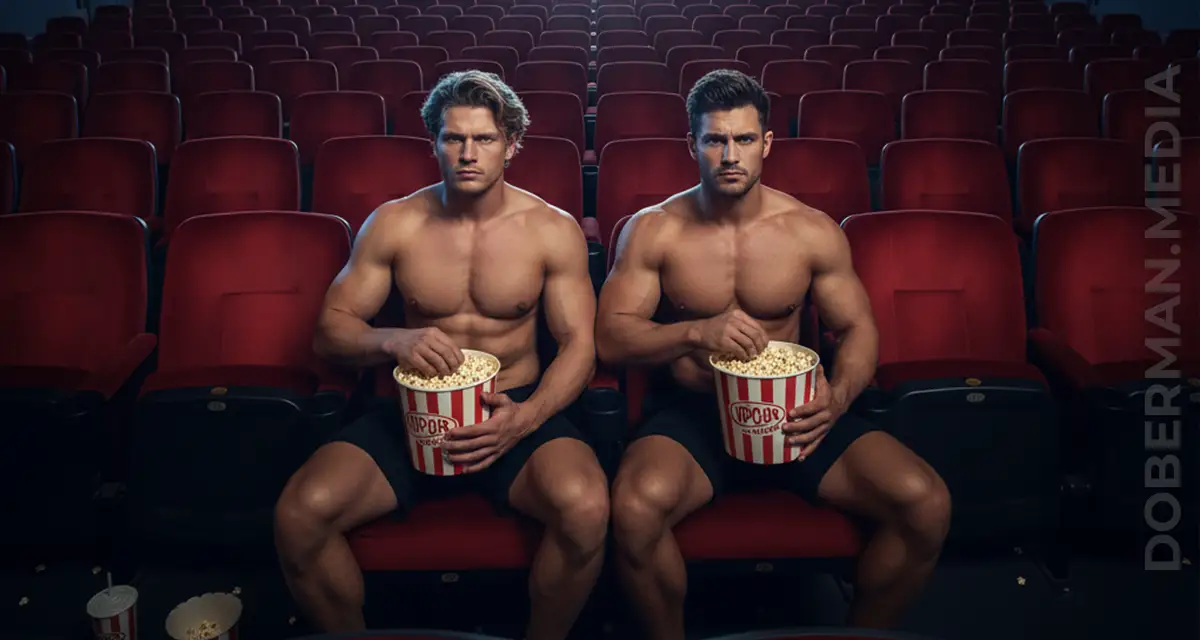

The portrayal of gay men in film has never been neutral. The industry feared something else: the masculine gay man. As long as homosexuality remained a decorative element—in the form of a fashion designer, stylist, theater intellectual, or the heroine’s sarcastic friend—the industry felt comfortable. Such a character did not undermine the central myth of popular culture: that a real man must be heterosexual.
Table of Contents
The problems began when gay men stepped outside the safe space of caricature. When they became cowboys. Soldiers. Boxers. A hockey player. When mainstream cinema was confronted with the reality that male homosexuality could exist within the very heart of traditional masculinity, it became clear: it wasn’t just the representation of a minority that was changing. The entire old system of ideas about what it means to be a man was beginning to crack.
It was at that very moment that the portrayal of gay men in film ceased to be merely a decorative element and became a cultural conflict.
At one time, mainstream cinema had a very simple answer to the question of who a gay man was: he was either funny, tragic, or dangerous. Sometimes—all at once. He existed in hints, in gestures, in speech that was too polished, in taste that was too refined. He wasn’t named outright, but he was almost always recognizable. This is exactly how cinema sidestepped the topic of male homosexuality for decades: it didn’t show it, but rather coded it.
And while today we might see a hockey player, a soldier, a cowboy, or a superhero on screen who doesn’t hide his sexuality, this isn’t just a shift in representation. It’s a cultural turning point. For a long time, mainstream cinema allowed gay men to exist only on the periphery—as stylists, fashion designers, theater types, comic relief, or victims. Then it gradually allowed them into tragedy. Then—into the mainstream. And only recently has it begun to cautiously acknowledge that a gay man need not be a symbol of foreign exoticism, but rather an ordinary man within the grand myth of masculinity.
How the portrayal of gay men in film has changed.
In early Hollywood, homosexuality existed in film not as a theme, but as a shadow. There were quite a few queer people in the industry—directors, actors, screenwriters, costume designers, producers—but open discussion of the subject was impossible. The situation became much more restrictive after the introduction of the Hays Code in the 1930s. It didn’t just regulate morality on screen. It defined what was considered an acceptable portrayal of sexuality and desire. And male homosexuality didn’t fit into that framework at all.
As a result, cinema developed a language of innuendo. A gay man could be recognized by his intonation, his mannerisms, his theatricality, his excessive refinement, and his love of fabrics, interiors, and gestures. Consequently, in the public consciousness, gay men on screen became permanently associated with a number of established archetypes: fashion designer, hairdresser, dandy, servant, aesthete, and villain with refined taste. This was not a random set of professions. It was a set of permitted codes. Cinema could not portray male homosexuality as a fully-fledged human reality, but it could transform it into a recognizable style.
It’s important to understand: this image was not “natural.” It was created by censorship. What appeared to the viewer as a natural portrayal of a “feminine gay man” was, in fact, the result of the fact that cinema was only allowed to show a caricatured version of him. The stereotype arose not only from mockery, but also from prohibition.
Why Were the Villains “Too Prim and Proper”?
Animation, too, has long used queer coding as a language of “dangerous otherness.” Many Disney villains—Ursula, Scar, Jafar, Captain Hook—stood out from traditional heroes with their mannerisms, theatricality, complex body language, and exaggerated aestheticism. Set against the backdrop of straightforward and “normatively masculine” princes, it was the villains who appeared more expressive, emotional, and visually “different.”
The character of Ursula from *The Little Mermaid*, inspired by the drag queen Divine, is particularly telling. Her exaggerated makeup, gestures, and hyper-feminine mannerisms have made the character one of the most famous examples of queer coding in popular culture.
This isn’t about a “Disney conspiracy,” but rather the cultural code of the era. When it was forbidden to openly depict homosexuality, film and animation often portrayed “the other” through queer aesthetics. As a result, for decades, popular culture associated unconventional gender expression with danger, artificiality, or moral deviance.
Why the "tragic gay man" has become the norm
In the 1960s, the situation began to change. Censorship was easing, society was gradually shifting, and cinema began, for the first time, to address homosexuality directly. But this freedom did not come as a relief; rather, it took the form of a new kind of punishment. Gay men began to be portrayed openly—but almost always as broken, lonely, suffering, and doomed individuals.
And so one of the most enduring archetypes of popular cinema was born: the tragic gay man. He may be intelligent, handsome, vulnerable, and sensitive, but he almost never gets a chance at peaceful happiness. His story is one of loss, shame, addiction, self-destruction, and death. Even when the film sympathizes with him, it still leaves the viewer with the impression that homosexuality is a path to pain.
One of the key films of this period is *The Boys in the Band* (1970). It’s an important film because it’s the first to show a group of gay men without any pretense. But it also reinforces a whole set of stereotypes: nervousness, inner cruelty, and emotional instability. The film gave them a visible presence, but it didn’t grant them full freedom of self-expression.
The main paradox of representation is that simply being shown does not mean being shown properly.
How AIDS Changed the Language of Film
In the 1980s and 1990s, the portrayal of gay men in mainstream cinema was influenced by AIDS. It was a period when the subject became both highly visible and extremely traumatic. Gay men on screen most often appeared as sick people who had lost loved ones, as doomed individuals awaiting death. Hollywood began appealing to the audience for sympathy. But that sympathy, too, was limited.
“Philadelphia” (1993) became one of the most significant landmark films. It brought the themes of discrimination, illness, and fear to the forefront—and with them, the idea that a gay man could be more than just a marginalized figure, but a person whose pain demands a societal response. That was important. But even here, homosexuality was often portrayed through the lens of suffering rather than desire. The film industry was still afraid to depict a man who loves another man as an ordinary hero in an ordinary story.
AIDS changed the tone of the image, but did not always change its structure. In the public imagination, the gay man remained a figure toward whom the viewer must either feel compassion or distance himself.
What "Brokeback Mountain" Broke
A true cultural breakthrough occurred when cinema allowed gay men to enter the realm of traditional masculine power. Not the theater. Not the runway. Not an interior with a designer lamp. But into the very places where heteromasculinity had long held a near-monopoly: the cowboy myth, the military code, sports, and professional male communities.
That is precisely why *Brokeback Mountain* (2005) became such an important film. It did more than simply tell the story of a romance between two men. It set that story within the most enduring American symbol of male heterosexuality—the world of cowboys.
In the collective consciousness, a cowboy is more than just a profession. It’s a shield. It’s the image of a man who is silent, hard on himself, emotionally closed off, and utterly self-sufficient. And suddenly it turns out that within this image, there may not be a denial of feelings, but rather a hidden love.
From that moment on, it became clear: a gay character on screen no longer had to be just a designer, an artist, or a comic sidekick to the female lead. He could be the kind of person that mainstream cinema, just yesterday, would have considered “too masculine” for such a story.
"From fashion designer to hockey player—this is not a path of professions, but a path to cultural legitimacy."
Why Has Sports Become the Latest Battleground?
If the fashion designer was a symbol of the old stereotypes about gay men, then the athlete is his complete opposite in the public imagination. For a long time, sports remained one of the most closed-off spaces for male homosexuality. Not because there are no gay men there, but because it is precisely there that masculinity has been turned into a ritual.
The body must be functional. The voice—confident. The demeanor—tough. Emotions—restrained. In such an environment, a gay man was perceived not as a person, but as a threat to the entire system.
That is why the emergence of gay figures in sports holds special cultural significance. This is no longer just a story about personal freedom. It is a challenge to the very structure of the masculine ideal. When a gay man becomes a hockey player, soccer player, boxer, or fighter, the old link between being a “real man” and mandatory heterosexuality is shattered.
That is precisely why sports stories elicit a much more intense reaction from the general public than stories about designers or artists. Sports remain one of the last areas where society is particularly adamant about defending the old model of masculinity.
A New Problem: The “Safe” Gay Man for Streaming
Contemporary mainstream cinema increasingly portrays gay people as a normal part of the world, rather than as an exception to it. This is progress. But along with it has come a new form of censorship.
The industry loves safe representation. It finds it convenient to portray a gay character who isn’t too sexual, isn’t too radical, isn’t too confrontational, and doesn’t clash too much with mainstream tastes. That’s why many contemporary characters seem as if their main goal is not to annoy the audience.
This creates a paradoxical situation. In the past, gay people were hidden away. Now they can be shown, but only in a way that doesn’t disturb anyone. They exist, but their desires are muted. They’re present, but not too unsettling. This is no longer the old-style censorship, but a new form of commercial self-censorship.
There is another conflict—one that lies within queer culture itself. Should we strive for the most “masculine” image of a gay man in order to gain acceptance from the general public? Or, on the contrary, is it important to preserve the right to femininity, theatricality, and radical otherness? Behind this debate lies more than just aesthetics. It raises the question: who is considered worthy of visibility?





0 comments
Enter your email — we’ll send you a one-time code. No passwords or accounts.
Code sent to
If the email doesn't appear in your inbox within a few minutes, check your spam, junk, or promotions folder, as some email services may mistakenly place automated messages there