

Gay and bisexual dating apps — Grindr, Scruff, Hornet, and dozens of more niche platforms — have long been part of the everyday reality of the LGBTQ+ community.
A separate niche is occupied by the so-called "anonymous" applications, where profiles without photos are the norm or even a feature of the service. At first glance, this format seems safer: the face is hidden, the identity is not revealed. In fact, everything is exactly the opposite. In this article, we will try to convince you DO NOT install anonymous dating apps, especially if they market themselves as LGBT-friendly apps (это личное мнение автора этой публикации, который считает такие приложения опасными для сообщества).
Table of Contents
The illusion of anonymity
The mere word "anonymous" in the name or description of the app does not guarantee anything. The Gay Daddy app, which was marketed on the App Store as a "private and anonymous" space for gay and bisexual men over 40, was leaked to Cybernews researchers: more than 50,000 profiles and more than 124,000 private messages — including geolocations, names, HIV status, relationship details, and intimate photos — became publicly available due to an unsecured database. Yahoo!
"Users expected anonymity and discreteness from the app, but it worked exactly the opposite", commented Aras Nazarovas, a security researcher at Cybernews.
The leak occurred due to hard-coded credentials in the application code and an incorrectly configured Firebase database. In addition to Gay Daddy, a similar problem affected BDSM People, CHICA, TRANSLOVE, PINK and BRISH - all of which are owned by the same developer, Mobile Apps Developers Limited. In total, more than 1.5 million intimate images were revealed. Yahoo!
Data breaches: "when", not "if"
Data breaches are not uncommon. It's a question of when, not if. Privacy Guides Applications that promise anonymity are especially vulnerable: this is where people are more willing to upload compromising content, believing that it is safe.
In 2016, the AdultFriendFinder service experienced one of the largest leaks in history, with more than 400 million accounts compromised, including data on sexual preferences. In 2024, researchers discovered API vulnerabilities in Tinder, Bumble, Grindr, and Hinge that allowed access to sensitive user data. Yahoo Finance
Hacking of dating app databases puts between 800,000 and 900,000 people at risk of blackmail and extortion. Cybersecurity Ventures // TechRadar, March 2025
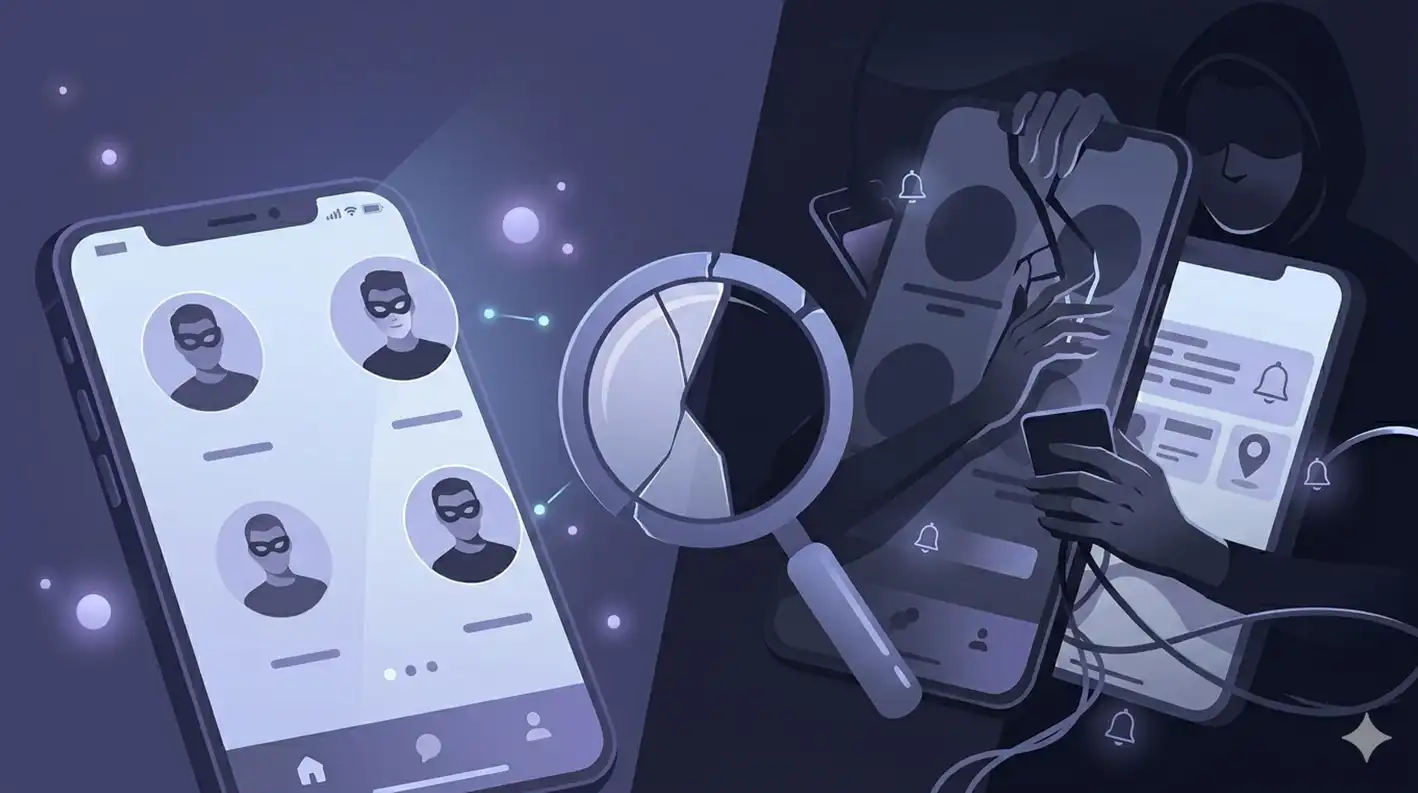
Sextortion: the main threat of anonymous platforms
The absence of a photo in the profile of another user is not a sign of modesty. Often this is a sign of a scammer.
The scheme works like this: the attacker pretends to be a potential partner in an anonymous LGBTQ+ app, conducts correspondence, quickly sends intimate photos and asks to send similar ones in response. If the victim agrees, blackmail begins. The scammer threatens to send photos and correspondence to friends, relatives or employer if they do not pay - as a rule, with gift cards. To be convincing, he names the specific names of those to whom he "tells" - this information is easy to find through the victim's phone number or social networks. Riograndecu
A separate target is the people in the "closet". Scammers threaten to "ruin lives" by revealing sexual orientation if the victim does not pay. Riograndecu
According to a 2025 study by Digital Forensics Corp, the average financial damage from sextortion is about $2,400, with the vast majority of victims — men. At the same time, paying the ransom does not help: 40% of paying victims received threats daily and after payment. Digital Forensics
Catfishing and identity spoofing
Catfishing is one of the most common risks: a scammer uses someone else's identity and other people's photos. This can be used as a kidnapping tactic. Pridedetox
In applications without a mandatory photo, it is even more difficult to verify the identity of the interlocutor. Experts recommend doing a reverse profile image search to make sure the person isn't impersonating someone else. Little Gay Book
Geolocation: Profile anonymity ≠ location anonymity
Many gay dating apps use geolocation by default. Geolocation data can be stored in the sent images, which allows the user's location to be determined. Reverse image search allows you to find a person's profiles in other networks, which means that a potential interlocutor can easily establish the identity of even an "anonymous" profile. Garbo
Persecution by the authorities
For users from countries that criminalize same-sex relationships, anonymous apps carry another risk.
In 2025, Human Rights Watch documented the use of dating apps by Ugandan authorities — following the adoption of the Anti-Homosexuality Act in 2023 — to extort, surve, and detain LGBTQ+ people. Privacy Guides
Dating apps are increasingly being used by those who want to cause harm, from government agencies trying to identify and apprehend LGBTQ+ people to dangerous people looking for new victims. The Conversation
Private chats in such apps are not as private as they seem
The development company can technically read and collect all "private" correspondence. In addition, nothing prevents the interlocutor from taking a screenshot and posting the content. Even disappearing messages are never truly deleted and can be saved without the sender's knowledge. Privacy Guides
Special risk: applications with offices in the EAEU countries
This is one of the least discussed but critically important risk factors. In recent years, new "anonymous" LGBTQ+ apps have appeared, registered in the countries of the Eurasian Economic Union — Russia, Belarus, Kazakhstan, Armenia, and Kyrgyzstan. Some of them actively position themselves as "safe spaces" and "LGBT-friendly" platforms, which creates a false sense of security.
The place of registration of the company directly determines who and on what grounds can access user data.
Russia, the legislative center of the EAEU in terms of data regulation, has introduced some of the most stringent requirements in the world for the localization of personal data. From July 1, 2025, the Russian law "On Personal Data" establishes a direct ban on the collection of personal data of Russian citizens using databases located outside Russia. This also applies to data controllers acting on behalf of the main controller. B1
Formally, this is presented as the protection of citizens. In fact, it is an instrument of state control. In 2019, the Russian authorities ordered Internet companies to install equipment that provides special services with access to user data at any time. Brookings Institution

Data localization requirements have an immediate purpose: to store data about citizens in Russia so that law enforcement agencies can access it more easily.
If you can't answer the question accurately "In which country and under what legislation is my data stored?" - Consider that they are potentially available to the authorities of the country where the application is registered. An app with an office in the EAEU zone, promising "anonymity" for gay users from countries where it is dangerous, is not a safe space.
The most reliable in terms of jurisdiction are applications registered in the US or the EU, which fall under the GDPR or US data protection laws — they at least create legal barriers to government access to personal data, although they do not eliminate all risks.
❗️Advertising on LGBT resources or LGBT bloggers is not a quality mark
One of the most common ways that anonymous apps gain an audience is through advertising on LGBTQ+-themed sites, forums, Telegram channels, and media projects. The user's logic is clear: "if this is advertised here, among their own people, then it is verified and safe." This is a dangerous misconception.
Most LGBTQ+ media projects are small newsrooms, volunteer initiatives, or personal blogs that exist on minimal budgets. Advertising is one of the few sources of income for them. In the face of constant financial pressure, it is extremely rare for newsrooms to abandon advertisers without even checking who is behind them.
As a rule, platforms do not conduct any verification of advertised applications: they do not study the jurisdiction, do not read the privacy policy, do not find out where user data is stored and to whom it can be transferred.
Ads are placed on a "paid, published" basis.
At the same time, the app itself can deliberately choose LGBT platforms for promotion — this is the most direct way to a vulnerable and gullible audience that is difficult to reach through mainstream advertising.
The fact of advertising on an LGBTQ+ resource does not mean:
– that user data is protected from transfer to third parties or authorities.
- that the application is tested for safety,
– that its developer has passed some kind of audit,
– that the editorial office knows where the company is registered.
This means only one thing: someone paid for the placement.
Minimal checklist before installing any app
Regardless of where you saw the ad, check for yourself:
- Jurisdiction. Find the "Seller" or "Developer" section in the App Store or Google Play — the country of registration of the company is indicated there.
- Privacy Policy. Find the answer to the question: where is the data stored, to whom and under what conditions it is shared, and how long it is stored after the account is deleted.
- Application history. Look up the name on Google along with the words "data breach", "leak", "privacy" – this is often enough.
- Date of creation. The application, which appeared a few months ago and is already actively advertised, is a reason to be wary, not to install.
- Reviews of independent researchers.
Websites Privacy Guides, EFF and Exodus Privacy regularly analyze trackers and app permissions.
Trust in an LGBT platform should not automatically extend to its advertisers. These are different things.
What to do
It is impossible to completely avoid risks, but they can be significantly reduced:
- Do not trust promises of anonymity. The word "anonymous" in the app description is marketing, not a technical guarantee.
- Do not send intimate photos strangers, especially those who do not show their faces.
- Turn off geolocation or limit location accuracy in the app settings.
- Use a separate phone number or email to register in such services.
- The first meeting is only in a public place. A meeting in a public place allows you to make sure that a person is exactly who he pretends to be, and assess the situation even before a more vulnerable situation. Little Gay Book
- Trust your instincts. If something seems suspicious, it probably is.
Anonymity on gay apps is not a shield, it's often a lure. Real security is built not on the absence of photos, but on conscious behavior, critical thinking, and an understanding of how these platforms work from the inside.
This material is an editorial and reflects the author's personal position, formed on the basis of publicly available research in the field of cybersecurity, human rights reports and documented cases of data breaches. The criticism in the text is addressed to the category of anonymous dating apps as a phenomenon — not to any specific services, companies, or developers. The mention of individual countries and jurisdictions is for informational purposes only and is based on the current legislation of these countries, which is a publicly available fact. The author and the editorial staff of Doberman.media are not responsible for interpretations that go beyond the scope of what is written.








0 comments
Enter your email — we’ll send you a one-time code. No passwords or accounts.
Code sent to
If the email doesn't appear in your inbox within a few minutes, check your spam, junk, or promotions folder, as some email services may mistakenly place automated messages there